

The 30-year fixed mortgage is a financial trap for the Southern California elite. While traditional banks push the “safety” of a permanent rate, they ignore the reality of your balance sheet and the actual cost of capital. You’re likely tired of high monthly carrying costs and rigid underwriting that ignores your complex income. It’s time to stop playing by the bank’s outdated rules. An adjustable rate mortgage isn’t a gamble; it’s a tactical liquidity tool for the 2026 market.
We know you want flexibility, not a thirty-year ball and chain. You need a way to manage cash flow without being locked into the highest rates in recent memory. This guide will show you how to master the mechanics of these loans to slash your initial payments and keep your cash liquid. You’ll get a clear look at SOFR index trends, exit strategies for selling or refinancing, and how to navigate complex loan structures that big banks won’t touch. Let’s look at how to make the Southern California market work for you.
Key Takeaways
- Learn why the initial lower rate on an adjustable rate mortgage is a tactical advantage for managing high-value Southern California properties.
- Discover the “Break-Even Point” math for $1M+ loans in Claremont to determine if an ARM beats a traditional fixed-rate mortgage.
- Master the rate cap structures that protect your bottom line from unexpected market volatility and keep your payments predictable.
- Build a proactive 24-month exit strategy to ensure you’re never stuck when interest rate trends shift.
- Find out how to navigate rigid underwriting by using a personalized, investor-focused lens for complex income scenarios.
What is an Adjustable Rate Mortgage (ARM) in 2026?
An adjustable rate mortgage is a strategic financing vehicle designed to maximize short-term cash flow by front-loading interest savings during a fixed introductory period. It’s a tool for the decisive borrower. Unlike the 30-year fixed mortgage, which prioritizes long-term stability at a premium price, an ARM allows you to pay for the money you actually use. In 2026, the market has shifted toward hybrid models like the 5/6, 7/6, and 10/6. These structures give you a fixed rate for five, seven, or ten years, followed by adjustments every six months. It’s a calculated play for those who value liquidity over rigid, decades-long commitments.
The Anatomy of an ARM: Index, Margin, and Caps
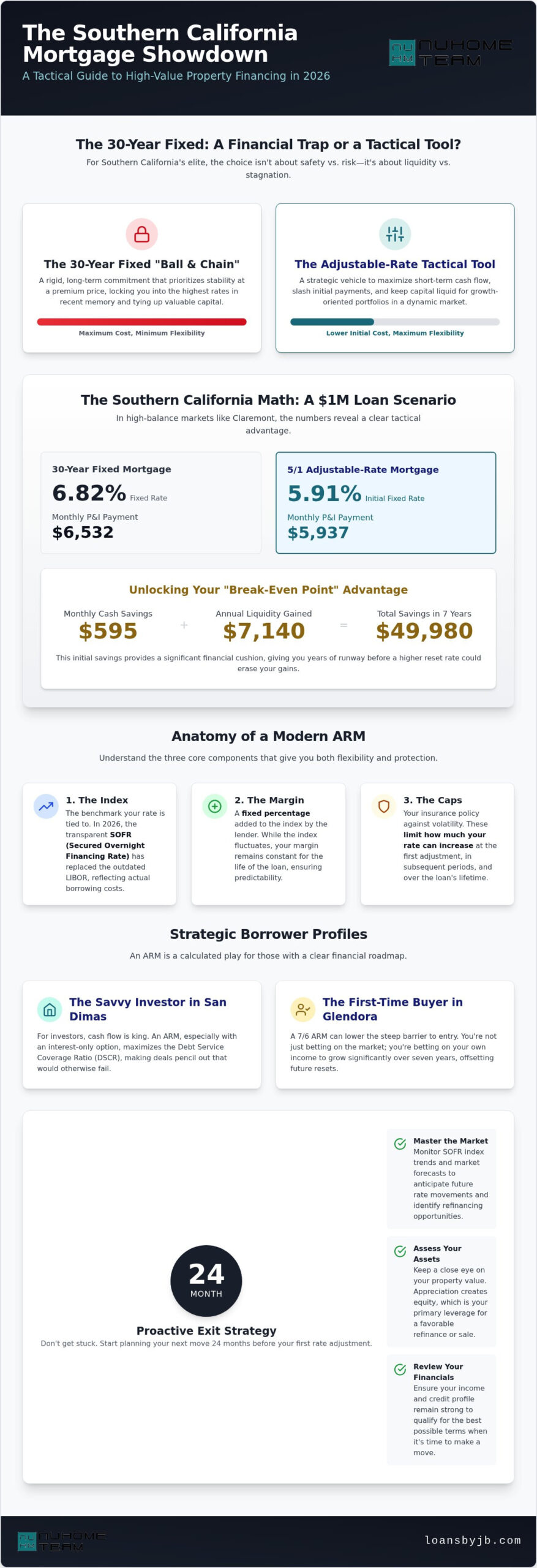
Understanding What is an Adjustable Rate Mortgage (ARM)? requires looking under the hood at three specific components. First, the index. In 2026, the Secured Overnight Financing Rate (SOFR) has fully replaced the outdated LIBOR as the industry benchmark. It’s more transparent and reflects actual overnight borrowing costs. Next is the margin. This is the fixed percentage your lender adds to the index. While the index moves, your margin stays the same for the life of the loan. Finally, you have interest rate caps. These are your essential safeguards. They dictate the maximum amount your rate can increase during the first adjustment, subsequent periods, and over the total life of the loan. Think of them as your insurance policy against market volatility.
Why 2026 Borrowers are Choosing ARMs
The math is simple. With the national average 30-year fixed-rate sitting at 6.82%, the spread offered by an adjustable rate mortgage is too significant to ignore. Smart money in Southern California is using the lower initial rate to keep monthly carrying costs down while home prices see modest appreciation. If you plan to sell or refinance within three to seven years, paying the “fixed-rate tax” makes zero sense. We look at this through an investor lens. An ARM is a cash-flow optimizer. It frees up capital that would otherwise be buried in a high-interest fixed payment. For self-employed borrowers in Claremont or Upland with complex income, this flexibility is the difference between a stagnant balance sheet and a growth-oriented portfolio. We don’t just pull credit; we look at how this debt fits into your ten-year wealth strategy.
ARM vs. Fixed-Rate Mortgage: The Southern California Math
Let’s talk numbers. In a high-balance market like Claremont, the difference between a fixed rate and an adjustable rate mortgage isn’t just a few dollars; it’s a lifestyle shift. Take a $1 million loan. At the 2026 national average fixed rate of 6.82%, your monthly principal and interest payment sits around $6,532. Opt for a 5/1 ARM at the national average of 5.91%, and that payment drops to approximately $5,937. You’re keeping nearly $600 in your pocket every single month. This ARM vs. Fixed-Rate Mortgage comparison shows that the “safety” of a fixed loan costs you over $7,000 a year in lost liquidity.
The “Break-Even Point” is your critical metric. If you save $7,000 annually for seven years, you’ve banked $49,000. Even if the rate resets higher in year eight, it would take several years of higher payments to erase that initial lead. The risk is real, though. If you can’t refinance when the rate resets because your home value dipped or your income changed, you’re at the mercy of the SOFR index. An ARM offers tactical flexibility for the agile mover, while a fixed rate provides rigid stability for the permanent settler. If you’re unsure which path fits your balance sheet, it’s time for a real conversation about your goals.
Scenario A: The First-Time Buyer in Glendora
Entry-level buyers in Glendora often face a steep barrier to entry. A 7/6 ARM can lower that wall. By utilizing a lower initial rate, you can qualify for a home that might be out of reach with a standard 30-year fixed loan. You aren’t just betting on the market; you’re betting on yourself. Most young professionals expect their income to grow significantly over seven years, easily offsetting any potential rate resets. Working with a seasoned mortgage officer ensures you have a roadmap for that first adjustment long before it arrives.
Scenario B: The Savvy Investor in San Dimas
For investors in San Dimas, cash flow is the only metric that matters. An adjustable rate mortgage with an interest-only option can maximize your Debt Service Coverage Ratio (DSCR), making a deal pencil out that would otherwise fail. When compared to hard money loans, an ARM provides a much lower cost of capital for mid-term holds of three to five years. You get the leverage you need without the crushing interest rates of private money, allowing you to scale your portfolio faster while the Southern California market recalibrates.
Decoding the Safety Features: How ARM Caps Protect You
Fear of the unknown is a poor basis for financial strategy. Traditional lenders often use the “exploding payment” myth to steer you into high-interest fixed loans. The reality of a modern adjustable rate mortgage is governed by strict, legally mandated safety features called caps. These aren’t just suggestions; they are hard limits on how much your rate can move. In the 2026 Southern California market, understanding these brakes is the difference between a calculated risk and a blind gamble. You need to know exactly how your interest rate is tethered to reality.
- Initial Cap: This limits the maximum jump your rate can take at the very first adjustment. It prevents a massive payment shock right out of the gate.
- Periodic Cap: This is the speed limit for subsequent intervals. It dictates the maximum change allowed during each adjustment period after the initial one.
- Lifetime Cap: This is the absolute ceiling. No matter what happens to the global economy or the SOFR index, your rate can never exceed this number.
A 5% lifetime cap is a critical safeguard for 2026 borrowers because it ensures that even in a worst-case economic scenario, your rate remains within a predetermined boundary. It provides the mathematical certainty you need to plan your exit strategy with confidence.
The 2/2/5 vs. 5/2/5 Structure Explained
When you look at an adjustable rate mortgage quote in Claremont or Upland, you’ll see a series of three numbers. These represent your caps. In a 2/2/5 structure, the first “2” means your rate can only rise 2% at the first adjustment. A 5/2/5 structure, however, allows for a 5% jump at that first reset. For most of our clients, the 2/2/5 is the superior choice for a five-year hold. It keeps the initial adjustment manageable while you execute your plan to sell or refinance. We evaluate these structures through an investor lens, prioritizing the lowest possible “worst-case” payment during your expected residency.
The Floor: Can Your Rate Actually Go Down?
Most borrowers focus on how high the rate can go, but you should also understand the floor. The floor is the minimum interest rate allowed on your loan. Typically, your floor is equal to your margin. If the SOFR index drops to near zero, your rate won’t follow it all the way down; it will stop at that margin. This prevents the rate from dropping to a level that would be unsustainable for the secondary market. Strategic timing is everything here. If you expect rates to fall, you might let your ARM float. If you see volatility ahead, locking in a refinance before the reset is the smart play. We help you monitor these trends so you’re never caught off guard.
The Southern California Exit Strategy: Don’t Get Stuck
An adjustable rate mortgage is a tactical tool, but it’s only as good as your exit strategy. Never sign for an ARM without a clear 24-month plan. Big banks love a passive borrower who drifts toward the reset date without a pivot. We don’t. You should monitor jumbo loan refinance rates long before your fixed period expires. If you’re in a high-value area like Rancho Cucamonga or Upland, your “Sell Strategy” must align with local appreciation. Don’t get caught holding the bag when the market shifts. Prepare to qualify for a fixed-rate loan at least 18 months before the first adjustment hits your statement.
Refinancing for Self-Employed Borrowers
If you’re self-employed in Downey or Glendora, standard tax returns often hide your true buying power. Traditional banks see a complex return and run. We don’t. Bank-statement loans are the secret weapon for exiting an ARM. They allow you to use actual cash flow rather than net profit to qualify. Explore these mortgage for self-employed borrowers options that bypass the rigid scrutiny of big-box lenders. Use the initial low-payment period of your adjustable rate mortgage to build equity aggressively. A lower Loan-to-Value ratio makes your future refinance smoother and significantly cheaper.
Property Carrying Costs and Market Timing
Total ROI on Southern California investment properties depends on controlling carrying costs. In La Verne and San Dimas, 2026 market trends show inventory is rising. This means your bridge strategy must be precise. An ARM can bridge the financial gap while you finish a project or wait for a specific market window. If you’re tackling a fixer-upper, use the ARM as a low-cost placeholder until you can roll into a permanent homestyle renovation loan. This keeps your capital liquid while the property value climbs. You aren’t just buying a home; you’re managing an asset.
Ready to map out your 24-month pivot and secure your liquidity? Let’s build your custom ARM exit strategy today.
Why LoansByJB is the Decision for Your 2026 ARM
Big banks treat you like a file number. They pull your credit, check a box, and shove you into a product that serves their bottom line, not yours. We operate differently. At LoansByJB, we start with a real conversation about your 10-year financial trajectory. An adjustable rate mortgage is a tactical choice; it shouldn’t be a shot in the dark. We specialize in the “Rebel Expert” approach. This means we navigate the complex income scenarios and high-balance hurdles that traditional institutions simply decline. Understanding the mortgage broker vs bank distinction is critical here — we know how to beat the rigid systems that sideline self-employed and high-net-worth borrowers.
Our local expertise in Southern California high-balance markets isn’t academic. We live and work in the same zip codes as your investments. Whether you’re looking at a property in Claremont or a multi-unit in Upland, we understand the specific appraisal nuances and investor requirements that make or break a deal. We optimize your loan structure from day one to ensure you pass underwriting the first time. No surprises. No last-minute denials. We prioritize results over corporate pleasantries.
The Investor Lens Advantage
Justin Brown brings over 25 years of experience as a broker, lender, and investor to every transaction. This isn’t just a job; it’s a discipline. We apply an investor lens to your adjustable rate mortgage, evaluating your exit strategy before you even sign the first disclosure. We don’t just want you to get the loan; we want you to win the deal. This is especially critical for those seeking a jumbo loan for investment property California. We know how to structure these high-stakes transactions to maximize your leverage and protect your cash flow. We see the obstacles before they become roadblocks.
Getting Started: Your Southern California Roadmap
Stop guessing about your financing. Our process is built for speed and clarity. It starts with a 15-minute strategy call. In that time, we’ll cut through the noise and give you a straight-shooter perspective on what’s possible for your specific situation. You’ll get transparent communication from the moment you apply until the day your loan funds. We value your time as much as you do. Don’t settle for a rigid bank that doesn’t understand your hustle. Schedule your strategic mortgage consultation with LoansByJB today.
Take Control of Your 2026 Liquidity
The traditional 30-year fixed loan isn’t the only path for the savvy Southern California borrower. You’ve seen the math. Choosing an adjustable rate mortgage is a tactical move to keep your capital liquid and your monthly carrying costs low. By mastering the SOFR index and the protection of modern cap structures, you move from market anxiety to strategic control. You’re no longer just a borrower; you’re an asset manager.
Don’t let rigid bank underwriting or the absence of a clear exit plan stall your progress in the Claremont or Upland markets. You need a partner who applies an investor lens to every transaction. With 25+ years of industry experience, we specialize in the complex jumbo scenarios that traditional lenders simply ignore. We are Southern California local market experts who know how to navigate the 2026 market recalibration to your advantage.
It’s time for a straight-shooter conversation about your financial future. Talk to Justin Brown about your 2026 ARM strategy and secure a loan structure that actually works for your balance sheet. Your next move starts with a decisive plan.
Frequently Asked Questions
Is an adjustable rate mortgage a good idea in 2026?
An adjustable rate mortgage is a powerful tool in 2026 if you value cash flow over rigid stability. With fixed rates averaging 6.82% while ARMs sit closer to 5.91%, the initial savings are undeniable. Borrowers in high-balance markets like Rancho Cucamonga use this spread to keep monthly carrying costs manageable while property values recalibrate. It’s a calculated play for those with a five to seven year residency plan.
How much can my ARM payment increase at the first reset?
Your payment increase is strictly limited by the initial adjustment cap. In a common 2/2/5 structure, your rate can’t jump more than 2% above your starting rate at the first reset. If you have a 5/2/5 cap, that first jump could be as high as 5%. We always evaluate these caps through an investor lens to ensure your worst-case payment in Claremont or San Dimas remains within your budget.
Can I switch from an ARM to a fixed-rate mortgage later?
You can switch by refinancing into a fixed-rate mortgage at any time. This is why we insist on a 24-month exit strategy before the first adjustment hits. Whether you’re a self-employed borrower in Downey or an investor in La Verne, we monitor jumbo loan refinance rates to help you pivot. We specialize in navigating the complex income hurdles that often block these transitions at traditional big-box banks.
What is the difference between a 5/6 and a 7/6 ARM?
The difference lies in the length of your fixed-rate period. A 5/6 ARM stays fixed for five years; a 7/6 ARM stays fixed for seven. The 6 indicates that after the fixed period, your rate adjusts every six months based on the SOFR index. Choosing between them depends on your residency goals in Glendora or Upland. We help you pick the term that matches your actual life plans and cash flow needs.
Do ARMs have prepayment penalties in California?
Standard residential ARMs in California rarely carry prepayment penalties due to strict consumer protection laws. This flexibility allows you to sell or refinance without extra costs if rates drop or your plans change. However, some specialized investor-focused or commercial products might have different terms. We review every disclosure with you to ensure there are no hidden barriers to your liquidity or your long-term exit strategy in the local market.
How do lenders determine the margin on an adjustable rate mortgage?
Lenders set the margin based on your credit profile, the loan-to-value ratio, and the property type. Unlike the index, which fluctuates with the market, your margin is a fixed percentage that stays the same for the life of the loan. On an adjustable rate mortgage, the index plus the margin equals your fully indexed rate. We work to optimize your profile so you pass underwriting with the best possible margin.
What happens if the SOFR index goes up significantly?
If the SOFR index spikes, your interest rate will increase, but it cannot exceed your periodic or lifetime caps. These safety features are your financial insurance policy. Even if the global economy becomes volatile, a 5% lifetime cap ensures your rate has a hard ceiling. We help clients in Rancho Cucamonga and Upland understand these mathematical boundaries so they can manage risk without the fear typical of traditional bank messaging.
Are ARMs only for high-net-worth investors?
No, they are a strategic option for any borrower focused on short-term residency or cash-flow optimization. First-time buyers in Glendora use them to lower the barrier to entry, while growing families in San Dimas use them to bridge the gap until their next move. You don’t need a massive portfolio to benefit from lower initial payments. You just need a clear plan and a lender who understands the Southern California market.
Need the mortgage math checked?
Talk through the loan before you guess.
Use the estimator, request a refinance quote, or book a call with The Nuhome Team. We will help you compare the options that actually fit the file.
This is not a commitment to lend. Approval, terms, and pricing depend on credit, income, assets, property, and program guidelines.