

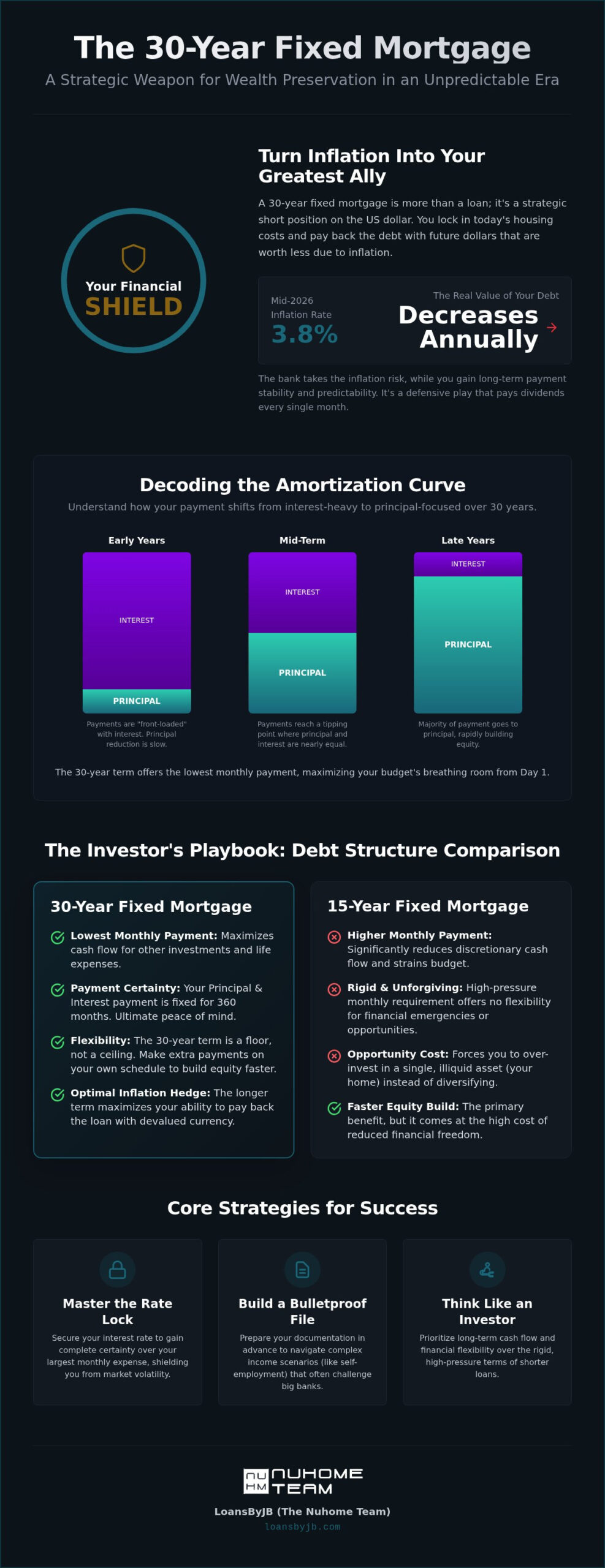
Most people see a mortgage as a ball and chain, but the smart money sees it as a weapon. Taking out a 30 year fixed mortgage in 2026 isn’t just about finding a place to sleep. It’s a calculated short position on the US dollar. You’re locking in today’s housing costs while the value of the currency shifts, effectively paying back your debt with future dollars that are worth less. It is the ultimate financial hedge for an unpredictable era.
We know you’re tired of watching interest rates bounce around like a heart monitor. It’s frustrating to deal with big banks that treat you like a number or reject you because your income doesn’t fit into a tidy little box. You want certainty. You want to know that your largest monthly expense won’t skyrocket while you’re trying to build a life. This guide will show you why the 30 year fixed mortgage remains the gold standard for long term wealth preservation and inflation protection. We’ll break down the math behind payment certainty, explain how to outpace a 3.8% inflation rate, and reveal the exit strategies that turn a simple loan into a strategic asset.
Key Takeaways
- Turn inflation into your greatest ally by using a 30 year fixed mortgage to lock in housing costs while the value of the dollar shifts.
- Decode the amortization curve to see how your monthly payments transition from interest-heavy to principal-focused over time.
- Compare debt structures with an investor’s lens to see why prioritizing cash flow beats the rigid terms of a 15-year loan.
- Learn how to navigate complex income scenarios that cause big banks to stumble, ensuring your self-employed status doesn’t kill the deal.
- Master the art of the rate lock and learn how to build a bulletproof loan file before you ever step foot in an open house.
Why the 30-Year Fixed Mortgage Remains the Ultimate Financial Hedge
The 30 year fixed mortgage isn’t just a loan. It’s the bedrock of American wealth. While big banks and “experts” might try to steer you toward exotic products or shorter terms that squeeze your cash flow, the traditional 30-year fixed remains the most powerful tool in your arsenal. It provides a level of predictability that’s virtually extinct in every other sector of the 2026 economy. You aren’t just buying a home; you’re buying a shield against future uncertainty.
Think about the current rental market. In June 2026, the median home price hit $440,600. Renters are at the mercy of landlords and market whims. Every year, they face the “rent hike” anxiety. When you lock in a fixed rate, you’re opting out of that volatility. You’re drawing a line in the sand. Your housing cost is frozen, even as the world around you gets more expensive. This is how you transform a liability into a fortress. It’s a defensive play that pays off every single month.
We need to kill the “debt is bad” myth once and for all. Not all debt is created equal. High-interest credit card debt is a parasite. But a low-interest, fixed-rate mortgage is a wealth builder. For a foundational fixed-rate mortgage overview, you can see that this structure has survived every market crash for a reason. It allows you to build equity using the bank’s money while you keep your own cash for other investments. In 2026, leverage is your best friend if you know how to use it.
The Psychology of Payment Certainty
Knowing your Principal and Interest (P&I) for exactly 360 months is a massive mental win. It’s one less thing to worry about. When the news cycle screams about interest rate volatility or economic shifts, you can simply change the channel. Your rate is locked. Your plan is set. This certainty is the cornerstone of a sane retirement strategy. You aren’t guessing what your biggest bill will be in fifteen years. You already know. For families also managing the future needs of aging relatives, Senior Housing Locator offers a free referral service to help find appropriate senior living options. That peace of mind is worth more than a few basis points on a riskier loan.
Shorting the Dollar: A Strategic Perspective
Decoding the Math: How Interest, Principal, and Amortization Work for You
The math behind a mortgage doesn’t lie, but it can be misleading if you don’t know where to look. When you sign for a 30 year fixed mortgage, your monthly payment is bundled into a four-headed beast known as PITI. This stands for Principal, Interest, Taxes, and Insurance. While taxes and insurance are pass-through costs that fluctuate based on your local municipality and provider, the Principal and Interest (P&I) are the only parts you truly control when you lock your rate. In August 2026, with conventional rates hovering around 6.75%, understanding how that interest is calculated is the difference between being a borrower and being a strategist.
You need to understand the amortization curve. Most of your early payments are “front-loaded” with interest. The bank takes its cut first. In the first few years, your principal reduction is a slow crawl. This isn’t a scam; it’s the standard mechanics of how fixed-rate debt works. The trade-off is simple. A 30-year term provides the lowest possible entry point for your monthly carrying costs. It gives you the most breathing room in your budget, allowing you to use your cash for other investments while the bank waits decades to be fully repaid.
The Power of Extra Principal Payments
The 30-year term is a floor, not a ceiling. You have the flexibility to pay it off faster without the rigid, high-pressure monthly requirements of a 15-year loan. Making just one extra principal payment per year can shave roughly five to seven years off your total term. This allows you to build equity on your own schedule. If you’re ready to see how these numbers look on your own balance sheet, you can explore your loan options with an advisor who understands the investor lens. You get the safety of a low mandatory payment with the option to accelerate your wealth building whenever you choose.
What Actually Drives 30-Year Mortgage Rates in 2026?
Stop obsessing over every Federal Reserve meeting. The Fed doesn’t set mortgage rates. They influence the short-term Federal Funds Rate, but the 30 year fixed mortgage is more closely tied to the 10-Year Treasury yield and the pricing of Mortgage-Backed Securities (MBS). When investors feel the economy is cooling, they buy bonds, which drives yields down and mortgage rates with them. Daily quotes are a reflection of global appetite for long-term debt. Understanding this relationship helps you time your rate lock without losing your mind over political headlines.
The Investor’s Playbook: Comparing the 30-Year Fixed to Other Debt Structures
Investors don’t play by the same rules as the average homebuyer. They view debt as a tool, not a burden. While traditional banks push the “save on interest” narrative of shorter terms, savvy players know that a 30 year fixed mortgage offers the most strategic flexibility. It provides the lowest mandatory carrying cost. This allows you to weather vacancies, unexpected repairs, or shifts in the 2026 rental market without breaking a sweat. You want control over your cash flow. This loan structure gives it to you.
Adjustable Rate Mortgages (ARMs) often look like a shortcut to lower payments. In 2026, that shortcut is often a minefield. With the 30-year fixed sitting in the mid-to-high 6% range, the spread for an ARM is frequently too narrow to justify the risk. You’re betting your financial stability on the hope that rates will drop before your reset. That isn’t a strategy. That’s gambling. A fixed rate lets you build a “Buy and Hold” portfolio on a foundation of concrete, not shifting sand. It is the preferred tool for anyone looking to build long term wealth without the constant threat of a payment spike. Buyers who want to maximize their equity position from day one should also consider how an FHA 203k loan can turn a fixer-upper into instant equity by bundling purchase and renovation costs into a single mortgage.
The Opportunity Cost of a 15-Year Mortgage
Big banks love the 15-year mortgage because it forces you to build equity fast. For an investor, this is often a trap. Locking up extra cash in a rigid, high-payment term is a strategic mistake. Cash flow is the lifeblood of your portfolio. You can’t use home equity to buy your next property or cover an emergency repair. By choosing the 30 year fixed mortgage, you maintain liquidity. You have the option to pay extra if you want, but you aren’t required to. Flexibility is the ultimate advantage in an unpredictable economy. Don’t let the bank dictate how you use your capital. That said, if your priority is building equity at maximum speed and slashing total interest paid, it’s worth understanding how a 15 year fixed mortgage functions as a wealth-building weapon before making your final decision.
Exit Strategies: Refinancing and Portability
You’ve likely heard the phrase “Date the Rate, Marry the House.” In 2026, this is more relevant than ever. A fixed-rate loan isn’t a life sentence. It is a safety net. If rates drop significantly, you can refinance to lower your costs. If they rise, you’re protected. When calculating your break-even point, look at the closing costs versus your monthly savings. A 30-year term is the perfect setup for a future cash-out refinance. You lock in the stability now, then pull equity out later when the time is right to expand your empire. It gives you an exit strategy that shorter terms simply can’t match.
Qualifying Beyond the W2: Navigating Complex Loan Scenarios in 2026
Big banks are built for robots. They want a standard W2, a steady pay stub, and a predictable life. If you’re a business owner, a freelancer, or a serial investor, you don’t fit their mold. Those rigid institutions will likely show you the door because your tax returns show heavy write-offs or your income fluctuates. In 2026, qualifying for a 30 year fixed mortgage requires more than just a high credit score. It requires a narrative. You need a broker who can translate your financial reality into a language that underwriters actually understand. Understanding why use a mortgage broker instead of a bank becomes especially clear when your income story doesn’t fit the algorithm a retail lender relies on.
We use a “Real Conversation” approach. Instead of letting an algorithm reject your application, we present your income story directly to the decision-makers. This is about more than just numbers on a page. It’s about explaining why your business structure is an asset, not a liability. Whether you’re navigating the 2026 conforming loan limit of $832,750 or looking for an FHA loan within the $541,287 limit, the strategy remains the same. You have to optimize your profile to pass the “investor lens” of a lender who values results over red tape.
If your bank said no because your situation is “too complex,” it’s time to talk to a complex income specialist who knows how to find the “yes.” We don’t just pull credit; we build a case for your approval.
Mortgages for the Self-Employed and Business Owners
Proving income shouldn’t be a nightmare. If your tax returns don’t tell the whole story, we pivot to bank statement programs. These allow you to use your actual cash flow, documented through 12 or 24 months of deposits, to qualify for a 30 year fixed mortgage. A seasoned advisor who understands P&L statements can identify “add-backs” like depreciation that big banks ignore. Your business structure, whether it’s an S-Corp or an LLC, should be a tool for wealth, not a barrier to homeownership.
Overcoming Underwriting Hurdles
Common red flags like large unexplained deposits or declining year-over-year income kill deals at traditional banks. We solve this by highlighting “compensating factors” such as significant cash reserves or a low loan-to-value (LTV) ratio. An investor lens means analyzing a deal by prioritizing the property’s debt-service potential and the borrower’s overall liquidity over simple, traditional income ratios. This shift in perspective is often the only difference between a rejection letter and a set of keys. Don’t let a “no” from a retail lender be the final word on your financial future.
Strategic Execution: How to Secure and Optimize Your 30-Year Fixed Rate
Securing a 30 year fixed mortgage in 2026 isn’t a passive event. It’s a tactical execution. You don’t just “get” a loan; you build a case for one. This starts with a bulletproof loan file. You need your documentation organized before you ever step foot in an open house. In a market where the conforming loan limit is $832,750, sellers have zero patience for shaky financing. They want to see a pre-approval that carries real weight, backed by an advisor who has actually reviewed your assets and income story.
Timing is the other half of the battle. The art of the rate lock requires a cold, analytical eye on the market. With 10-Year Treasury yields shifting daily, you can’t afford to lose your mind over every headline. You need a strategy that identifies the “dip” and strikes. This isn’t about guessing; it’s about using historical data and current trends to protect your monthly payment. We help you cut through the noise so you can lock with confidence and stop checking the ticker every hour.
Choosing a Partner, Not a Platform
The “Push Button, Get Mortgage” promise is a myth designed for the easy deals. If your situation is complex, an algorithm is your enemy. You need a partner who acts as a rebel expert, someone willing to challenge rigid underwriting and fight for your deal. With over 25 years of experience, LoansByJB (The Nuhome Team) understands how to navigate the nuances that stop big banks in their tracks. We aren’t just processing paperwork. We are architecting a financial solution that fits your long-term wealth goals. If you’ve ever wondered why use a mortgage broker instead of a bank, the answer comes down to access: wholesale rates, specialized loan products, and an advocate who works for you rather than the institution.
Your Next Steps to Homeownership
Success starts with an initial consultation. We set the strategy before you even start your search. This ensures your debt-to-income ratio is optimized and your profile is ready for the investor lens of modern lenders. Once your strategy is set, we provide a pre-approval that signals to sellers you are a serious, qualified buyer. For more details on timing your entry, check out our guide on Rate Locking. Your fortress of stability is waiting; you just need the right key to open the door.
Lock in Your Financial Future
The 30 year fixed mortgage is more than a monthly bill. It is a strategic anchor. By locking in your rate today, you create a permanent shield against the rent hikes and market volatility that define the 2026 economy. You’ve learned how to use the bank’s money to hedge against inflation while maintaining the cash flow flexibility that shorter terms destroy. Whether you are a first time buyer or a seasoned investor, the goal remains the same: total payment certainty.
Standard banks will try to force you into a box. We don’t. With over 25 years of industry-leading brokerage experience, we specialize in the complex income scenarios that make retail lenders sweat. We bring a national reach and a personalized, straight-shooter approach to every deal. We use an investor lens to ensure your loan passes underwriting, even if you are self-employed or have a non-standard income story.
Stop guessing and start strategizing; get a real conversation about your 30-year fixed mortgage today. Your path to long term wealth starts with a single, decisive move. Let’s build your fortress of stability together.
Frequently Asked Questions
Is a 30-year fixed mortgage better than a 15-year mortgage?
Choosing a 30 year fixed mortgage is generally the smarter move for anyone who values cash flow and financial flexibility over aggressive debt reduction. While a 15-year loan saves interest, it locks you into a high mandatory payment that can be dangerous if your income fluctuates. With a 30-year term, you get a lower required payment and the option to pay extra whenever you want. It puts you in control of your capital rather than the bank. If you want to explore the other side of the argument, our deep dive into the 15 year fixed mortgage as a wealth-building strategy lays out exactly when the shorter term wins.
Can I pay off my 30-year fixed mortgage early without penalty?
You can absolutely pay off your 30 year fixed mortgage early without facing a penalty in almost all conventional, FHA, and VA scenarios. This flexibility is what makes the 30-year term so powerful. You can treat it like a 15-year loan by making extra principal payments during good months, but you aren’t penalized if you need to revert to the lower base payment during a lean month. No prepayment penalty is the industry standard.
How much is the average 30-year fixed mortgage rate in 2026?
As of early August 2026, the average interest rate for a conventional 30-year fixed mortgage sits between 6.63% and 6.778%. FHA rates are currently around 6.25% while VA and Jumbo loans are averaging 6.125%. These numbers reflect a stabilizing market after years of volatility. Your personal rate will depend on your credit profile and the complexity of your income story. We specialize in finding the right fit for your specific financial scenario.
What happens to my fixed rate if the Federal Reserve raises interest rates?
Nothing happens to your interest rate once your loan is closed; that is the entire point of a fixed-rate product. While Federal Reserve hikes influence the rates for new loans, your existing payment remains frozen. This is why the 30-year fixed is the ultimate hedge against inflation. Even if the Fed pushes short-term rates to historic highs, your principal and interest payment won’t budge for the next 360 months. You get total certainty in an uncertain world.
What credit score do I need for a 30-year fixed mortgage?
You generally need a minimum credit score of 580 for an FHA loan or 620 for a conventional 30-year fixed mortgage. However, just meeting the minimum doesn’t mean you’re getting the best deal. Lenders use risk-based pricing, meaning a score above 740 will unlock significantly lower interest rates and cheaper mortgage insurance. If your score is lower, we look for compensating factors like large cash reserves or a low debt-to-income ratio to secure a solid approval.
Can self-employed borrowers qualify for a 30-year fixed-rate loan?
Self-employed borrowers qualify for a 30-year fixed-rate loan every day, though they often fail at big banks that don’t understand business structures. If your tax returns show heavy deductions that lower your on-paper income, we can use bank statement programs to prove your actual cash flow. We look at 12 to 24 months of deposits to establish your ability to pay. It’s about finding a lender that uses an investor lens rather than a rigid corporate manual.
How much down payment is required for a 30-year fixed mortgage?
Your required down payment can be as low as 0% if you are a veteran using a VA loan. For most other buyers, FHA loans require 3.5% down, while some conventional programs allow for just 3% for first-time buyers. While the 20% down rule is a common myth, putting down more can help you avoid private mortgage insurance. In 2026, with the median home price at $440,600, many buyers choose lower down payments to keep their cash liquid. Buyers targeting properties that need work should also explore how an FHA 203k loan combines purchase and renovation financing into one low-down-payment solution.
Is it worth refinancing a 30-year fixed mortgage?
Refinancing is worth it when the monthly savings outweigh the closing costs within a reasonable break-even period, usually 24 months or less. Most experts look for a rate drop of at least 0.75% to justify the move. You might also consider a cash-out refinance if you’ve built significant equity and want to fund a new investment or consolidate high-interest debt. We run a net-tangible-benefit analysis to ensure the move actually puts more money in your pocket.
Need the mortgage math checked?
Talk through the loan before you guess.
Use the estimator, request a refinance quote, or book a call with The Nuhome Team. We will help you compare the options that actually fit the file.
This is not a commitment to lend. Approval, terms, and pricing depend on credit, income, assets, property, and program guidelines.