

Your local big bank doesn’t want to fund your vision. They want a safe, predictable W-2 employee buying a finished box in the suburbs. If you’re self-employed or eyeing a complex multi-unit project in Southern California, a traditional construction loan often feels like a trap of endless rejections and red tape. You aren’t just building a house. You’re executing a high-stakes financial maneuver that requires an investor’s lens, not a bureaucrat’s checklist.
We know the frustration of watching interest rates fluctuate while you’re stuck in the draw process or worrying if SB 684 density rules will actually work in your favor. It’s exhausting. This guide changes that. You will learn how to master the mechanics of construction lending to turn raw land into a high-value asset. We’re breaking down everything from the 2026 high-cost conforming limits of $1,249,125 to the one-time close strategy that secures your permanent mortgage before you break ground. It’s time to stop asking for permission and start building with confidence.
Key Takeaways
- Choose between one-time close rate protection or two-step loan flexibility. Match your capital structure to your project’s ultimate exit strategy.
- Leverage Southern California density rules to build more doors on a single lot. Learn why ADUs and multi-family units are the secret to maximizing land value.
- Navigate the draw process and interest-only payments with zero surprises. Secure a construction loan designed to keep your project liquid from foundation to finish.
- Shift from a standard W-2 mindset to an investor lens. Position your project’s future value to satisfy underwriters even if big banks already said no.
What is a Construction Loan? Financing Your Vision from the Dirt Up
A construction loan is a specialized, short-term financial tool used to cover the costs of building a residential property from scratch. It isn’t a standard mortgage. You don’t get a lump sum at the closing table to buy a finished home. Instead, this is a tactical line of credit that fuels the transition from raw land to a high-value asset. It’s designed to be temporary, typically lasting 12 to 24 months, acting as the essential fuel for your project’s build phase.
Big banks are often allergic to uncertainty. They view ground-up projects as high-risk because they can’t easily value a structure that doesn’t exist yet. If a borrower walks away from a half-finished foundation, the lender is left with a liability, not an asset. To counter this perception, you need to present your project as interim bridge financing with a clear, guaranteed exit strategy. Success in this arena requires moving beyond the “hopeful homeowner” mindset and adopting an investor’s perspective.
The Core Differences Between Construction Loans and Standard Mortgages
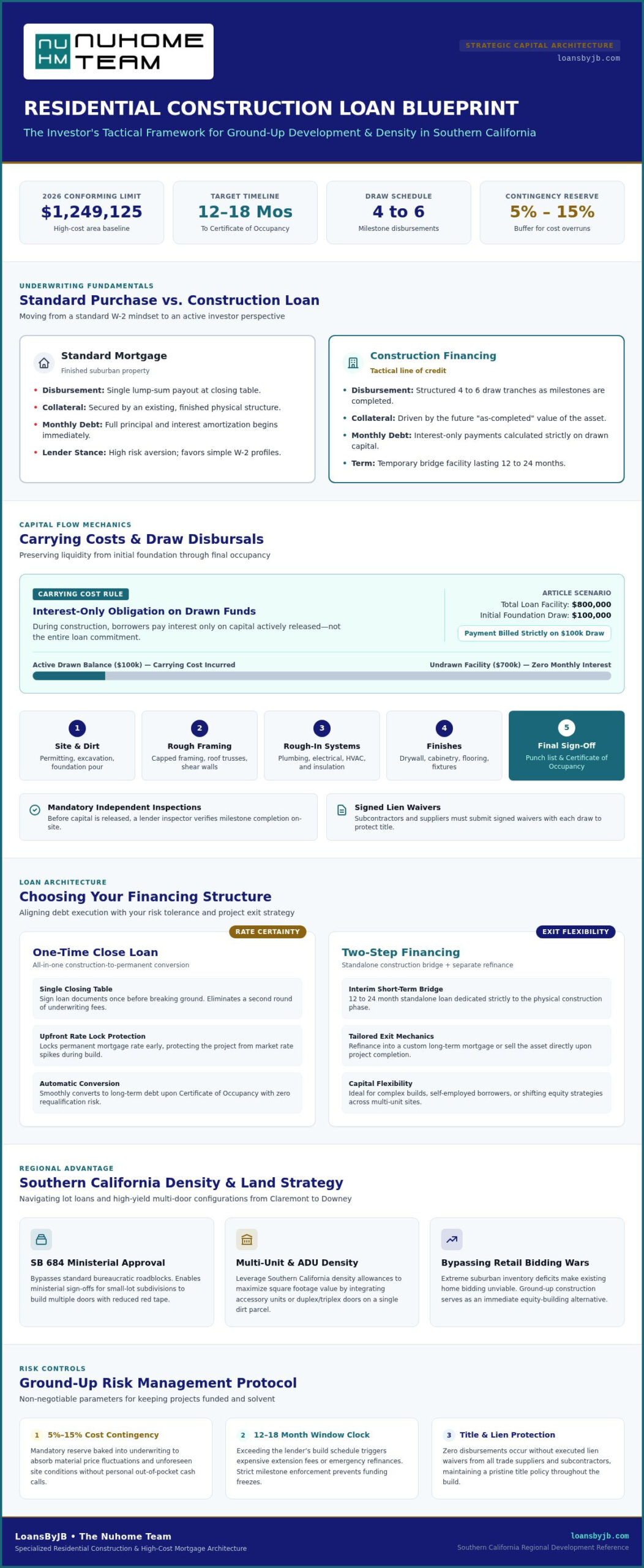
The biggest shift is in how the money moves. In a standard purchase, the bank cuts one check. With a construction loan, funds are released through a “draw” schedule. Your builder hits a milestone, like finishing the rough framing, and the lender releases the next chunk of capital after an inspection. You aren’t paying for the whole house on day one; you’re paying for progress.
This structure also changes your monthly costs. During the build, you typically only pay interest on the funds you’ve actually drawn. If your total loan is $800,000 but you’ve only used $100,000 for the foundation, your payment is based solely on that $100,000. It keeps your carrying costs manageable while the site is still a dirt lot. Unlike a traditional mortgage backed by an existing house, the collateral here is the future “as-completed” value of the project.
Why 2026 is the Year for Ground-Up Development
Inventory shortages across Southern California, from Claremont to Downey, have made finding an existing home nearly impossible without a bidding war. Building is no longer just an alternative; it’s a strategic advantage. Modern density laws like SB 684 now allow for ministerial approval of small-lot subdivisions, meaning you can maximize your land value by building more doors with less red tape. A construction loan is a tactical bridge to long-term equity.
How Construction Financing Works: Draws, Timelines, and Interest-Only Payments
A construction loan is a race against the clock. Unlike a standard purchase where you close and move in, construction financing requires active management of a moving target. You usually have a 12 to 18 month window to get from a dirt lot to a certificate of occupancy. If you miss that window, you face expensive extensions or a messy refinance. Timing isn’t just a detail; it’s your biggest risk factor.
The engine of this process is the draw schedule. Your lender doesn’t trust you or your builder with the full loan amount upfront. Instead, they release funds in 4 to 6 disbursements as specific milestones are met. Before any money moves, an inspector verifies the work. If the foundation isn’t poured or the framing isn’t capped, the check doesn’t get cut. This CFPB guide on construction loans provides a solid baseline for how these government-regulated disbursements should look.
Navigating the Draw Process Without Delays
Funding freezes are project killers. To keep the money flowing, you must align with a licensed contractor who understands the paperwork. Every draw request should include signed lien waivers from every subcontractor and supplier. This protects your title and ensures nobody can place a claim on your property for unpaid work. Don’t let a disorganized builder stall your project. Verify that your draw milestones are realistic before you sign the loan documents.
Managing Carrying Costs During the Build
You don’t pay for the whole house while it’s just a skeleton. Your monthly obligation is interest-only, calculated solely on the amount you’ve drawn to date. As the project nears completion, that payment grows. It’s vital to bake a 5% to 15% contingency reserve into your budget to absorb the inevitable cost overruns that occur in ground-up development. These reserves act as a buffer so you aren’t forced to pay out-of-pocket for material price spikes.
Once the final punch list is done and the city signs off, it’s time to exit the temporary debt. Most borrowers transition into a 30-year fixed mortgage to lock in long-term stability. Managing these phases requires a steady hand and an expert who understands the nuances of the Southern California market. If you’re feeling overwhelmed by the math, talk to a specialist who can help structure your project for success.
One-Time Close vs. Two-Step: Choosing the Right Capital Structure
Your capital structure is more than just a rate. It is the tactical foundation of your entire build. In the Southern California market, you have two primary paths: the one-time close or the two-step strategy. Big banks will tell you the one-time close is the only logical choice. They’re wrong. The right path depends entirely on your exit strategy and your need for leverage. Don’t let a loan officer’s limited menu dictate your project’s financial feasibility.
The Consumer Financial Protection Bureau overview of construction loans clarifies that these products are designed as short-term instruments. How you transition that debt into a long-term mortgage is where the real strategy happens. You either bake the transition in from day one or you keep your options open for a more aggressive refinance later.
The One-Time Close Advantage
The One-Time Close, also known as construction-to-permanent financing, is built for stability. You qualify once. You sign one set of loan documents. You pay one set of closing costs. For a primary residence in a stable neighborhood like Rancho Cucamonga or Glendora, this is a powerful hedge against volatility. You lock your long-term interest rate before the first shovel hits the dirt. If rates spike during your 12-month build, you’re protected. In 2026, with the high-cost conforming ceiling for Los Angeles and Orange County sitting at $1,249,125, staying within conforming limits on a single-close product can save you thousands in interest over the life of the loan.
When the Two-Step Strategy Wins
Investors and developers often find the one-time close too restrictive. If your goal is maximum leverage or a “cash-out” exit, the two-step strategy is the superior play. You secure a standalone construction loan for the build phase. Once you have a certificate of occupancy, you refinance into a permanent mortgage based on the new, higher “as-completed” value. This allows you to pull equity out of the project immediately rather than waiting years for natural appreciation.
Speed is another factor. Traditional banks move at a glacial pace. Using a hard money loan for the initial build phase allows you to bypass the mountain of red tape that stalls most ground-up projects. You pay a higher rate for 12 months in exchange for the ability to seize a lot and start pouring concrete while your competitors are still waiting on a W-2 review. You win by being first, not by being the most patient.
Qualification Myths: Why Your “Investor Lens” Matters More Than Your W2
Big banks love W-2 employees. They want predictable, boring boxes that fit into a standard underwriting grid. If you’re a self-employed entrepreneur or an investor with optimized tax returns, traditional lenders often see risk where we see opportunity. A construction loan shouldn’t be out of reach just because your income doesn’t arrive on a standard paystub. We look at your project through an investor lens, prioritizing the asset’s future value and your total financial picture over a single tax line.
The “skin in the game” requirements for ground-up projects are often misunderstood. You don’t always need a mountain of cash to start. For raw land with no utilities, expect to bring a 35% to 50% down payment. However, if you’re building on an improved lot with pavement and utilities already at the curb, that requirement often drops to 20% or 30%. While traditional banks typically cap their Loan-to-Cost (LTC) at 75% or 80%, investor-focused structures can push up to 85% or 90% LTC. This allows you to preserve your liquidity for the build phase rather than burying it all in the dirt.
The Three Pillars of Construction Underwriting
Underwriting a ground-up project is a three-way vetting process. It isn’t just about you; it’s about the feasibility of the vision. Lenders evaluate three specific pillars before releasing a dime:
- The Borrower: Your credit and liquidity are important, but we also look at your experience level and your ability to carry the interest payments as the loan balance grows.
- The Project: This includes your detailed plans, specs, and a realistic budget that includes a 5% to 15% contingency reserve for cost overruns.
- The Builder: Your lender cares as much about your contractor as they do about you. They will vet the builder’s insurance, financial stability, and track record to ensure the project actually reaches the finish line.
Financing for the Self-Employed and Investors
If you’re building multi-unit projects or ADUs to maximize Southern California density, standard debt-to-income (DTI) metrics are often irrelevant. We leverage DSCR loans for the permanent takeout phase, focusing on the project’s projected rental income rather than your personal tax returns. This structure allows you to scale your portfolio without the friction of traditional bank rules. Your ability to pay off the construction debt through a sale or long-term refinance is the single most critical factor in your approval.
Stop letting rigid bank guidelines stall your development plans. Work with a specialist who understands how to structure complex income scenarios for underwriting success.
Building in Southern California: Navigating Lot Loans and Local Density
Southern California real estate is a game of inches and density. You aren’t just building a house; you’re manufacturing equity in one of the most supply-constrained markets in the country. Whether you’re eyeing a vacant parcel in Claremont or a teardown in Downey, the dirt is the foundation of your wealth. But you cannot treat a Southern California build like a standard transaction. You have to navigate local zoning, Title 24 energy mandates, and the aggressive density overhauls that became fully enforceable in 2026. This isn’t just about borrowing money. It is about navigating a regulatory landscape that rewards those who know the rules.
The LoansByJB difference comes from 25 years of street-smart experience. We don’t just look at your credit score; we look at the parcel’s potential. We understand how cities like San Dimas and Upland view infill development. We know that a construction loan in Los Angeles County needs to be structured with the 2026 high-cost conforming limit of $1,249,125 in mind to maximize your borrowing power while minimizing your rate. We act as your advocate, finding the path forward when traditional banks get tangled in their own red tape.
Turning Vacant Lots into High-Performing Assets
Lot loans are your tactical entry point. If you aren’t ready to break ground today, you need a strategy to secure the land before someone else does. For raw land without utilities, expect to bring a 35% to 50% down payment. Improved lots in La Verne or Rancho Cucamonga with utilities to the curb are more accessible, often requiring only 20% to 30% down. The regulatory environment shifted on January 1, 2026. Under SB 543 and SB 684, local jurisdictions can no longer use discretionary hearings to stall ministerial approvals for ADUs or small-lot subdivisions of up to 10 units. Your financing should reflect this speed. We help you leverage these laws to spread your land basis across multiple doors, turning a single lot into a high-performing residential asset.
Your Next Move: From Dirt to Doorstep
We don’t start with a generic application form. We start with a real conversation about your project’s exit strategy. If your vision involves an existing structure or a complex rebuild, we can optimize your project for a VA loan or an FHA 203k renovation product. We bridge the gap between raw land and a finished certificate of occupancy. Stop letting rigid institutional rules stall your development goals. You need a partner who knows the Southern California dirt as well as you do. Schedule a consultation with the Nuhome Team to map your build strategy.
Build Your Vision on Solid Ground
The path from a vacant lot to a high-value asset is paved with tactical financial decisions. You’ve learned that a construction loan is not a standard mortgage; it’s an interim tool that requires precise management of draw schedules and interest-only payments. Whether you choose the rate protection of a one-time close or the aggressive leverage of a two-step strategy, your success depends on looking at the project through an investor lens. Big banks might see risk in Southern California’s density laws, but we see the opportunity to manufacture massive equity.
Don’t let rigid institutional rules stall your progress. You need a partner who understands the nuances of the local market from Claremont to Downey. With over 25 years of expert brokerage and investment experience, Justin Brown offers direct access to a rebel expert who prioritizes your results over corporate pleasantries. We specialize in complex scenarios that leave traditional lenders confused. It’s time to stop asking for permission and start breaking ground. Get a personalized construction loan strategy from Justin Brown and the Nuhome Team. Your vision is ready for the real world.
Frequently Asked Questions
What is the minimum down payment for a construction loan in 2026?
Expect to bring at least 20% to 30% for an improved lot that already has utilities at the curb. If you are financing raw land in Southern California areas like Claremont or Upland, the requirement usually jumps to 35% or 50% down. While some specialized investor products allow for higher leverage, these equity benchmarks remain the industry standard. We help you structure your total project costs to satisfy these requirements while preserving your liquidity.
Can I act as my own builder (Owner-Builder) on a construction loan?
Most lenders reject owner-builder scenarios unless you are a licensed, professional contractor with a verified track record of similar projects. Banks view inexperienced builders as a massive risk to the project’s completion. If you aren’t a pro, you must hire a licensed contractor to manage the build. We vet your builder’s insurance and financial stability to ensure the project meets underwriting standards before any funds move.
What happens if the construction project takes longer than the loan term?
You face expensive extension fees or a forced refinance if you miss your 12 to 24 month window. Timing is the biggest risk in a construction loan. Lenders may grant short-term extensions if progress is documented, but you’ll pay for the privilege. We help you build a realistic timeline with your contractor and include contingency reserves to absorb delays before they trigger a financial crisis during the build.
Are construction loan interest rates higher than standard mortgage rates?
Yes, you’ll typically pay a premium of 75 to 150 basis points above standard 30-year fixed rates. Lenders charge more because they’re financing a structure that doesn’t exist yet. Private or hard money options for investors can be even higher in exchange for speed and flexibility. You only pay interest on the funds drawn, which keeps your monthly carrying costs manageable while the site is still a skeleton.
Can I use a construction loan to buy the land and build at the same time?
You can absolutely bundle the land purchase and the build costs into one loan. This is a common strategy for a one-time close construction loan. The lender pays off the land seller at the initial closing and holds the remaining funds in escrow for the build phase. This allows you to secure a lot in cities like Downey or San Dimas and start pouring concrete without managing two separate debts.
What documents do I need to provide for a builder to be approved by the lender?
Your lender needs a deep dive into the builder’s professional life. Prepare to provide their general liability insurance, workers’ compensation coverage, and a detailed resume of completed projects. They will also review the builder’s financial statements and professional references. We act as a bridge, ensuring your contractor’s paperwork is as strong as your own financial profile so the project clears underwriting without a hitch.
How does a one-time close construction loan protect me from rising rates?
This structure locks your long-term interest rate before the first shovel hits the dirt. You qualify once and sign one set of documents. If rates spike while you’re building in Rancho Cucamonga, your permanent 30-year mortgage rate is already secured. It eliminates the rate shock risk that often haunts the two-step process, providing total financial certainty from the foundation to the final walk-through and certificate of occupancy.
Can I use equity in my current land as a down payment for the construction loan?
Your land equity counts as skin in the game for the project. If you already own a lot in Southern California, the appraised value of that land can often satisfy the lender’s down payment requirement. This allows you to finance a higher percentage of the actual build costs if the land value is high enough. We calculate your loan-to-cost ratio based on the total project value to keep your out-of-pocket costs low.
Need the mortgage math checked?
Talk through the loan before you guess.
Use the estimator, request a refinance quote, or book a call with The Nuhome Team. We will help you compare the options that actually fit the file.
This is not a commitment to lend. Approval, terms, and pricing depend on credit, income, assets, property, and program guidelines.