

A Fannie Mae HomeStyle renovation loan lets you finance the purchase (or refinance) and the renovation in one conventional mortgage, based on the home’s after-repair value. LoansByJB helps Southern California buyers compare it with FHA 203(k), subject to qualification and program guidelines.
In markets like Los Angeles or Thousand Oaks, move-in-ready inventory can be scarce or expensive. A conventional HomeStyle path can finance purchase and renovation together when the as-completed appraisal and guidelines support the file. Also see renovation and construction loan options.
Key Takeaways
- Stop overpaying for “move-in ready” homes and learn to manufacture equity by targeting dated properties with massive upside.
- Use a homestyle renovation loan to roll your purchase and luxury upgrades, including pools and ADUs, into one strategic mortgage payment.
- Leverage the “as-completed” appraisal to borrow against your home’s future value, unlocking capital that traditional banks refuse to touch.
- Understand why this conventional tool outperforms the FHA 203k for investment properties and high-end landscaping projects.
- Master the “A-Team” strategy to vet licensed contractors and structure your renovation for maximum speed and minimal stress.
Stop Compromising on the Fixer-Upper: The Equity Strategy for 2026
Buying a house in Claremont or San Dimas shouldn’t feel like a defeat. Most buyers fight over the same “move-in ready” listings. They pay a massive premium for someone else’s mediocre taste. That’s a losing game. The real money is in the dated property with the “good bones” and the 1980s kitchen. You aren’t just buying a home; you’re acquiring a dormant equity goldmine. A homestyle renovation loan lets you compete outside turnkey bidding wars. You buy the house for its current value and finance the future version of it today.
Liquidity is king in Southern California. Don’t drain your savings on a renovation after you close. Construction costs are volatile. Keep your cash in the bank for emergencies or other investments. This loan funds the construction directly. It keeps your personal capital safe while the property value climbs. You get the luxury you want without the retail markup or the cash-flow stress. It’s about building wealth, not just a kitchen.
The Problem with Traditional Mortgages
Traditional banks are rigid. They want a perfect product. If a house has “deferred maintenance,” they see risk and walk away. Most lenders reject properties with a leaky roof or an outdated electrical system. They might push you toward a FHA 203k loan, but those come with strict primary residence requirements and lower limits. We don’t operate that way. LoansByJB (The Nuhome Team) structures the deal to pass underwriting before the first hammer swings. We solve the “un-financeable” property problem by focusing on the exit strategy.
Avoid the trap of the post-closing credit card renovation. High-interest plastic is a recipe for financial disaster. It offers zero leverage and kills your DTI. We ensure your renovation is baked into a low-interest mortgage. It’s a cleaner, smarter way to build. We handle the complexity so you can focus on the design.
Manufacturing Equity in SoCal
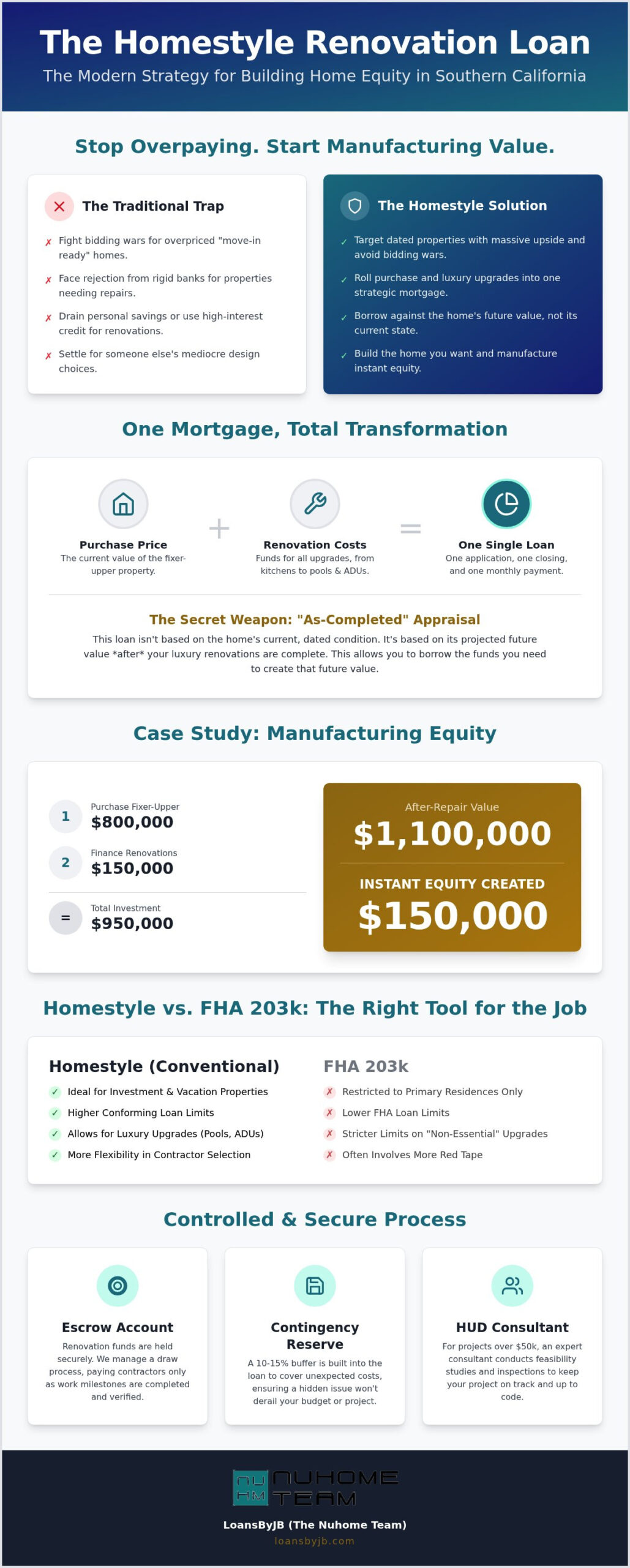
Look at the numbers in Rancho Cucamonga and Upland. Home prices are forecast to rise through 2026. This makes the “Purchase Price + Reno Cost < After Repair Value" formula your best friend. Imagine buying a fixer-upper for $800,000 and investing $150,000 in smart upgrades. If the after-repair value supports a higher appraisal, that gap may reflect value created by the renovation – outcomes vary by property, work quality, and market conditions. This is a strategic renovation. You are building the luxury you want while the market pays you for the effort. Stop settling for what's available. Start building what's profitable.
The homestyle renovation loan is a conventional mortgage that folds your purchase price and construction costs into a single package. This isn’t just a loan; it’s a capital strategy. Most lenders fixate on the property’s current condition, but we focus on the “as-completed” value. This appraisal approach is a core part of how renovation loans are structured. It allows you to borrow against the future value of the home before the first nail is driven. You aren’t limited by what the house is worth today; you’re empowered by what it will be worth after the transformation is finished.
Efficiency is the core of this protocol. You deal with one application, one set of closing costs, and one monthly payment. There’s no need to hunt for a secondary line of credit or a high-interest personal loan after you move in. This product offers massive flexibility that other programs can’t match, as it’s available for your primary residence, a vacation home, or even a rental property. If you want to structure a renovation strategy with LoansByJB (The Nuhome Team) to maximize your borrowing power, you need an advisor who knows the protocol inside and out.
How the Funds are Managed
Your renovation money doesn’t just disappear into a black hole. It sits in a secure, interest-bearing escrow account. We manage the draw process to keep your project moving. As your contractor completes specific milestones, we release funds to pay them directly. This ensures work is verified before cash leaves the account. The Contingency Reserve is the 10-15% buffer for unexpected costs. This safety net is built into the loan, so a hidden plumbing issue doesn’t derail your entire budget. It keeps the project solvent and your stress levels low during the construction phase.
The Role of the Consultant
For major projects, you need an ally on the ground. Fannie Mae’s Selling Guide does not require a HUD-approved consultant for HomeStyle (that oversight model is an FHA 203(k) standard). Some lenders may still require a consultant or extra project controls as an overlay on larger or structural scopes, so confirm the investor’s current guidelines. LoansByJB (The Nuhome Team) helps coordinate the appraiser, lender, contractor, and any project-oversight steps the chosen lender requires. Source: Fannie Mae HomeStyle Renovation fact sheet and Selling Guide B5-3.2 (contractors licensed when state law requires; 203(k) consultants are listed as an FHA contrast). Conforming loan limits are set by FHFA and vary by county (including higher-cost Southern California counties) – confirm the current FHFA limit for the property address and the lender’s Homestyle maximum.
Homestyle vs. FHA 203k: Which Renovation Tool Wins?
Choosing between these two loans isn’t just about interest rates. It’s about what you’re allowed to build. The FHA 203k is a survival tool. It’s designed to make a house habitable. But if you want a lifestyle upgrade, it will fail you. FHA rules explicitly ban “luxury” items. You can’t use it for a pool, a permanent outdoor fire pit, or high-end landscaping. The homestyle renovation loan has no such ego. It treats your vision as an investment in the property’s future value. If the market says a pool adds value, Fannie Mae lets you build it.
The financial math also favors the conventional path. FHA loans carry Mortgage Insurance Premium (MIP) that usually lasts for the life of the loan. Conventional PMI on a Homestyle loan disappears once you reach 20% equity. Since you’re manufacturing equity through renovations, you’ll likely hit that threshold years faster than a standard buyer. While FHA is more forgiving of credit scores below 620, Borrowers with a 620 or higher may want to compare HomeStyle to avoid the long-term mortgage insurance cost and the primary-residence-only restriction. Savvy borrowers also pair their Homestyle strategy with an adjustable rate mortgage to slash initial carrying costs and keep more cash liquid during the renovation phase.
The Pool and ADU Factor
In Glendora and Downey, outdoor living isn’t a luxury. It’s a requirement for resale value. The Homestyle program is the premier choice for Southern California because it embraces the “as-completed” appraisal for pools and Accessory Dwelling Units (ADUs). As of March 31, 2026, Fannie Mae allows for up to three ADUs on single-unit properties. This is a massive shift. You can use one loan to buy a property and build a guest house that generates immediate rental income. This strategy pairs perfectly with a DSCR Loan Guide: Scale Your Portfolio Without Tax Returns in 2026 if you plan to transition the property into a long-term rental powerhouse later.
The “Investor Lens” Comparison
Smart investors avoid FHA because it’s restricted to primary residences. You can’t use it for a flip or a rental. The Homestyle loan is the strategic choice for the “Rebel Expert” who wants to scale. It works for investment properties and second homes, providing a conventional path to property appreciation. It also makes your exit strategy cleaner. Properties renovated under Homestyle guidelines don’t have to deal with the 90-day FHA anti-flipping rules or strict FHA appraisal standards when you go to sell. For a deeper look at the FHA alternative, check out our FHA 203k Loan: The 2026 Guide to Turning Fixer-Uppers into Equity. But for most SoCal buyers looking at luxury and leverage, Homestyle is the clear winner.
Qualifying for Homestyle in Southern California: Actionable Steps
Success with a homestyle renovation loan isn’t about luck; it’s about precise execution. Most people fail because they treat the mortgage and the renovation as two separate problems. They aren’t. To win in a competitive market like Claremont or Upland, you need a unified strategy that moves as fast as the sellers do. Follow these steps to secure your capital and start your build.
- Step 1: Strategic Pre-Approval. Don’t settle for a basic letter. You need a pre-approval that accounts for both the purchase price and your estimated construction budget. We look at the total project cost to ensure your buying power remains intact.
- Step 2: Assemble the A-Team. You need a licensed contractor, a savvy broker, and potentially an architect. This isn’t just about hiring help; it’s about building a team that understands renovation underwriting.
- Step 3: Secure Documented Bids. Fannie Mae won’t accept a handshake deal or a ballpark estimate. You need detailed, line-item bids that meet strict documentation standards before the loan can move forward.
- Step 4: The Appraisal. This is the pivot point. Your appraiser must understand the SoCal market value of upgrades like ADUs or luxury kitchens to ensure the future value supports your loan amount.
- Step 5: Underwriting and Closing. Once the numbers align, you close once. The funds for the purchase are released, and the renovation money is moved into a secure escrow account to begin the work.
The Self-Employed Hurdle
California is the capital of the self-employed. Big banks look at your tax returns, see your legal write-offs, and immediately label you a risk. We don’t. LoansByJB (The Nuhome Team) specializes in navigating complex returns to find the actual income that traditional algorithms miss. Debt-to-income limits are lender and program dependent (agency automated underwriting may allow higher ratios on some files). Confirm current guidelines for the specific program. If you’re tired of being rejected by retail lenders who don’t understand your business, explore our guide on Mortgage for Self-Employed Borrowers: 5 Loan Products That Beat the Big Banks in 2026.
Contractor Requirements in SoCal
Fannie Mae demands professional accountability, meaning your “buddy with a truck” won’t pass the mandatory vetting process for licensed and insured contractors. In cities like Downey and Upland, code enforcement is strict and permits are non-negotiable. Your contractor must provide a clear timeline and a “Schedule of Values” for the project. This document is your protection. It breaks down exactly when and why money is released from escrow. It ensures you only pay for verified work, keeping the project on track and the contractor motivated. Ready to stop guessing? Get your strategic pre-approval today and take the first step toward your dream remodel.
The LoansByJB Advantage: Why Experience Trumps Algorithms
Big banks love algorithms. Algorithms love “perfect” houses. If your target property has a dated layout or a neglected yard, the computer usually says no. We don’t. A homestyle renovation loan requires more than a checklist; it requires a strategy. We use twenty-five years of street-smart brokerage experience to bridge the gap between a computer’s “no” and your “yes.” We’ve operated as brokers, lenders, and investors in Southern California since the late 90s. We know exactly why a fixer-upper in San Dimas or Upland is worth the risk when a rigid institution sees a problem. Understanding the full mortgage broker vs bank decision for Southern California in 2026 is essential before you commit to a lender, especially when your deal involves complex income or a property that needs work.
We don’t just push paper. We structure liquidity. For investors and savvy homeowners, this means keeping your cash free while the loan builds your equity. We advocate for the “Rebel Expert” approach. When an impersonal institution sidelines you because of a complex income situation or a property’s condition, we find the path forward. Local expertise matters for accurate valuations. You can’t value a Claremont remodel from a cubicle in another state. You need an advisor who knows the street-level appreciation trends of the Inland Empire.
Real Conversations, Not Call Centers
You won’t get a script-reading loan officer here. You get a real conversation with Justin Brown. We evaluate property carrying costs and exit strategies before you ever sign a document. We want to ensure the renovation math actually works for your long-term goals. If your project exceeds the FHFA conforming limit for the property county, jumbo or other structures may need to be compared. Check out our 2026 Jumbo Loan Refinance Guide for Southern California if your vision requires a larger capital injection. We specialize in the complex scenarios that make traditional banks flinch.
Next Steps: Transform Your Property
Getting started is simple and direct. We provide a custom renovation analysis for your target home, mapping out the numbers before you make an offer. We guide you through the timeline from that first call to a fully funded renovation escrow. Stop letting big banks dictate your potential based on outdated rules. It’s time to use a modern, flexible approach to Southern California real estate. Get a strategic renovation loan evaluation from LoansByJB today and take control of your property’s future value.
Take Command of the 2026 SoCal Market
The days of waiting for a perfect listing are over. In Southern California, you don’t find equity; you manufacture it. Using a homestyle renovation loan helps you compete for homes that need work and build the luxury lifestyle you actually want. You’ve seen why this tool beats restrictive FHA alternatives and how the “as-completed” appraisal puts the power back in your hands. It’s about strategic liquidity and long-term wealth. This is the decisive path for buyers who refuse to overpay for someone else’s mediocre choices.
Don’t trust your vision to a call center algorithm. You need a Southern California local expert with an investor-focused strategy. We bring 25+ years of experience to the table to ensure your renovation doesn’t just look good but makes absolute financial sense. We’ve navigated the complex underwriting that stops big banks in their tracks. It’s time to stop settling for what’s available and start financing what’s possible. Stop guessing and start building; get your Homestyle Renovation analysis from LoansByJB. Your dream home isn’t on the market yet. Let’s go build it.
Who a Homestyle renovation loan may fit
A Fannie Mae Homestyle renovation loan may be worth reviewing when you want to buy or refinance a property that needs work and prefer one mortgage that can include eligible renovation costs. Common fits include:
- Primary-home buyers targeting a dated house rather than a turnkey listing in Southern California markets.
- Borrowers comparing Homestyle with FHA 203(k) when pools, outdoor living, or other items treated as luxury under FHA rules matter to the plan.
- Second-home or investment-property scenarios where FHA 203(k) is not available and conventional renovation financing may apply, subject to lender overlays.
- Projects that need a licensed contractor, a clear scope of work, and an as-completed appraisal rather than cash renovations after closing.
Fit depends on credit, income documentation, reserves, property type, loan amount, occupancy, and current Fannie Mae and lender guidelines. This is not a commitment to lend.
Documentation typically reviewed
Exact documents vary by lender and file. A Homestyle review usually includes:
- Standard mortgage application items: income, assets, credit, and occupancy details.
- Detailed contractor bids or a Schedule of Values covering materials, labor, and timeline.
- Evidence the contractor is licensed and insured as required by the lender and local rules.
- Plans or specifications for larger scopes; a HUD-approved consultant is an FHA 203(k) requirement, not a Fannie Mae HomeStyle rule, though some lenders may add an overlay (confirm the lender’s current guidelines).
- An as-completed appraisal that reflects the proposed work, not only as-is condition.
- Contingency reserves and draw/disbursement procedures managed through escrow after closing.
Down payment, mortgage insurance, and maximum loan amount are lender and program dependent. Conforming loan limits are set by FHFA and vary by county; check the current FHFA limit map for the property county rather than relying on a single statewide number.
Tradeoffs to weigh
- Versus cash renovation after a standard purchase: Homestyle can reduce the need to fund repairs out of pocket after closing, but underwriting, contractor vetting, and appraisal take more time than a simple purchase loan.
- Versus FHA 203(k): Homestyle is a conventional path that may allow a wider set of value-adding improvements and non-primary occupancy in some cases; FHA 203(k) may fit some lower-down-payment or credit profiles but has different property and improvement restrictions. Compare insurance costs, occupancy rules, and eligible work side by side.
- Versus hard money or bridge: Short-term investor financing may close faster for some files but often carries different rate, term, and exit requirements. Homestyle is generally a longer-term conventional mortgage when the file qualifies.
- Process complexity: Draws, inspections, and contingency reserves add steps. Timelines vary by scope, appraisal, and how quickly documents and contractor paperwork return – there is no fixed closing speed.
Not a commitment to lend. Rates, terms, limits, and eligibility change with guidelines and lender overlays.
Next step: See how HomeStyle sits among other conventional loan options in California, then compare it with FHA 203(k) if credit or down payment is the constraint.
Frequently Asked Questions
Can I use a Homestyle loan for a swimming pool?
Yes, you absolutely can. While other programs like the FHA 203k label swimming pools as “luxury” items and ban them, the homestyle renovation loan embraces them. This is a critical advantage for homeowners in Rancho Cucamonga or Glendora looking to maximize their outdoor living space. As long as the pool adds value to the “as-completed” appraisal, you can fold the construction costs directly into your single mortgage payment.
What is the minimum down payment for a Fannie Mae Homestyle loan in 2026?
Minimum down payment depends on the specific conventional program, occupancy, and lender overlays (for example, some first-time buyer conventional options may allow as little as 3% when eligibility rules are met; many standard conventional purchases start around 5%). Conforming loan limits are published by FHFA and differ by county – confirm the current FHFA limit for the property county and the lender’s Homestyle overlays. Lower down payment can preserve cash for contingency, but mortgage insurance, reserves, and pricing still apply when required.
Can I do the renovation work myself with a Homestyle loan?
You can perform some work yourself, but there are strict limits. The program allows for do-it-yourself (DIY) work for up to 10% of the total renovation project. You must prove you’re qualified to handle the specific tasks and get lender approval before starting. For major structural changes or high-cost upgrades in cities like Upland, we always recommend using licensed professionals to ensure the work passes inspection.
Can I use a Homestyle loan for an investment property?
Yes. This is one of the most powerful features of the homestyle renovation loan. Unlike FHA products that require you to live in the home, you can use Homestyle for second homes and investment properties. This may allow investors in San Dimas or La Verne to buy rentals that need work and renovate them under conventional Homestyle guidelines when the file and appraisal support it. It’s a professional-grade tool for building a portfolio.
How does the appraisal work for a renovation loan?
The process uses an “as-completed” appraisal. The appraiser doesn’t just look at what the house is worth today in its “fixer-upper” state. They review your contractor’s detailed bids and architectural plans to determine the future value of the home once all work is finished. This allows the loan amount to be based on the after-repair value supported by the appraisal, which is how many renovation files are structured.
What happens if the renovation costs go over budget?
Every loan includes a “Contingency Reserve,” which is a 10% to 15% buffer for unexpected costs. If your contractor finds hidden plumbing issues or structural rot, these funds cover the repair without stopping the project. If you exceed this reserve, you’re responsible for the difference. We focus on getting accurate, detailed bids upfront to minimize these risks and keep your project solvent from start to finish.
Can I use a Homestyle loan to build an ADU?
Building an Accessory Dwelling Unit (ADU) is a primary use for this loan. As of March 2026, Fannie Mae rules allow up to three ADUs on single-unit properties. This is a game-changer for homeowners in Downey or Claremont looking to create multi-generational housing or generate rental income. You can finance the construction of a guest house or garage conversion as part of your initial purchase mortgage.
How long does it take to close a Homestyle renovation loan?
Closing timelines vary. Renovation loans often take longer than a standard purchase because of contractor vetting, the Schedule of Values, and the as-completed appraisal. A realistic timeline depends on how complete the bids and plans are, appraisal turnaround, and underwriting conditions – not a promised closing date.
Need the mortgage math checked?
Talk through the loan before you guess.
Use the estimator, request a refinance quote, or book a call with The Nuhome Team. We will help you compare the options that actually fit the file.
This is not a commitment to lend. Approval, terms, and pricing depend on credit, income, assets, property, and program guidelines.