

Your tax return is a masterpiece of strategic deductions, but to a big bank, it looks like you’re broke. It’s the ultimate irony of entrepreneurship. You have the cash flow to afford a luxury home in Rancho Cucamonga, yet a retail underwriter sees your “paper loss” and hands you an automatic rejection. Finding a mortgage for self-employed borrowers shouldn’t feel like you’re being punished for being successful. You’ve spent years building a business, not a W-2 paper trail; it’s time your lender understood the difference.
We agree that the traditional banking system is fundamentally broken for business owners. This article is your roadmap to bypass the rigid gatekeepers and secure a competitive rate using your actual cash flow. You’ll discover five specific loan products that prioritize your real-world income over a line on a tax form. We’re breaking down bank statement programs, DSCR options, and how to navigate the $832,750 conforming limit in a competitive 2026 market. Stop letting your CPA’s hard work stand between you and your homeownership goals.
Key Takeaways
- Understand why big banks are hard-wired to reject entrepreneurs and how to bypass their rigid, automated “W2 bias” systems.
- Learn how bank statement loans use your actual business deposits to prove buying power, keeping your strategic tax write-offs intact.
- Discover how to secure investment properties using DSCR loans that qualify the property’s cash flow instead of your personal income.
- Identify the best mortgage for self-employed borrowers by comparing P&L-only programs and asset depletion strategies designed for high-liquidity owners.
- Master the “Pre-Flight” underwriting strategy to move faster than the competition in Southern California’s high-stakes real estate market.
Why Traditional Banks Fail Self-Employed Borrowers
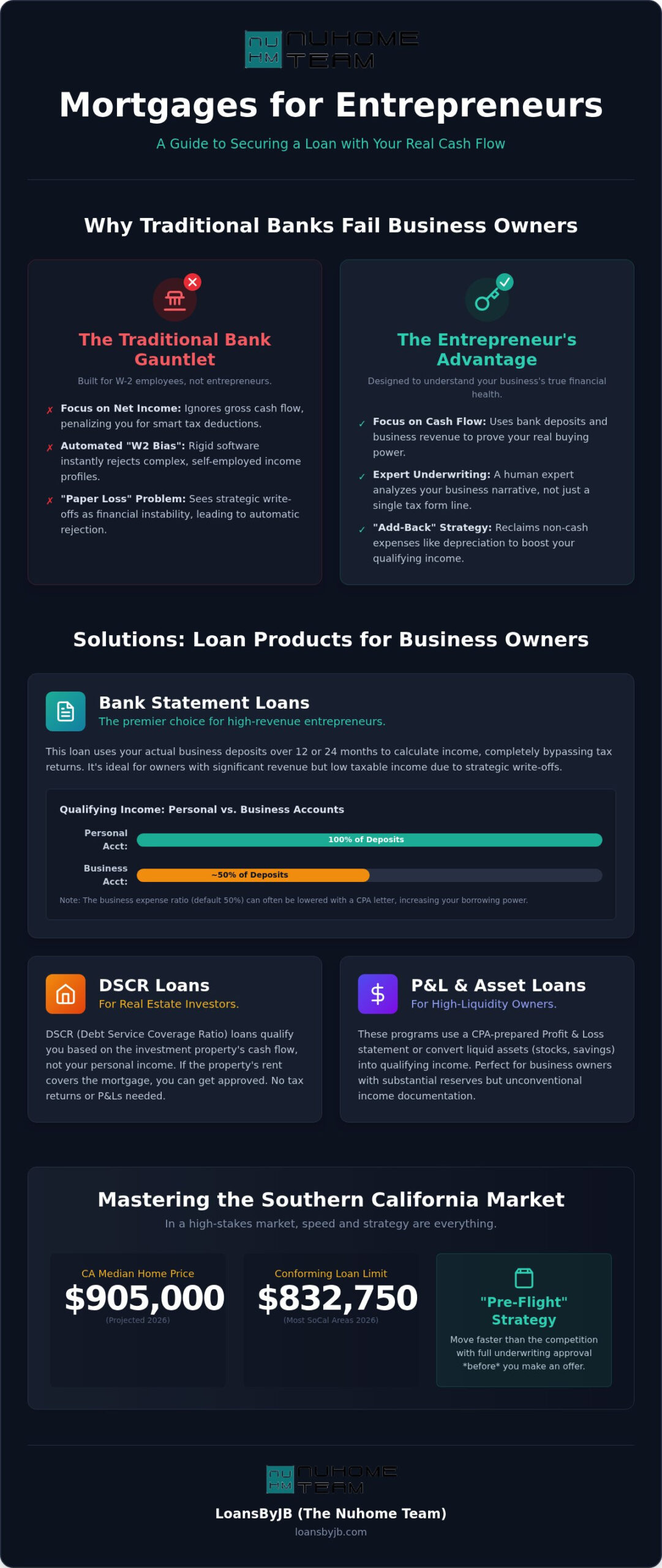
Retail banks are built for the path of least resistance. They want a clean W-2 and a simple pay stub. If you own the company, you’re an outlier. Most big banks rely on automated underwriting systems that are fundamentally biased against business owners. These systems don’t think; they calculate. If your income doesn’t fit into a pre-defined digital box, the “computer says no” response is instant. This is the reality of the W2 bias. It treats the most successful entrepreneurs like high-risk liabilities simply because their paperwork is complex.
Then there’s the deduction dilemma. Your CPA is doing their job by minimizing your tax liability and maximizing write-offs. It’s a brilliant move for your bottom line, but it’s often a death blow for a standard mortgage loan application. Traditional lenders look at your net income after all those deductions. They ignore the gross cash flow that actually pays your mortgage and fuels your lifestyle. They see a “paper loss” and assume you can’t afford the home, even when your bank accounts tell a completely different story.
The 2026 market doesn’t make things any easier. With the California median home price projected to hit $905,000 this year, the margin for error is zero. You can’t afford to wait for a digital portal to glitch or a junior loan officer to “get back to you” after they consult a manual. Market volatility requires a real conversation with an expert who understands business structures. You need a lender who uses an investor lens. This means looking at property carrying costs, real-world cash flow, and exit strategies before you ever sign a contract.
The Flaw in Standard Underwriting
Standard banks fixate on net income. We look at gross cash flow. In high-cost Southern California markets like Claremont or Rancho Cucamonga, a high debt-to-income (DTI) ratio is often an illusion created by tax-efficient accounting. Retail lenders see a high DTI and panic. They don’t have the authority to look past the software’s verdict. This “straight-jacket” approach to underwriting is why so many business owners get rejected by the same banks where they keep their commercial accounts.
The LoansByJB Advantage
We don’t just look at a credit score; we look at the narrative. With 25 years of experience, we know how to structure a mortgage for self-employed borrowers that actually passes underwriting. We move past the rigid, one-size-fits-all rules of a traditional 30-year fixed mortgage to find the specific product that fits your business model. We speak “business owner” fluently. We understand that your true buying power isn’t found on a single line of your tax return; it’s found in the momentum of your business.
Product #1: Bank Statement Loans (The Entrepreneur’s Choice)
Tax returns are designed to show the IRS as little profit as possible. That’s smart accounting, but it’s toxic for a standard bank application. Bank statement loans flip the script. Instead of fixating on your net income after deductions, lenders look at your actual cash flow over the last 12 or 24 months. If you’re a consultant in Upland or a business owner in Claremont, this is often the most efficient path to a home. It’s the premier mortgage for self-employed borrowers who have high revenue but low taxable income.
One of the most powerful tools in this program is the “Add-Back” strategy. We can often reclaim non-cash expenses like depreciation or one-time equipment purchases that artificially lowered your reported income. This effectively restores your buying power. If you’re unsure which deposits count toward your total, you can chat with our team to review your recent history and find the hidden income traditional banks ignore.
Personal vs. Business Bank Statements
Not all bank statements are treated equally. If you deposit your business income into a personal account, lenders often count 100% of those deposits as qualifying income. If you use business accounts, the lender applies an “expense ratio” to account for overhead. While the default is often 50%, a well-crafted CPA letter can sometimes lower that ratio. This allows you to qualify for a much higher loan amount. It’s about presenting the real narrative of your business, not just the raw, uncontextualized numbers.
Qualifying for Jumbo Limits
In Southern California, a standard loan often isn’t enough. With the 2026 conforming loan limit set at $832,750 for most areas, many homes in Claremont and Upland require high-balance or Jumbo financing. Bank statement programs are essential here. They allow you to cross the Jumbo threshold without the invasive scrutiny of a retail bank. Whether you’re buying a new estate or searching for a 2026 Jumbo loan refinance guide for Southern California, these products offer the flexibility that traditional loans lack. You get the capital you need based on the money you actually make.
Product #2: DSCR Loans for Self-Employed Investors
Big banks like Wells Fargo have a massive blind spot. They demand your personal tax returns even when you’re purchasing an income-generating asset. This approach is a trap for business owners. It creates a ceiling on your growth and forces you to justify every deduction your CPA made. If you want a mortgage for self-employed borrowers that actually scales with your ambition, you need to look at the property, not your paycheck. DSCR loans are the definitive tool for this shift. Your personal income is effectively ignored because the property’s performance is the primary collateral. This is the ultimate mortgage for self-employed borrowers who are ready to stop trading time for money.
Using an investor lens means we prioritize the rent-to-payment ratio. We look at the carrying costs and the potential for long-term success in local markets like Downey or Rancho Cucamonga. This allows you to bypass the traditional DTI walls that stop most entrepreneurs in their tracks. It’s about efficiency and speed. In a competitive market, being able to close without a forensic audit of your business accounts is a massive advantage.
The DSCR Math That Matters
The math is refreshingly simple. A Debt Service Coverage Ratio (DSCR) is calculated by dividing the monthly rental income by the total mortgage payment; this includes taxes, insurance, and HOA fees. A ratio of 1.0 or higher means the property pays for itself. This unlocks financing with zero personal income verification. It’s the fastest path to closing for busy entrepreneurs who value their time. You can find more strategies in our DSCR Loan Guide: Scale Your Portfolio Without Tax Returns in 2026. Typically, these loans require a 20 to 25 percent down payment, but the lack of red tape makes the capital worth the entry price.
DSCR for Short-Term Rentals
The 2026 rental market has evolved. You don’t need a massive history of Airbnb or VRBO tax records to qualify for a new acquisition. We use projected rental data from specialized industry sources to prove the property’s viability. This is a game-changer for investors targeting high-value Southern California markets where traditional limits don’t apply. If you’re looking at luxury assets, our 2026 Guide: California Jumbo Investment Property Loans provides the framework for securing high-balance financing. Stop playing by the banks’ rules and start using products designed for your real-world strategy.
Product #3 & #4: P&L Loans and Asset Depletion
Tax returns are a rearview mirror. They show where your business was, not where it’s going. If your company saw explosive growth in 2026, waiting for your next IRS filing to prove your income is a strategic mistake. A mortgage for self-employed borrowers shouldn’t be a history lesson. It should be a reflection of your current success. This is where P&L loans and asset depletion programs come in. These are the “rebel” products of the mortgage world. They bypass the IRS entirely and focus on the real-time health of your finances.
Structuring these deals requires more than just a software upload. It requires a narrative. Big banks see a blank space where an “Employer” should be and they panic. We see a high-net-worth individual with a strategic financial position. Whether you’re leveraging a booming business or a massive brokerage account, these products allow you to buy the home you’ve earned without the standard red tape. If you’re ready to move beyond the algorithm, you can find the right loan structure with our team today.
The P&L Advantage
A Profit and Loss (P&L) loan is the ultimate shortcut for a rapidly scaling business. Instead of two years of tax returns, we use a CPA-prepared P&L statement covering the last 12 months. This allows us to use your most recent, highest income figures to qualify you for a larger loan. You should expect a rate premium of roughly 1.5% to 2.0% over conventional rates for this flexibility. It’s a small price to pay for the ability to secure a home based on today’s reality rather than yesterday’s struggle. Your CPA becomes your best advocate, providing the documentation that proves your business is a powerhouse. For entrepreneurs who want to ensure their tax strategies and wealth management are handled with this level of precision, Timothy Roberts & Associates, LLC provides comprehensive solutions that bridge the gap between tax efficiency and financial readiness.
If you’ve already won the game, you shouldn’t have to prove you’re still playing. Asset depletion is designed for borrowers with significant liquid wealth but no traditional “job” or taxable income. We take your total eligible assets, such as savings, stocks, or retirement accounts, and divide them by a set term, usually 30 years. This creates a “monthly income” that the underwriter can use to satisfy debt-to-income requirements. It’s a clean, logical way to turn your success into a qualifying factor. It’s perfect for the entrepreneur who has moved into a consulting role or semi-retirement but still wants to leverage Southern California real estate. Business owners with strong liquidity who want to keep more cash working for them should also explore how an adjustable rate mortgage can serve as a tactical liquidity tool to slash initial carrying costs and preserve capital in the 2026 market.
Navigating the Southern California Market as a Business Owner
To explore how specialized portals like Online Pôžičky facilitate non-banking loans for entrepreneurs, read more.
Southern California real estate is a high-stakes environment where speed is your greatest currency. In markets like San Dimas and Glendora, houses don’t just sit; they disappear. If you’re an entrepreneur, you’re already at a perceived disadvantage in the eyes of a traditional seller. They see your complex income and worry about a “fallout” during escrow. You need a mortgage for self-employed borrowers that doesn’t just promise a closing but guarantees it with the weight of a vetted approval. This is where a “Pre-Flight” underwriting review becomes your secret weapon.
A “Pre-Flight” review is a deep dive into your financials before you ever set foot in an open house. We don’t just glance at your credit score. We look at your business structure, your cash flow, and your potential loan products. By the time you make an offer in Upland or La Verne, your Non-QM approval is so solid it can compete with all-cash buyers. You’re showing the seller that your financing is a sure thing, backed by a team that speaks “business owner” fluently. National call centers can’t offer this level of precision; they’re too busy trying to fit your round-hole business into their square-peg W2 box.
Winning in a Competitive Market
The role of an experienced mortgage broker is to be your advocate. When your offer hits a listing agent’s desk in Claremont, I’m often the one calling them to validate your strength. I explain the narrative behind the numbers. We discuss the “investor lens” we used to structure the deal, focusing on exit strategies and realistic carrying costs. This level of local expertise is what separates a closed deal from a “thank you for your interest” email. We know the nuances of San Bernardino and Los Angeles counties, including the 2026 conforming loan limit of $832,750 and when a Jumbo product is the smarter move for a high-balance property. For self-employed buyers who want to maximize value in this market, a Fannie Mae HomeStyle renovation loan can be a powerful strategy to roll purchase price and upgrade costs into a single loan, manufacturing instant equity in high-cost Southern California neighborhoods.
Next Steps: Your Real Conversation
Stop guessing. Start strategizing. You’ve spent hours reading about bank statement loans and DSCR math, but every business is unique. A 10-minute real conversation beats a 2-hour online application every single time. We don’t do generic corporate pleasantries; we do results. If you’re tired of the automatic rejections and the retail bank runaround, it’s time for a different approach. You’ve built a successful business; it’s time to work with a lender who actually respects that achievement. Get a personalized strategy session with the Nuhome Team and let’s map out your path to homeownership in the local market you love.
Secure Your Southern California Homeownership Future
The traditional banking system isn’t built for you. That shouldn’t stop your progress. You’ve seen how bank statement programs and DSCR loans prioritize your actual cash flow over a line on a tax return. Whether you’re scaling a portfolio in Rancho Cucamonga or buying a high-value estate in Claremont, the right mortgage for self-employed borrowers exists. It just requires a lender who speaks your language and understands that a paper loss is often a strategic win.
With 25 years of Southern California market dominance, we specialize in Non-QM and complex income scenarios that leave retail banks confused. You get direct access to Justin Brown’s investor-focused expertise to structure a deal that actually closes. Stop letting rigid algorithms dictate your lifestyle. It’s time to work with a team that values your entrepreneurship as an asset, not a liability. Stop getting rejected by big banks; get your custom self-employed mortgage strategy here. Your business is built on results. Your mortgage should be too.
Frequently Asked Questions
Can I get a mortgage if I’ve only been self-employed for one year?
Yes, you can. While big banks demand a two-year history, many Non-QM products accept one year of self-employment if you have a prior W2 history in the same field. This is common in Rancho Cucamonga’s tech and consulting sectors. We look at the continuity of your expertise rather than just the age of your business entity. It’s about proving stability through professional experience.
How much higher are interest rates for bank statement loans compared to traditional loans?
Expect a small rate premium. In September 2026, bank statement loan rates range from 6.625% to 7.125% depending on your credit profile. This is often just a slight increase over the current 30-year fixed average of roughly 6.7%. This flexibility allows you to bypass tax returns that would otherwise disqualify you entirely. It’s a strategic trade-off for access to capital in a high-priced market.
Do I need a higher down payment as a self-employed borrower?
It depends on the loan product. For a standard FHA loan, you might only need 3.5%. However, specialized bank statement programs often require 10% to 20% down. DSCR loans for investment properties typically require 20% to 25%. These higher requirements protect the lender against the perceived risk of variable income. In competitive markets like Glendora or Downey, a larger down payment also strengthens your offer.
What is the minimum credit score for a self-employed mortgage in California?
You typically need a 580 for FHA or a 620 for conventional loans. For specialized Non-QM products, many lenders look for a 660 or higher to offer the best terms. If your score is lower, we can still find paths through private money or specific FHA renovation loans. Your credit score is just one piece of the narrative we build for underwriters in the Southern California market.
Can I use a DSCR loan for my primary residence?
No, DSCR loans are strictly for investment properties. The math relies on the property’s rental income to cover the mortgage payment, which isn’t applicable to a home you live in. For your primary residence in Upland or La Verne, you should look at bank statement or P&L-only loans. These products use your business’s success to qualify you for a home without needing a tenant’s lease.
How do lenders calculate income from my business bank statements?
Underwriters total your eligible deposits over 12 or 24 months and apply an expense ratio. For business accounts, the default ratio is often 50%, meaning they count half of your deposits as qualifying income. If your overhead is low in Claremont, a CPA-prepared letter can sometimes lower this ratio. This calculation is the foundation of a mortgage for self-employed borrowers who don’t show high net profits on tax forms.
What documents should I have ready before calling a mortgage broker?
Gather your most recent 12 to 24 months of bank statements and a valid business license. If you’re pursuing a P&L loan, have your CPA prepare a year-to-date profit and loss statement. Having these ready allows us to move at the speed of the local San Dimas market. We skip the generic data entry and go straight to structuring a deal that passes an underwriter’s investor-focused review.
Will my tax write-offs still hurt me if I use a P&L loan?
No, your tax write-offs are irrelevant for a P&L loan. This product uses a CPA-prepared financial statement to verify your income instead of your IRS filings. It’s specifically designed to help entrepreneurs who use legal deductions to minimize their tax liability. By bypassing the tax return, you reclaim the buying power that big banks would otherwise strip away during their automated underwriting process. It’s a clean break from IRS scrutiny. Self-employed buyers who want to expand their options beyond move-in-ready homes should also explore how a homestyle renovation loan can combine purchase financing and improvement costs into one streamlined solution for Southern California fixer-uppers.
Need the mortgage math checked?
Talk through the loan before you guess.
Use the estimator, request a refinance quote, or book a call with The Nuhome Team. We will help you compare the options that actually fit the file.
This is not a commitment to lend. Approval, terms, and pricing depend on credit, income, assets, property, and program guidelines.