

Your bank’s rigid checklist is the biggest threat to your next real estate deal. In the 2026 market, securing a jumbo loan for investment property California is no longer about just having a good credit score; it’s a high-stakes demonstration of your financial liquidity. You’ve likely noticed that underwriting for non-owner occupied properties has become a gauntlet of 12 month reserve requirements and volatile appraisals in luxury SoCal zip codes. It feels like the system is designed to sideline even the most successful investors.
We’re here to change that narrative. This guide gives you the exact blueprint to master the stricter 2026 benchmarks for high-balance financing and structure your application to win. You’ll learn the specific credit and debt to income ratios required to beat the $1,249,125 high-cost threshold. We’ll also dive into how self-employed pros are using bank statement programs to bypass traditional tax return hurdles. It’s time to stop asking for permission from big banks and start leveraging the strategies that actually close deals in California.
Key Takeaways
- Identify the 2026 loan limits for high-cost Southern California counties to know exactly when your financing crosses into jumbo territory.
- Understand why a 720+ credit score and a 25% to 30% down payment have become the non-negotiable benchmarks for a jumbo loan for investment property California.
- Learn how to structure self-employed income documentation using two-year averages and YTD trends to satisfy the most rigorous underwriting standards.
- Master a five-step liquidity audit to ensure your cash reserves are properly seasoned and your credit profile is clear of unnecessary noise.
- Discover why a decisive broker alternative provides the flexibility needed to win in luxury markets where rigid bank automation often fails.
Defining the 2026 Jumbo Threshold for California Investment Properties
The rules of the game shifted on January 1, 2026. If you’re hunting for a Jumbo mortgage to fund your next rental, you need to know exactly where the FHFA’s authority ends and private capital begins. In most of the country, the conforming limit sits at $832,750. But this is California. Here, the “standard” doesn’t apply. Any jumbo loan for investment property California investors seek must navigate a complex map of county-by-county ceilings that dictate your down payment, interest rate, and underwriting scrutiny.
In 2026, market liquidity is the invisible hand guiding lender appetite. When banks feel squeezed, they pull back on high-balance rentals first. Securing these loans requires more than a high credit score; it requires a financial structure that tells a story of stability that automated systems simply can’t read. You aren’t just applying for a loan. You’re pitching a business case to a lender who will likely hold that debt on their own books for years to come.
Conforming vs. Jumbo: The Line in the Sand
In high-cost hubs like Los Angeles and Orange County, the 2026 conforming limit reaches up to $1,249,125 for one-unit properties. Cross that dollar amount by even one cent and you’ve left the safety of automated Fannie Mae approvals. You’re now in the territory of manual underwriting. For investors looking at San Bernardino and Riverside counties, the 2026 jumbo threshold triggers at the baseline of $832,750. This distinction is critical. Crossing this line means your application moves from a computer algorithm to a human underwriter’s desk. They won’t just scan your tax returns; they’ll audit your entire liquidity position and your history as a landlord.
Why Investment Jumbos Carry a Premium
Lenders view non-owner occupied properties as higher risk. If the economy stumbles, people protect their primary residence first and their rentals second. This reality creates a risk premium that shows up in your interest rate and reserve requirements. Most jumbo loan for investment property California products are portfolio loans. The lender keeps the risk on their own balance sheet instead of selling it to the government. While this allows for more flexible guidelines than a standard Fannie Mae product, it also means the rules are stricter. For long-term stability, many investors still target the 30-year fixed mortgage as their primary hedge against inflation. It’s the standard for a reason. It locks in your cost of capital while your rents continue to climb in the California market.
The Stricter Benchmarks: Credit, Reserves, and LTV
Big banks love to advertise 700 credit scores and 20% down payments. For a jumbo loan for investment property California, those numbers are often fantasies. In the 2026 lending environment, the baseline for entry is a 720 middle score. Anything lower is usually a non-starter for high-balance investors. Lenders aren’t just looking at your ability to pay; they’re looking at your history of managing significant debt. This is where tradeline depth matters more than just a FICO score. You need a track record of handling high-limit accounts over several years to prove you can manage the weight of a million-dollar rental mortgage.
Expect to bring more cash to the table than you would for a primary residence. The standard 20% down payment has been replaced by a 25% or 30% requirement for high-balance rentals in most SoCal markets. This increased equity protects the lender against the appraisal volatility common in luxury neighborhoods. If you want the most competitive terms, you’ll need to show you have significant skin in the game. Navigating these hurdles requires a strategy that looks beyond the surface. You can speak with a seasoned advisor to see how your specific portfolio stacks up against these 2026 benchmarks.
Calculating Your True Reserve Requirement
The reserve requirement is the hurdle that catches most investors off guard. Lenders typically demand 12 to 18 months of Principal, Interest, Taxes, and Insurance (PITI) in liquid assets after the deal closes. This isn’t just for the new property. If you own a portfolio of rentals, the lender will calculate reserves for every property you own. You don’t necessarily need all that cash sitting in a checking account. Most underwriters allow you to use a percentage of your 401k or brokerage account value to satisfy these liquidity rules. It’s a strategic workaround that keeps your capital working while checking the lender’s boxes.
DTI and Carrying Costs: The Investor Lens
Underwriters use a microscopic lens on your Debt-to-Income (DTI) ratio, usually capping it at 43%. In Southern California, property taxes and skyrocketing insurance premiums can bloat your carrying costs quickly. You must justify the property’s performance by showing consistent cash flow. A savvy advisor uses an “investor lens” to present your business write-offs and depreciation in a way that reflects your true income. It’s about framing the narrative of your wealth to fit the rigid 2026 standards without sacrificing your tax advantages. If you already own high-value California real estate, understanding current jumbo loan refinance rates can also help you unlock equity and restructure your carrying costs across your entire portfolio.
Qualifying with Complex Income: The Self-Employed Strategy
W2 income is the financial equivalent of an “easy button.” It’s predictable, boring, and underwriters love it. But let’s be real. If you’re building a real estate empire in Southern California, you likely don’t have a standard pay stub. You have a complex web of LLCs, S-corps, and K-1s. Standard banks see this complexity and run. We see it as a roadmap to your actual wealth. They want a simple story; we know how to tell a complex one that still gets funded.
When you apply for a jumbo loan for investment property California, the 2026 rules require a deep dive into your self-employed history. Underwriters typically look at a two-year average of your taxable income. This creates a massive hurdle if you’ve maximized your tax efficiency through heavy business write-offs. To win, you must structure your Profit and Loss statements to show stability without sacrificing your tax strategy. If your tax returns simply don’t reflect your true cash flow, Non-QM options become your strongest play. These programs prioritize your actual bank deposits over the bottom line on your 1040. Business owners navigating this exact challenge should explore the mortgage for self-employed borrowers loan products specifically designed to beat the big banks in 2026.
Asset Depletion and Rental Income Offsets
Sometimes your income doesn’t come from a job; it comes from your existing wealth. Asset depletion allows us to convert your stock portfolios or large cash holdings into qualifying “monthly income” by dividing the total value by a set term. It’s a strategic move for high-net-worth individuals who are retired but still active in the market. Additionally, we use 75% of your projected rental income to offset the new mortgage payment. This often wipes out the debt-to-income hurdle entirely. If your tax returns are a nightmare of complexity, check out our DSCR loan guide to see how you can scale your portfolio using only the property’s performance.
Documenting Multi-Entity Structures
Underwriters hate rabbit holes. If you own five companies and they all flow into each other, you need to organize your K-1s and business returns before the first audit. A clear, punchy “Letter of Explanation” is your best weapon. Use it to explain one-time capital gains or strategic business shifts that might look like instability to a computer. In 2026, digital asset liquidity is also a factor. If you’re using crypto gains for your down payment, ensure those funds are seasoned in a domestic bank account for at least 60 days. Transparency is the only way to keep a manual underwriter from stalling your deal.
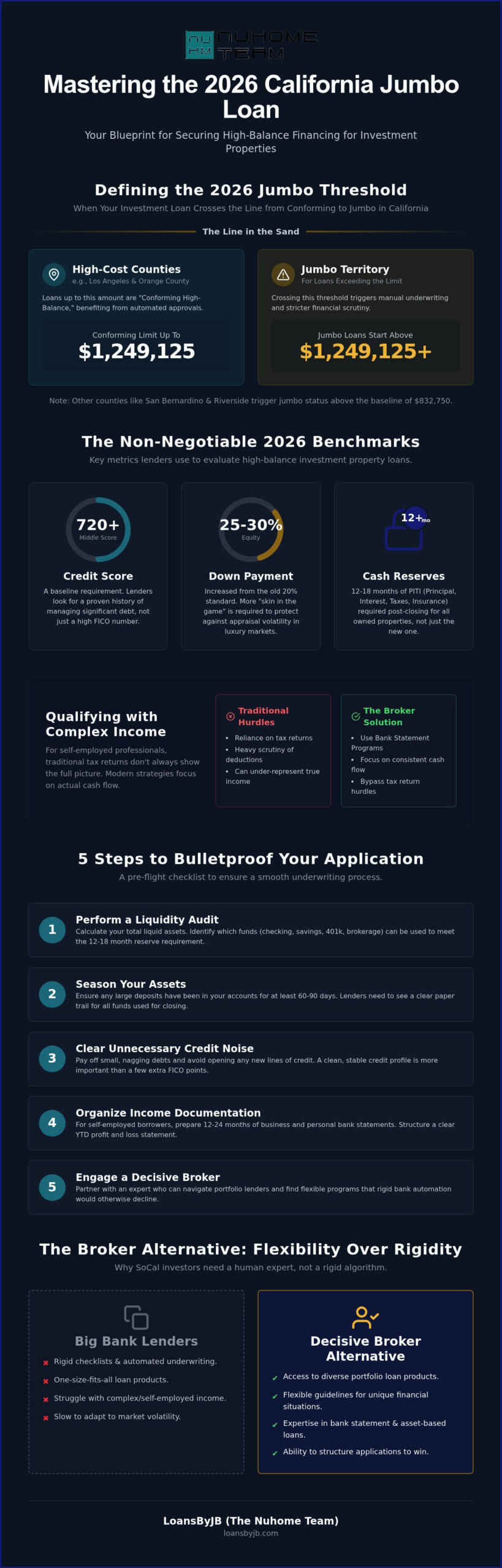
5 Steps to Bulletproof Your Jumbo Investment Application
For investors with US citizenship, navigating the complexities of American tax reporting for real estate is a vital step in maintaining this transparency; click here for specialized assistance.
Don’t fall for the “pre-approved in minutes” trap. That marketing fluff is designed for simple W2 loans, not the high-stakes world of high-balance rentals. Securing a jumbo loan for investment property California requires a tactical strike, not a hopeful guess—a level of strategic planning often mirrored in the analytical work of Rebellion Research. If your application isn’t airtight before it hits the underwriter’s desk, the deal will die in committee. You need a process that anticipates the hurdles of the 2026 market before they trip you up.
Execution is everything. You can start your full underwriting audit today to ensure your application stands up to the rigorous 2026 standards.
The 60-Day Rule for Large Deposits
Jumbo lenders scrutinize every dollar that enters your account like a forensic accountant. If you’re moving money from a business distribution or receiving gift funds, you must be ready to prove the source. Any deposit that isn’t a regular payroll check will trigger a request for more documentation. Paper trailing is the most critical part of the jumbo process because any “mystery money” will be disqualified from your available cash. Season your funds early. If the money isn’t in your personal account two months before you open escrow, you’re asking for a delay that could cost you the property.
Appraisal Strategy in High-Demand SoCal Markets
Appraisal “value gaps” are a constant threat in cities like Glendora and Rancho Cucamonga. When prices move fast, the comps often lag behind the contract price. If you’re already pushing a high LTV, a low appraisal can force you to bring significantly more cash to the table or kill the loan entirely. This is where local expertise is non-negotiable. A broker who understands the nuances of Downey or Upland comps can provide the underwriter with the right data to support the value. We don’t just order an appraisal; we manage the narrative of the property’s worth to protect your equity and your deal.
Why SoCal Investors Need a Decisive Broker Alternative
Big banks are built for the masses. Their automated systems are designed to process simple, W2 based applications at scale. When you approach them for a jumbo loan for investment property California, you’re trying to fit a complex, multi-entity business structure into a rigid, one-size-fits-all box. It doesn’t work. These institutions often fail precisely when the deal requires local nuance or an “investor lens” to see the true value in a high-balance rental. If your income comes from multiple K-1s or you’re managing a portfolio across Claremont and Downey, you need a partner who understands the math behind the wealth.
Navigating the high-balance limits in San Dimas or Rancho Cucamonga requires more than just a computer scan. It requires 25+ years of experience as a broker, lender, and investor. We know why portfolio lenders say “no” and, more importantly, we know how to structure the deal to get them to “yes.” We don’t just look at the current transaction; we help you customize carrying costs and exit strategies that build long-term wealth. Whether you’re planning a 30-year hold or looking for a Hard Money bridge for a speed-sensitive flip, the strategy must be decisive.
The LoansByJB Difference: A Real Conversation
We’ve moved past the staccato “yes/no” of traditional underwriting. At LoansByJB, we start with a real conversation about your goals. Justin Brown’s background as an investor means your application is built to pass the first time. We anticipate the underwriter’s questions before they’re asked. We don’t hide behind corporate pleasantries or slow-moving committees. We provide a decisive alternative to the big banks, focusing on results and street-smart relatability that actually moves the needle for your portfolio.
Your Southern California Jumbo Roadmap
Complex, multi-property scenarios are our specialty. If you’re tired of being sidelined by rigid financial institutions, it’s time for a different approach. We offer a personalized roadmap for investors who demand speed, accessibility, and insider knowledge. Stop wasting time with lenders who don’t speak your language. You can Start your jumbo investment strategy with LoansByJB today and secure the funding your California portfolio deserves.
Dominate the 2026 California Investment Market
Navigating the $1,249,125 high-cost ceiling in Los Angeles or Orange County isn’t just about finding a lender. It’s about finding an advocate who understands the math of high-balance real estate. You now know the benchmarks. A 720+ credit score, 25% down, and seasoned liquidity are your entry tickets. But the real edge comes from how you frame your story. Whether you’re self-employed with multi-entity income or a seasoned pro scaling a portfolio, your financial structure must be bulletproof before the underwriter ever sees it.
Securing a jumbo loan for investment property California requires more than a standard bank’s automated checklist. You need a decisive partner who applies an investor lens to every deal. With 25+ years of experience as a broker and investor, we specialize in Southern California high-balance markets (NMLS #1647915). We know how to navigate the rules to your advantage while the big institutions are still stuck in committee. Stop settling for rigid, slow-moving finance. It’s time to Structure your Jumbo Investment with a Rebel Expert. Your next high-balance acquisition is waiting. Let’s go get it.
Frequently Asked Questions
What is the minimum credit score for a jumbo investment loan in 2026?
The baseline credit score for a 2026 jumbo investment loan is 720. While some institutions advertise 700, those programs often collapse under the weight of high-balance rental underwriting. We look for tradeline depth and a history of managing significant debt. If you want the most competitive terms in Claremont or Upland, aim for a 740 middle score. This proves you have the financial stability to handle a complex portfolio.
How much down payment is required for a jumbo loan on a rental property?
You should expect to put 25% to 30% down for a high-balance rental property. The old standard of 20% rarely applies to a jumbo loan for investment property California in the current market. Lenders require this extra equity to buffer against appraisal volatility in luxury SoCal neighborhoods. More skin in the game translates to better interest rates and a smoother manual underwriting process for your next acquisition.
Can I use a DSCR loan instead of a jumbo loan for a California investment?
Yes, a DSCR loan is a powerful alternative if your tax returns are too complex for traditional jumbo underwriting. Instead of looking at your personal income or debt-to-income ratio, we focus on the property’s ability to cover its own debt. This strategy is ideal for investors in Rancho Cucamonga or Glendora who have high cash flow but low taxable income. It allows you to scale without the rigid documentation of a big bank.
How many months of cash reserves do I need for a jumbo mortgage?
Lenders typically demand 12 to 18 months of Principal, Interest, Taxes, and Insurance reserves. This requirement covers the new property and any other rentals in your portfolio. Don’t panic if you don’t have that much cash in a checking account. We can often use 401k or brokerage account balances to satisfy these liquidity rules, ensuring your capital stays invested while checking the lender’s boxes for post-closing stability.
What is the 2026 conforming loan limit for Los Angeles County?
For 2026, the FHFA conforming loan limit for a one-unit property in Los Angeles County is $1,249,125. Any financing amount that exceeds this ceiling is classified as a jumbo loan. This high-cost threshold also applies to most of Orange County. Knowing this line in the sand is critical for structuring your down payment and determining whether your application will face the scrutiny of manual portfolio underwriting instead of an automated system.
Can I qualify for a jumbo loan if I am self-employed?
Self-employed investors qualify by using an investor lens rather than a rigid W2 checklist. We specialize in using 12 to 24 months of bank statements to prove your actual cash flow. This approach bypasses the business write-offs that often lower your taxable income on standard returns. Whether you’re a business owner in Downey or a freelancer in San Dimas, we know how to document your wealth to win in the 2026 market. For a deeper look at the specific loan products available to you, explore the full breakdown of mortgage for self-employed borrowers that are outperforming traditional bank options in 2026.
Are jumbo loan interest rates higher for investment properties?
Jumbo interest rates for investment properties are generally higher than those for primary residences. Lenders view non-owner occupied debt as higher risk because investors are more likely to default on a rental during a market downturn. Because these are portfolio loans held on the lender’s own books, they include a risk premium. We help you offset this by locking in long-term stability through a 30-year fixed mortgage structure that hedges against inflation. If you already hold high-value California real estate, reviewing your options through a 2026 jumbo loan refinance strategy can help you reduce that risk premium and improve your overall portfolio returns.
How long does it take to close a jumbo investment loan in SoCal?
Closing a complex jumbo investment deal in Southern California typically takes 30 to 45 days. Manual underwriting is a forensic process that cannot be rushed by a simple algorithm. We prioritize a real conversation approach to identify potential hurdles like appraisal gaps or seasoning issues in the first week. This proactive strategy ensures your deal closes on time in competitive markets like La Verne or Claremont without any last-minute surprises.
Need the mortgage math checked?
Talk through the loan before you guess.
Use the estimator, request a refinance quote, or book a call with The Nuhome Team. We will help you compare the options that actually fit the file.
This is not a commitment to lend. Approval, terms, and pricing depend on credit, income, assets, property, and program guidelines.