

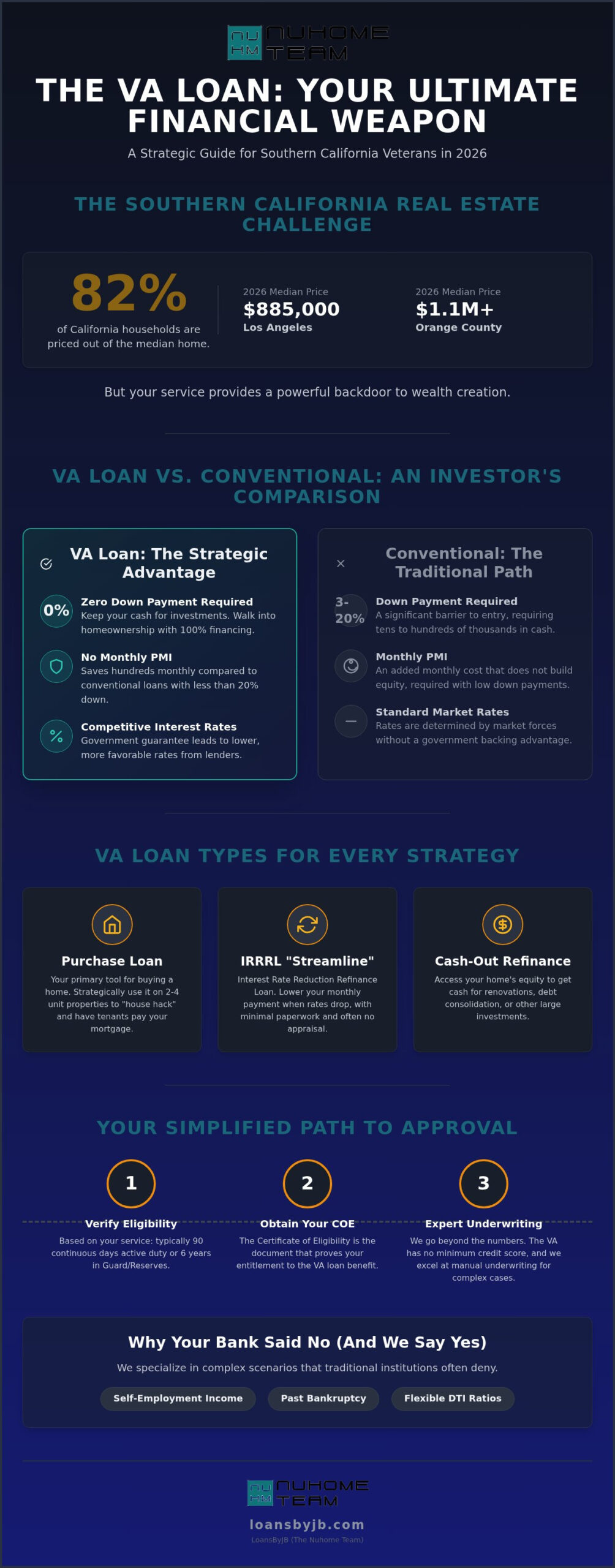
The va loan isn’t just a “thank you” for your service; it’s the single most powerful financial weapon in the Southern California real estate market. While 82% of California households are currently priced out of the median home, veterans have a backdoor to wealth that most investors would kill for. In 2026, the game has changed. Median prices in Los Angeles hit $885,000 and Orange County climbed past $1.1 million. You can’t afford to treat this benefit like a standard mortgage. It’s a strategic tool for building massive equity without the weight of a down payment or the drain of private mortgage insurance.
You’re likely tired of losing out to aggressive cash buyers or feeling sidelined by confusing entitlement rules and Tidewater appraisal delays. It’s frustrating to watch home prices soar while you’re stuck wondering if your self-employment income will even pass the test. This guide will show you how to master your benefit with an investor-focused lens. We’re going to break down the 2026 funding fees, explain how to bypass standard loan limits with full entitlement, and give you the exact blueprint to build long-term wealth in the Inland Empire and beyond.
Key Takeaways
- Transform your service benefit into a strategic wealth-building engine by using the va loan as a high-leverage investment tool.
- Master the 2026 high-balance limits to secure properties in premium Southern California neighborhoods without a massive down payment.
- Learn why the VA option beats conventional 30-year fixed mortgages for long-term cash flow and equity growth.
- Discover how to use multi-unit properties to offset your living expenses and jumpstart your real estate portfolio.
- Overcome self-employment income hurdles and rigid bank denials with a “rebel expert” approach to complex loan scenarios.
What is a VA Loan? The Gold Standard of Mortgage Benefits
Stop looking at this as just another mortgage. A VA loan is a $0-down mortgage option backed by the Department of Veterans Affairs. It’s designed specifically for Veterans, Active Duty service members, and eligible surviving spouses. In a market like Southern California where the median price has climbed past $900,000, this isn’t just a benefit. It’s an equalizer. Most buyers are scrambling for a massive down payment just to get a foot in the door. You’re walking in with 100% financing and terms that traditional banks can’t touch. It is the only 100% LTV (Loan-to-Value) product that makes sense in a volatile market. While others worry about market corrections, you’re leveraging the government’s guarantee to preserve your liquid cash for other investments. It’s the ultimate financial hedge for your future.
The Core Benefits of VA Financing
The math is simple. The va loan removes the two biggest hurdles to homeownership: capital and ongoing costs. Traditional lenders thrive on fees and insurance, but the VA program cuts through the corporate noise to keep your monthly carrying costs low.
- Zero Down Payment: You don’t need to liquidate your savings to buy a home in Claremont or Upland. Keep your cash in the bank or put it into high-yield assets.
- No Monthly PMI: Conventional loans with less than 20% down require Private Mortgage Insurance. VA loans don’t. That’s hundreds of dollars back in your pocket every month, increasing your purchasing power.
- Competitive Interest Rates: Because the VA guarantees a portion of the loan, lenders can offer rates that typically undercut standard 30-year fixed mortgage products.
VA Loan Types for Every Strategy
The flexibility of this program allows you to pivot based on your financial goals. Whether you’re buying your first home or scaling a portfolio, there’s a specific path for your situation. We don’t just look at the paperwork; we look at the long-term play.
- Purchase Loans: Use this for your primary residence. Smart veterans use it for 2-4 unit properties to “house hack,” letting tenants pay the mortgage while they build equity.
- IRRRL (Interest Rate Reduction Refinance Loan): This is the “Streamline” refinance. If market rates drop, you can lower your payment with minimal paperwork and often no appraisal.
If you’re a self-employed veteran, don’t let a traditional bank’s “no” stop you. We use an investor lens to look at your income differently, ensuring your service translates into real estate success in 2026.
VA Loan Requirements: Getting Your COE and Beyond
Don’t get bogged down in red tape. The VA Loan Requirements start with your Certificate of Eligibility (COE). It is the only document that proves you’ve earned the right to 100% financing. Service requirements are straightforward. If you’re active duty, you generally need 90 continuous days. For National Guard or Reserve members, it’s usually six years, though active-duty call-ups can shorten that window significantly. If you’ve served, you’ve earned the benefit. Now you just need to claim it.
The Certificate of Eligibility (COE) Process
Most veterans can pull their COE in minutes through the eBenefits portal. If your DD-214 is missing or there’s a clerical error, don’t panic. We handle these files daily. Your COE also details your entitlement. This is the dollar amount the VA guarantees. If you’ve used a va loan before, you might have partial entitlement left. We calculate exactly how much “bonus entitlement” you have for your next Southern California purchase so you can keep your cash in your pocket.
Underwriting Realities: Credit and Debt-to-Income
Big banks love to quote a “minimum credit score” of 620 or 640. Here is the truth: the VA itself doesn’t set a minimum score. Lenders do. If your score took a hit from a past bankruptcy or medical debt, you need a lender who understands manual underwriting. We look at the whole picture, not just a three-digit number. We’ve seen plenty of files that were “dead” at a retail bank get a clear to close in our office.
Debt-to-Income (DTI) ratios are another area where traditional institutions fail you. While they obsess over a 41% limit, the VA prioritizes Residual Income. Residual Income is the true measure of affordability for the VA. It ensures you have enough cash left over for gas, groceries, and life after the mortgage is paid. This flexibility is why the va loan often has lower foreclosure rates than conventional products despite the $0 down requirement.
Income verification is where most self-employed veterans hit a wall. If you’re running a business in Rancho Cucamonga or Upland, your tax returns might show heavy deductions that “lower” your qualifying income. We use a strategic lens to add back depreciation and non-cash losses. If you’re tired of being told your business makes you “unqualified,” it’s time for a real conversation about your actual buying power.
VA vs. Conventional: Applying the Investor Lens
Wealthy veterans often get bad advice. They’re told to put 20% down on a conventional loan to “save money.” That’s amateur thinking. The va loan is the ultimate leverage tool. If you put $200,000 down on a million-dollar Southern California property, that cash is dead. It’s trapped in the walls. Using your VA benefit allows you to keep that capital in a high-yield brokerage account or use it to buy a second investment property. The bank takes 100% of the risk while you maintain total control of your liquidity. It’s about how hard your money works for you, not how much of it you can bury in your backyard.
Carrying costs tell the real story. A standard 30-year fixed mortgage requires Private Mortgage Insurance (PMI) if you put down less than 20%. That’s pure waste. With a VA loan, PMI doesn’t exist. According to the U.S. Department of Veterans Affairs, the government guarantee replaces the need for borrower-paid insurance. This lowers your monthly nut and increases your cash flow from day one. When you compare the total out-of-pocket costs over the first five years, the VA option wins by a landslide every single time.
Total Cost Analysis: VA vs. FHA and Conventional
VA interest rates are consistently lower than conventional counterparts. As of August 2026, VA rates hover between 5.99% and 6.44%. This interest rate advantage compounds. Over three decades, you aren’t just saving on PMI; you’re paying significantly less in total interest. If you find a distressed property in Claremont that doesn’t meet VA’s strict “Minimum Property Requirements,” we might pivot. An FHA 203k loan allows you to wrap renovation costs into the mortgage. This creates a path to equity through forced appreciation that a standard purchase loan can’t offer. We analyze these numbers with you to ensure your loan matches your property strategy.
The Funding Fee Explained
The funding fee is the only real “cost” of the benefit. It’s a one-time hit, not a monthly drain. In 2026, the fee for first-time use with 0% down is 2.15%. Subsequent use jumps to 3.3%. If you have a service-connected disability rating of 10% or higher, you’re exempt. We often see veterans with Purple Hearts or those receiving VA compensation also qualify for this exemption. Most of our clients roll this fee into the loan balance. This preserves your liquidity. Paying a small percentage upfront to avoid a 20% down payment and monthly PMI is a trade any savvy investor makes. It keeps your cash working where it belongs: in your pocket.
Navigating the Southern California Market with a VA Loan
Southern California is a battlefield for buyers. Sellers in Claremont and Rancho Cucamonga often harbor a bias against the va loan, wrongly assuming it means a slow closing or picky inspectors. We crush that narrative. A well-positioned offer backed by a local expert who closes fast can beat cash every day of the week. We don’t just send a pre-approval letter. We call the listing agent and explain exactly why your file is bulletproof. Winning in this market requires a broker who knows the local comps and can speak the language of aggressive SoCal real estate.
House hacking is the ultimate wealth-building play for 2026. You can buy up to a 4-unit property with $0 down. Imagine living in one unit while three tenants pay your mortgage in Downey or San Dimas. You’re building massive equity in one of the most expensive markets on earth using other people’s money. While conventional investors are forced to put 25% down on multi-family homes, you’re entering the game with maximum leverage and zero out-of-pocket for the down payment. It is the fastest path to financial freedom in California.
High-Cost County Limits for 2026
If you have full entitlement, the VA doesn’t impose a loan limit. However, if you have partial entitlement from a previous purchase, the 2026 limits are your guide. In high-cost counties like Los Angeles and Orange County, the limit for partial entitlement is $1,249,125. For standard counties, it sits at $832,750. Navigating the “Jumbo” VA space requires a savvy insider who understands how to maximize your remaining entitlement. Veterans who have already built equity in a high-value property may also want to explore jumbo loan refinance rates in Southern California to unlock cash-out opportunities above these thresholds. We help you calculate exactly how much you can borrow before a down payment is required, ensuring you don’t leave any of your benefit on the table.
The VA Appraisal and Tidewater Initiative
VA Minimum Property Requirements (MPRs) are designed to protect you. They ensure the home is safe, sound, and sanitary. If the appraisal comes in lower than the contract price, we trigger the Tidewater process. This is a 48-hour window where the appraiser asks for additional data to support the value. We don’t just sit back and hope for the best. We proactively provide the most relevant comps from Claremont, Upland, and La Verne to keep your deal alive. We’ve saved countless transactions by knowing how to appeal an appraisal like a professional. Ready to stop renting and start owning? Get a strategic review of your VA buying power today.
Complex Scenarios: Why Your Bank Said No (And We Say Yes)
Big box lenders are built for W2 employees with simple lives. If you’re a veteran running a business in Southern California, you’ve likely hit a wall. They look at your tax returns, see your deductions, and tell you that you don’t make enough money. We don’t play that game. We look at your business through an investor lens to find the real income hidden by paper losses. If your bank said no, it’s usually because they don’t have the tools or the patience to handle a complex file. We do. A va loan can be approved even when traditional underwriting fails, provided you have a broker who knows how to present the facts.
Justin Brown doesn’t operate like a call center. With 25 years of experience, he specializes in the “real conversations” that retail banks avoid. We don’t just check boxes; we solve problems. Whether you’re dealing with multiple income streams or a unique property type, we find the path to “yes” while the big guys are still reading from a script.
Self-Employed and Non-QM Strategies
Income hurdles shouldn’t stop you from using your benefit. For veterans who own multiple businesses, we structure the file to highlight your actual cash flow. We add back depreciation and non-cash expenses that standard lenders ignore. Sometimes, the property itself is the hurdle. If you’re eyeing a distressed property in Upland that won’t pass a VA inspection today, we have a workaround. You can pivot to Hard Money to secure the asset and fund the repairs. Once the home meets Minimum Property Requirements, we refinance you into a permanent va loan. This strategy allows you to capture equity in fixer-uppers that other veterans can’t touch.
Multiple VA Loans: The “Move-Up” Strategy
Most people think you get one shot with your VA benefit. That is a myth. You can have two VA loans at the same time using second-tier entitlement. This is the ultimate wealth-building move in the Claremont and La Verne markets. You buy your first home, live in it for a year, and then turn it into a rental. You then use your remaining entitlement to buy your next primary residence with $0 down. You’re scaling a real estate portfolio using government-backed leverage. We calculate your “bonus entitlement” to ensure you’re maximizing your borrowing power without needing a massive cash injection. As your portfolio grows into higher price points, understanding your options for 2026 jumbo loan refinance rates becomes a critical part of your long-term strategy. It’s about playing the game at a higher level than the average buyer.
Claim Your Stake in the California Market
The Southern California real estate market is unforgiving, but your service has earned you a distinct advantage. The va loan remains the most effective way to secure a piece of this market with zero down payment and no monthly insurance costs. Whether you are eyeing a high-balance purchase in Orange County or a strategic multi-unit property in the Inland Empire, the math is clear. You can maintain your liquidity while building massive equity in one of the most stable housing markets in the world.
Don’t let a rigid retail bank tell you that your self-employment income or complex file is a deal-breaker. Justin Brown uses over 25 years of strategic mortgage experience to find solutions where others find obstacles. We provide the local Southern California expertise and the “real conversations” required to win in 2026. Stop overpaying and start leveraging; talk to Justin Brown today. You’ve already done the hard work of serving your country. Now it is time to make the market work for you.
Frequently Asked Questions
Can I use a VA loan to buy an investment property?
You can’t buy a pure investment property from day one, but you can house hack. The va loan requires you to occupy the home as your primary residence. However, you can buy a multi-unit property with up to four units, live in one, and rent out the others. After living there for a year, you can move out and turn the entire building into a rental asset.
What is the minimum credit score for a VA loan in 2026?
The Department of Veterans Affairs doesn’t set a minimum credit score; individual lenders do. While big banks often demand a 620 or higher, we look at the whole story. If you have a lower score but strong residual income, we can often find a path to approval. We specialize in complex files that traditional institutions in Rancho Cucamonga or Upland simply won’t touch.
How many times can I use my VA loan benefit?
Your benefit is for life. You can use it as many times as you want, provided you have remaining entitlement or have restored it by paying off a previous loan. It isn’t a one-time gift. Savvy veterans use the benefit repeatedly to move up into better homes in San Dimas or La Verne while building a portfolio of rental properties over time.
Does the VA loan cover closing costs?
The loan itself doesn’t cover closing costs, but you have strategic ways to avoid paying them out of pocket. You can negotiate for the seller to pay up to 4% of the purchase price toward your closing costs and prepaids. In a cooling Southern California market, this is a powerful tool to get into a home with literally zero dollars leaving your pocket at the closing table.
Can I have two VA loans at the same time?
Yes, you can have two active loans simultaneously through second-tier entitlement. This is a common move-up strategy. You keep your first home as a rental and buy your next primary residence with your remaining benefit. We calculate your “bonus entitlement” to show you exactly how much you can borrow for a second home in Glendora or Downey without needing a down payment.
Is there a maximum loan limit for VA loans in California?
If you have full entitlement, there is no official VA loan limit. You can borrow as much as your income allows. For veterans with partial entitlement, the 2026 limits apply. In high-cost counties like Los Angeles and Orange County, the limit is $1,249,125. In standard-cost areas, it is $832,750. We help you navigate these numbers to maximize your buying power without a down payment.
What are VA Minimum Property Requirements (MPRs)?
MPRs are standards that ensure a home is safe, sound, and sanitary. They cover essential items like a functional roof, working heat, and structural integrity. While some sellers think these are a hassle, they actually protect you from buying a property with hidden disasters. If a home in Claremont has minor issues, we often find ways to address them during the escrow process.
How long after a bankruptcy can I get a VA loan?
You don’t have to wait forever to own a home again. Generally, you can qualify for a va loan just two years after a Chapter 7 bankruptcy discharge. If you filed Chapter 13, you might be eligible after only 12 months of on-time payments with court approval. We focus on your current financial stability and residual income rather than dwelling on past credit hits.
Need the mortgage math checked?
Talk through the loan before you guess.
Use the estimator, request a refinance quote, or book a call with The Nuhome Team. We will help you compare the options that actually fit the file.
This is not a commitment to lend. Approval, terms, and pricing depend on credit, income, assets, property, and program guidelines.