

If you’re waiting for a big bank to approve your Southern California investment, you’ve already lost the deal to a cash buyer. In a market where Orange County single family homes hit $1.5 million in mid-2026, speed isn’t just a luxury. It’s your only leverage. Banks see complex income and freeze. They look at a property with massive potential and see a liability. You need a private money lender who understands that real estate moves faster than a committee meeting in a skyscraper.
We know the frustration of watching a perfect opportunity slip away because of a 45 day underwriting cycle. It’s exhausting to be sidelined by rigid rules that don’t apply to the real world of investing. This guide is your roadmap to taking back control. You’ll learn how to leverage private capital to close complex deals in a fraction of the time banks require. We’re breaking down the 2026 lending landscape, including current SoCal rate trends and the specific strategies you need to scale your portfolio using flexible, fast-moving debt.
Key Takeaways
- Stop losing deals to cash buyers by understanding how a private money lender prioritizes property potential over your tax returns or credit score.
- Discover the critical difference between institutional hard money and relationship-based private capital to choose the right funding for your specific exit strategy.
- Master the “Bridge to Perm” tactic to secure distressed Southern California properties quickly before transitioning into stable, long-term financing.
- Focus on equity and asset value to bypass the rigid debt-to-income ratios and “straight-jacket” rules that typically kill bank loans.
- Leverage local market expertise from Claremont to the San Gabriel Valley to navigate 2026’s competitive landscape with speed that traditional banks can’t match.
What is a Private Money Lender and Why Banks Are Failing You
Banks are built for the average person with a W2 and a white picket fence. If you’re a Southern California investor, that’s rarely you. A private money lender provides capital from non-institutional sources, secured by real estate. It’s a faster, more agile alternative to the slow-motion bureaucracy of traditional lenders. To understand the mechanics of this asset class, you can research What is Private Money Investing for a deeper look at the industry structure.
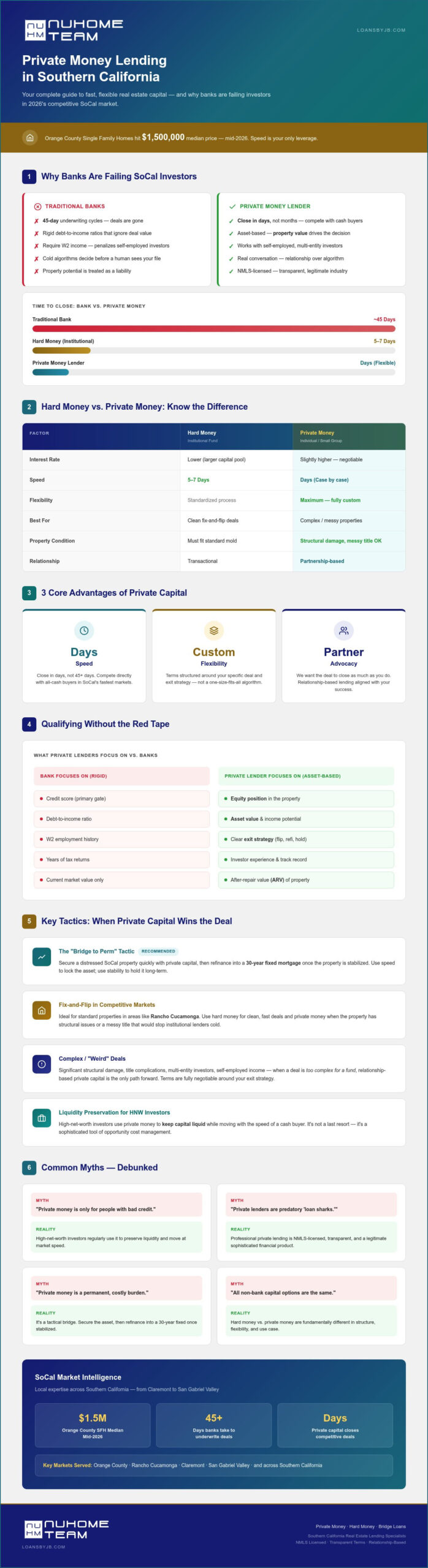
Traditional institutions are drowning in red tape. They prioritize credit scores and rigid debt-to-income ratios over the actual value of the deal. If you’re self-employed or operate through multiple entities, you’ve likely felt the sting of a bank rejection. They don’t understand your business model. We do. Private money isn’t a long-term weight around your neck; it’s a tactical bridge. You use it to secure the asset, then refinance into a 30-year fixed mortgage or sell for a profit once the property is stabilized.
The Core Difference: Relationship vs. Algorithm
Banks use cold algorithms to say “No” before a human even sees your file. A private money lender uses a real conversation to find a way to “Yes.” We evaluate the property’s potential to generate income rather than just staring at your tax returns. This asset-based approach means the property is the star of the show. Private money is a strategic tool for opportunistic acquisitions that require immediate execution.
Common Misconceptions About Private Capital
Don’t believe the myths. Many people think private capital is a last resort for borrowers with bad credit. That’s simply wrong. In reality, high-net-worth investors use these loans to keep their liquidity and move with the speed of a cash buyer. It’s about opportunity cost, not desperation.
Another common fear is the “loan shark” label. Professional private lending is a legitimate, transparent industry. We operate with clear terms and maintain NMLS licensing to ensure borrower protection. You’re not getting a back-alley deal; you’re getting a sophisticated financial product designed for speed. Consider these advantages:
- Speed: You close in days, not months.
- Flexibility: We look at the deal, not just the paperwork.
- Advocacy: We want the deal to close as much as you do.
Private Money vs. Hard Money: Decoding Your Capital Options
Don’t fall for the trap of thinking all non-bank capital is the same. Most people claim hard money and private money are identical. They aren’t. Hard money usually refers to institutional-grade capital backed by large lending funds. A private money lender, however, is often an individual or a small group of high-net-worth investors. Understanding this distinction is the key to choosing the right tool for your specific deal. For a foundational perspective on why investors are shifting toward these options, refer to this Guide to Private Lending for Real Estate. For those diversifying their portfolio into the Southwest, Applewood Funding Inc is a strategic resource for hard money and alternative mortgage solutions in Arizona.
The choice between these two options comes down to three factors: speed, cost, and the “messiness” of the property. Hard money often comes with lower interest rates than individual private money because it’s backed by a larger pool of capital. However, private money offers a level of human flexibility that a fund simply cannot match. It is the difference between a mass-produced tool and a custom-built solution. One is for speed; the other is for survival in a complex market.
Hard money is built for volume and velocity. These lenders use standardized processes to move files through underwriting in as little as 5 to 7 days. It’s the ideal choice for standard fix-and-flip projects in competitive areas like Rancho Cucamonga where the property fits a specific mold. You trade a bit of flexibility for absolute institutional reliability. If the deal is “clean” but needs to close yesterday, hard money loans are your best bet. They offer a predictable path to the closing table when time is the enemy.
When Private Money Offers the Ultimate Flexibility
Sometimes a deal is too “weird” for a fund. Maybe the property has significant structural damage, or the title is messy. This is where a private money lender shines. Because you’re dealing with relationship-based capital, the terms are negotiable. You can structure the debt based on your specific exit strategy rather than fitting into a fund’s box. This capital can even be layered with other products like DSCR loans to help you scale without the burden of personal income verification. If your scenario is complex, you need an advisor who knows how to optimize your loan structure for maximum profit.
Tactical Scenarios: When Private Capital Wins the Deal in SoCal
Southern California real estate is a high-stakes battlefield. If you’re eyeing a distressed property in Rancho Cucamonga or San Dimas, you don’t have the luxury of a 45 day bank escrow. A private money lender gives you the ability to strike while the iron is hot. You close in days, not months. This isn’t just about securing debt; it’s about having the tactical speed to win the deal before your competition even gets a call back from their loan officer.
The Quick Close: Beating Cash Buyers
Speed is your most powerful negotiating lever. In aggressive markets like Downey, a multi-family unit might hit the MLS and vanish within 48 hours. A pre-approval letter from a private source carries the same psychological weight as a cash offer. Sellers want certainty and a clean exit. While other investors are stuck waiting on bank appraisals and rigid committee approvals, you’ve already cleared the inspection. Use this speed to negotiate a lower purchase price. You’re solving the seller’s problem of time, and they’ll often reward you with a price discount that more than covers the cost of the capital.
The “Bridge to Perm” strategy is the gold standard for savvy local investors. You use private capital to secure the asset fast, then immediately pivot once the property is stabilized. After you’ve added value, you refinance into a 30-year fixed mortgage to lock in long-term stability. This approach allows you to scale your portfolio without tying up your own liquid cash for years in a single project.
ADU Construction and Density Maximization
The housing shortage in Southern California has turned Accessory Dwelling Units (ADUs) into a primary wealth-building tool. Traditional lenders often struggle to value unfinished construction or the potential of a backyard build. They can’t see the income potential of a new unit in Glendora or Upland. Private capital looks through an “investor lens” that prioritizes future value. You can use these funds for the heavy rehab phase, then transition into an FHA 203k loan or a similar product once the unit is income-producing and the equity is realized.
Every day a property sits empty in Upland, your carrying costs eat your profit. Bank delays are often more expensive than the higher rate of a private loan when you factor in lost rent and mounting taxes. Calculate the cost of the “deal you didn’t get” versus the cost of the capital. In SoCal, the math almost always favors the investor who can close the fastest and maximize the density of the lot.
Qualifying Without the Red Tape: The Investor’s Checklist
Banks want a mountain of paperwork. They want three years of tax returns, a perfect credit score, and a W2 that never fluctuates. We want a profitable deal. When you work with a private money lender, the asset is the star of the show, not your personal financial history. We prioritize the property’s potential and your plan to execute it. This doesn’t mean there are no rules; it means the rules actually make sense for an investor. If the property has the value and you have the vision, the capital is there.
Equity is the foundation of every private loan. While banks might push for high leverage, the sweet spot for private capital in Southern California is typically between 65% and 75% Loan-to-Value (LTV). This protective layer of equity ensures that both the borrower and the lender are insulated against market shifts. Your experience also plays a massive role. If you have a proven track record of flipping houses in Claremont or managing multi-family units in Downey, that history reduces the perceived risk. Experienced investors often secure better terms because they’ve proven they know how to navigate the local landscape.
The ‘Investor Lens’ Underwriting Process
We look at deals differently than a retail bank. Our underwriting process uses an “investor lens” to evaluate property carrying costs, ensuring the debt doesn’t bleed the profit out of your project. A real conversation about the property’s potential is worth more to us than an automated credit check. We want to know the After Repair Value (ARV) and how you intend to reach it. In this environment, your exit strategy is the most critical part of a private loan application. Whether you plan to sell the property or refinance into long-term debt, a clear path to repayment is what gets the deal funded. Self-employed investors who have been turned away by banks may also benefit from exploring non-qm loans, which use bank statements and alternative income documentation to qualify borrowers that traditional underwriting ignores.
Vetting Your Private Money Lender
Not every lender is a partner. You need to protect your deal by vetting who you work with. Watch out for red flags like upfront “application fees” or “processing fees” demanded before you even see a term sheet. Legitimate lenders earn their keep when the deal closes, not by nickel-and-diming you at the start. Verification is simple but essential. Check their NMLS status and ask for local Southern California references. Transparency is non-negotiable. You should demand a clear breakdown of points, interest, and any potential junk fees before signing anything. If you’re ready to move past bank rigidity, you can see how we structure loans to help you win.
LoansByJB: Your Southern California Guide to Private Money
Justin Brown has spent 25 years watching traditional banks fail the very people they should be serving. He didn’t build LoansByJB to be another rigid institution. He built it to be the straight-shooter alternative for investors who are tired of being sidelined. We move beyond the straight-jacket rules that treat every borrower like a number. As a private money lender with deep roots in Claremont, La Verne, and the San Gabriel Valley, we understand the local dirt. We don’t just fund deals; we provide the street-smart strategy required to win them.
Our approach is proactive. We act as your rebel expert in a market that often feels rigged against the self-employed or the complex scenario. We don’t hide behind layers of management. You get professional authority combined with relatability. We know the nuances of the SoCal market better than any impersonal, national entity. It’s time to stop waiting for a bank committee to decide your future. Start the conversation that actually gets you funded.
Why Experience Matters in a Volatile Market
Market cycles are predictable if you’ve seen enough of them. Justin Brown’s 25-year legacy means we’ve seen the highs, the lows, and everything in between. This depth of knowledge allows us to structure loans that actually close, even when the broader market feels unstable. We are dedicated advocates for the sidelined borrower. If a bank rejected you because of complex income, we see that as a reason to look closer, not to walk away. You won’t find any call centers here. You get direct consultation with experts who value your time and your results.
Next Steps: Get Your Term Sheet Today
We’ve stripped away the bureaucracy to create a high-speed path to capital. Our process is methodical but brisk. You provide the details; we provide the solution. To get started, have these three things ready: your property address, a realistic estimated value, and a clear exit plan. Whether you are bridging to a long-term mortgage or preparing for a quick flip, we need to see how you win. Don’t let another deal slip away because of slow financing. Start your private money application with the Nuhome Team and take control of your investment portfolio today.
Secure Your Next SoCal Deal Before the Competition Wakes Up
You’ve seen how the right private money lender acts as a strategic partner rather than just a source of debt. By focusing on the asset’s potential and utilizing the “investor lens,” you can bypass the rigid algorithms that stall traditional banks. Whether you’re executing a high-speed flip in Downey or maximizing density with an ADU in Claremont, speed is your primary leverage. This isn’t just about borrowing money; it’s about having the tactical agility to win in a market that doesn’t wait for committee meetings.
Justin Brown brings over 25 years of real estate investing and lending experience to your transaction. As an NMLS licensed broker (#1647915) and a local Southern California expert, he understands that a deal’s success depends on execution, not just paperwork. It’s time to stop letting bank bureaucracy dictate your portfolio’s growth. Get a Term Sheet in 24 Hours – Talk to Justin Brown. Take the lead, move with confidence, and close your next deal on your own terms. Your future portfolio will thank you.
Frequently Asked Questions
Is a private money lender different from a hard money lender?
Yes, though the terms are often used interchangeably in casual conversation. Hard money typically refers to institutional-grade capital from large, established lending funds with standardized underwriting rules. A private money lender is usually an individual or a small group of high-net-worth investors. This relationship-based capital offers more flexibility for “outside the box” properties that rigid funds won’t touch. Hard money is built for volume; private money is built for specific, complex scenarios.
What are the typical interest rates for private money in 2026?
In mid-2026, California private capital rates generally range from 9% to 15%. Most local investors find deals landing between 10% and 13% for first-position loans. You should also expect origination fees, or “points,” to fall between 2 and 5 points. These rates reflect the speed and risk of the transaction. They act as a short-term bridge rather than a long-term debt burden for your Southern California investment portfolio.
Do I need a high credit score to qualify for a private loan?
No, a perfect credit score isn’t the primary requirement for this type of funding. While we check credit to understand your financial history, we prioritize the property’s value and your equity position. A private money lender focuses on the asset’s potential. If the deal has a strong After Repair Value and a clear exit strategy, we can often overlook past credit hiccups that would trigger a rejection from a bank.
How fast can a private money lender actually close a deal?
We can often close a deal in 5 to 10 business days. Traditional banks usually take 30 to 45 days because of appraisal delays and internal committee reviews. In competitive markets like Rancho Cucamonga or Downey, this speed allows you to compete directly with cash buyers. We move at the pace of the market. This ensures you don’t lose a distressed property while waiting for a bureaucrat to sign a form.
Can I use private money for a primary residence in California?
Generally, no. Most private money is strictly for business-purpose loans, meaning investment properties you don’t intend to live in. Federal and state regulations like the Truth in Lending Act apply heavily to consumer primary residences, which slows down the process. While there are rare exceptions for bridge loans, most lenders in this space focus on fix-and-flips, rentals, or commercial projects to stay within business-purpose exemptions and maintain speed. For companies requiring broader support, Black Onyx Corporation, LLC offers professional business and commercial financing solutions.
The sweet spot for private capital is typically 65% to 75% Loan-to-Value (LTV). In early 2026, the average LTV for private loans in California was 67%. This ensures there is enough skin in the game to protect both the borrower and the lender. While some lenders may go higher for experienced flippers with a proven track record, maintaining a solid equity position is the standard for securing fast, reliable funding.
Are there prepayment penalties on private money loans?
Some private loans include a minimum interest requirement, often three to six months, rather than a traditional long-term penalty. This ensures the lender receives a baseline return for the work of setting up the loan. However, because these are short-term tactical tools, many structures allow you to pay off the balance as soon as you sell or refinance. Always demand a clear breakdown of these terms before signing your term sheet.
What happens if I can’t refinance out of the private loan on time?
You need to communicate with your private money lender immediately if your exit strategy stalls. California foreclosure regulations in 2026 have increased borrower protections, requiring lenders to engage in outreach. However, we prefer a performing loan over a foreclosure. We can often discuss extensions or loan modifications if you have a viable plan to finish the project or sell the asset, but proactive communication is non-negotiable for a resolution.
Need the mortgage math checked?
Talk through the loan before you guess.
Use the estimator, request a refinance quote, or book a call with The Nuhome Team. We will help you compare the options that actually fit the file.
This is not a commitment to lend. Approval, terms, and pricing depend on credit, income, assets, property, and program guidelines.