

The 30-year mortgage is the most expensive product you will ever buy, yet it is the only one banks go out of their way to sell you. Why? Because it keeps you in debt longer and often doubles the total cost of your home through interest alone. It is time to stop playing their game. A 15 year fixed mortgage isn’t just a loan; it’s a high-yield savings vehicle masquerading as debt. If you feel like you’re making zero progress on your principal while interest eats your wealth, you’re right to be frustrated.
You deserve to actually own your home, not just lease it from a lender for three decades. This guide will show you how to stop overpaying and build massive equity faster with a strategic 15 year fixed mortgage. We’re going to dive into how you can pay off your property in half the time and save six figures in total interest. You will learn the specific math behind rapid equity growth and how to secure a debt-free retirement years ahead of schedule. It’s time to take control of your balance sheet and stop being the bank’s favorite customer.
Key Takeaways
- Learn why the 180-month amortization schedule is a strategic weapon that front-loads your equity from day one.
- See the math behind saving six figures in total interest by avoiding the common 30-year debt trap.
- Discover if you have the credit and income profile to qualify for a 15 year fixed mortgage at the most competitive 2026 rates.
- Evaluate the “Cash Flow vs. Equity” trade-off to determine if your financial goals align with a faster path to absolute ownership.
- Leverage an investor-focused lens to structure your financing for maximum long-term leverage and a clear exit strategy.
What is a 15-Year Fixed Mortgage? Cutting Through the Fluff
Banks love the 30-year loan for one reason: it’s profitable for them. They collect interest for three decades while you barely touch the principal in the early years. A 15 year fixed mortgage flips the script and puts the power back in your hands. It is a financial contract that locks your interest rate and monthly payment for exactly 180 months. This is the fastest path to 100% equity for homeowners who prioritize long-term wealth over the illusion of monthly cash flow. It is a straight-shooter’s tool designed to kill debt before it kills your retirement plans.
The Core Mechanics: Rate vs. Term
The math is simple but brutal for the lenders. Lenders typically offer 15-year rates that are 0.5% to 1% lower than their 30-year counterparts. You are less of a risk when you’re paying off the debt in half the time, and the market rewards that. This shorter term forces a massive percentage of every dollar directly toward your principal from day one. In a volatile 2026 economy, the certainty of a fixed rate is your best defense against inflation and market swings. Understanding what is a fixed-rate mortgage helps you see that while the housing market fluctuates, your path to absolute ownership remains locked. You aren’t just paying a monthly bill; you’re buying back your freedom with every check you write.
15-Year Fixed vs. 30-Year Fixed: The Quick Look
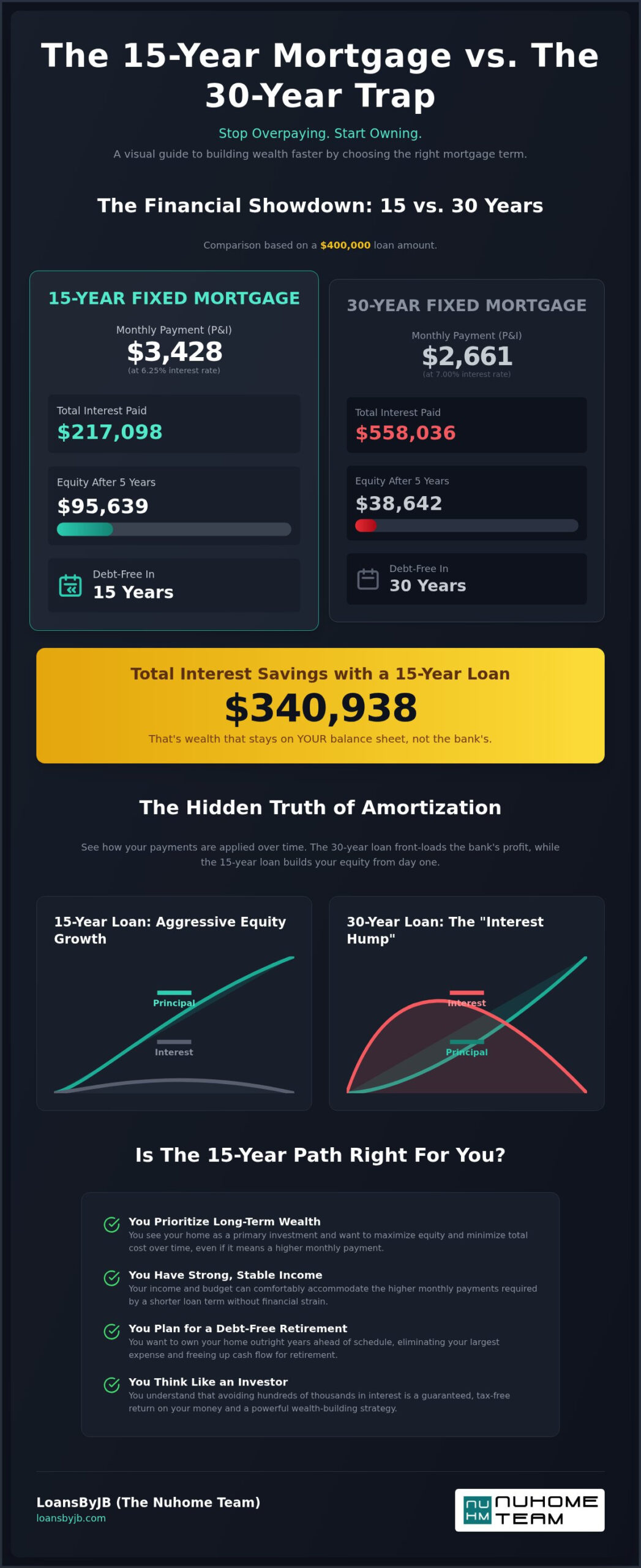
Most borrowers look at the monthly payment and stop there. That is a massive mistake. The “savings” on a 30-year payment is often a mirage that disappears when you calculate the total interest paid over the life of the loan. On a standard $400,000 mortgage, the interest difference between these two terms can easily exceed $200,000. Consider the speed of your progress:
- Equity Build-up: In the first five years, a borrower with a 15 year fixed mortgage has often built three times the equity of a 30-year borrower.
- Interest Ratios: You stop funding the bank’s skyscrapers and start funding your own future immediately.
- Total Cost: You own the home outright in 15 years, not 30. That is 15 years of zero housing payments to fuel your next investment.
Choosing this path requires discipline because the monthly commitment is higher. However, the reward is total ownership in half the time. It is the ultimate move for those who are tired of making progress in inches and want to start taking miles.
The Math of Interest: Why 15 Years Crushes the 30-Year Trap
A 30-year loan is effectively a 100% markup on your home price. You buy one house for yourself and another for the bank. It’s a trap designed to keep you in a cycle of perpetual interest payments while your principal balance barely moves. By choosing a 15 year fixed mortgage, you decide to stop being a profit center for your lender. On a $400,000 mortgage, switching to a 15-year term can save you over $200,000 in total interest. That isn’t just “savings.” It’s reclaimed wealth that stays on your balance sheet instead of the bank’s.
The “Interest-to-Principal” ratio is where the real battle is won. On day one of a 30-year loan, almost your entire payment goes toward interest. You’re renting the money, not owning the asset. With a 15-year term, more of your money stays in your pocket as equity from the very first payment. As the CFPB notes, a shorter loan term generally means lower interest rates and significantly less total cost over time. This structure acts as a forced savings account with a guaranteed, tax-free return on your investment.
The Investor Lens: ROI on Your Mortgage
Savvy investors don’t just look at monthly cash flow; they look at the total cost of capital. Interest avoidance is a tax-free return on investment. In the volatile market of 2026, finding a guaranteed 6% or 7% return is rare. Your 15 year fixed mortgage provides exactly that by eliminating interest expense. Investors use these shorter terms to create “free and clear” cash flow faster. Instead of waiting three decades to see the full profit from a property, they own it outright in 15 years. Once that equity is built, smart investors know that a second mortgage can unlock that home equity without disturbing the original low rate on their primary loan. If you want to see how this fits your specific portfolio, you can evaluate your options here.
Amortization Schedules: The Hidden Truth
The 30-year amortization schedule features a massive “interest hump.” You pay nothing but bank profit for years before your principal balance starts to move. A 15-year schedule is an aggressive downward slope. Borrowers in 2026 are choosing shorter terms to hedge against inflation. Why? Because equity is a real asset. Paper money loses value, but a paid-off home is a fortress. You’re building a pile of bricks, not a pile of receipts. Stop funding the bank’s dividends and start funding your own legacy.
Cash Flow vs. Equity: Deciding Which Master You Serve
Every dollar in your budget has a job. You just have to decide who it works for. Choosing a 15 year fixed mortgage requires a straight-shooter approach to personal finance that prioritizes long-term net worth over monthly breathing room. It is a choice between having more money to spend today or having absolute freedom tomorrow. If you value certainty, this is your play. If you prefer to keep your options open, you might find the higher commitment restrictive. It is about deciding which master you serve: your current lifestyle or your future self.
The trade-offs are clear and unforgiving. Before you commit, you should use a calculator to determine what type of mortgage works better for your specific goals. While the interest savings are massive, you must account for the higher Debt-to-Income (DTI) bar lenders set for these loans. Consider these factors:
- The Pros: You snag the lowest possible rates; you build equity at a blistering pace; you hit a debt-free date in half the time.
- The Cons: Your monthly payment is significantly higher; you have less liquid cash for emergency repairs or other investments; your DTI ratio becomes much tighter.
- The Psychological Win: There is an unquantifiable peace of mind that comes with knowing you actually own the dirt beneath your feet.
The Case for the 30-Year (And Why We Might Disagree)
Many advisors claim “cash flow is king.” They argue that a 30-year loan gives you the flexibility to manage a tight budget or scale a real estate portfolio faster. The common wisdom is to take the 30-year loan and “invest the difference” in the stock market. In the market volatility of 2026, that argument is getting harder to defend. Most people don’t actually invest the difference. They spend it on depreciating assets or lifestyle creep. A 15 year fixed mortgage removes the temptation to waste that capital. It forces you to build wealth every single month without fail.
The Case for the 15-Year: Aggressive Wealth Building
This path is ideal for high-earners who want to set their finances on autopilot. It is also the perfect tool for late-start retirement planning. If you are 50 years old and just buying a home, a 30-year mortgage is a recipe for carrying debt into your 80s. A 15-year term ensures you cross the finish line with a paid-off asset. By locking in your standard of living now, you ensure that your biggest monthly expense disappears right when you need that income the most. You aren’t just buying a house; you’re buying a decade and a half of retired life free from the bank’s reach.
Qualifying for the Higher Bar: Ready for 15-Year Pace?
Getting approved for a 15 year fixed mortgage is the varsity level of home financing. It is not for everyone. Because the monthly payments are significantly higher than a standard 30-year term, the bank’s scrutiny is significantly deeper. Your Debt-to-Income (DTI) ratio will be the first thing to feel the squeeze. A payment that looks comfortable on a long-term schedule can suddenly push your DTI past the qualifying limit on a 15-year term. You need a rock-solid income profile and a lean list of existing debts to clear this hurdle.
Credit scores matter more here than anywhere else. To snag the most competitive 2026 rates, which currently average between 6.0% and 6.11%, you generally need top-tier credit. If your score is below 740, the interest rate gap between terms starts to close. At that point, you are taking on a much higher payment without receiving the full interest-saving benefit. LoansByJB looks through an investor lens to find qualifying income that traditional banks often ignore. We focus on the strength of the asset and your total financial picture rather than just a single box on a tax return.
Cash reserves are your safety net. Committing to a 15 year fixed mortgage without a healthy war chest is a high-risk move. We recommend having a clear view of your liquidity before applying. Consider these three pillars of qualification:
- The DTI Threshold: Aim for a total debt ratio below 43% to account for the higher payment.
- The Credit Tier: Maintain a 740+ FICO to ensure you actually get the lower rate you’re chasing.
- The Reserve Fund: Keep six to twelve months of carrying costs in liquid accounts.
This ensures that a temporary job change or a major repair doesn’t turn your wealth-building weapon into a financial anchor. If you want to see if your profile meets the mark, you can check your qualifying income with our team today.
Self-Employed and Investor Hurdles
Big banks are built for W-2 employees with simple lives. If you are self-employed or a professional investor, your tax returns are likely a maze of write-offs and complex structures. Standard underwriters often see these as red flags. We see them as strategy. We specialize in navigating high-balance and complex loan structures that big banks reject. Whether it is using asset depletion or other non-QM strategies, we find ways to document your true buying power. Understanding why use a mortgage broker instead of a bank becomes especially clear when your income profile is complex and a traditional lender’s algorithm simply can’t see your full financial picture. An experienced broker is a requirement, not an option, for high-balance loans in this environment.
Beyond traditional brokerage, if your investment plan requires quick, specialized funding for real estate acquisitions, you can check out Jet Lending, LLC for tailored loan products.
The 2026 Underwriting Environment
The 2026 market is defined by volatility and rising carrying costs. Conforming loan limits have increased to $832,750 for one-unit properties, which gives you more room to run, but the standards for approvals remain tight. You must stress test your own budget. Factor in the reality that property taxes and insurance premiums are not static. They will go up. Your strategy only works if you can maintain the pace regardless of what the broader economy does. We help you look past the initial approval to ensure the loan fits your ten-year exit strategy.
Strategic Financing with LoansByJB: Moving Beyond the Bank
Banks see you as a data point on a spreadsheet. They pull your credit, verify your income, and shove you into whatever product is easiest for their automated underwriters. That is not a strategy; it is an assembly line. At LoansByJB, we do things differently. We start with a real conversation about your exit strategy before we ever talk about rates. A 15 year fixed mortgage is a heavy-duty financial instrument. It requires a specific plan. Are you building a legacy for your children? Are you looking to eliminate your largest monthly expense before a career change? We need to know where you are going so we can build the right vehicle to get you there.
We customize loan structures for residential, investment, and jumbo scenarios that leave traditional lenders scratching their heads. Our advantage is simple. We have 25 years of experience as brokers, lenders, and investors. We are rebel experts who understand the rules well enough to know exactly how to navigate them for your benefit. We have seen every market cycle and handled the most complex income scenarios. If you are ready to stop overpaying for your home, it is time to run the math on your specific property. We don’t just offer loans; we offer a way out of the 30-year debt cycle.
The LoansByJB Process: Speed and Strategy
Corporate red tape is where good deals go to die. We bypass the slow, rigid bureaucracy of traditional lenders by using a personalized, non-bank approach to underwriting. Justin Brown and the Nuhome Team act as your protective guides through the entire process. You won’t find yourself stuck in a call center menu or waiting days for an email reply. We focus on results and immediate clarity. Closing fast is our priority because every month you spend in a 30-year trap is a month of wasted interest. We move at the speed of your ambition so you can start building equity today.
Your Next Move: Lock in Your 15-Year Rate
The 2026 economy doesn’t wait for the indecisive. Rate volatility is a reality, and the best opportunities disappear quickly for those who hesitate. A 15 year fixed mortgage is the ultimate power move for anyone tired of the status quo. You need a clear plan of action to secure your financial future. Follow these steps to take control:
- Step 1: Get a clear picture of your current equity and your long-term wealth goals.
- Step 2: Connect with a LoansByJB advisor for a custom scenario that fits your specific income profile.
- Step 3: Execute the strategy and start your 180-month countdown to absolute financial freedom.
Ownership is the only way to insulate yourself from market swings and inflation. Don’t let the banks convince you that carrying debt for 30 years is normal. It is time to execute your exit strategy and own your future outright.
Own Your Future Instead of Leasing It
The 30-year mortgage is a product designed for the bank’s bottom line, not your personal balance sheet. Choosing a 15 year fixed mortgage is the most effective way to kill debt and build massive equity before you hit retirement. You now understand that interest avoidance is a guaranteed, tax-free return on your investment. It is the ultimate power move for those who value absolute ownership over temporary cash flow.
LoansByJB offers the 25+ years of experience and investor-focused strategy you need to bypass corporate red tape. With our national coverage, we specialize in helping self-employed and high-balance borrowers who are ready to move beyond standard bank limitations. We don’t just close loans; we execute wealth strategies. Stop overpaying interest; get your custom 15-year quote here.
The 180-month countdown to your financial freedom starts the moment you decide to stop being the bank’s favorite customer. Take the first step today and secure the legacy you have worked to build. You have the tools; now it is time to use them.
Frequently Asked Questions
Is a 15-year fixed mortgage better than a 30-year fixed?
It is better if your goal is absolute ownership and massive interest savings. While the 30-year loan offers lower monthly payments, the 15 year fixed mortgage ensures you own your home in half the time. You avoid the “interest hump” where the bank takes all the profit while your principal balance remains stagnant.
How much higher is the payment on a 15-year mortgage vs. a 30-year?
Expect a monthly payment that is roughly 40% to 50% higher than a 30-year loan for the same amount. You are compressing 30 years of principal repayment into 15. This higher monthly commitment is the price of total financial freedom and a significantly lower interest rate.
Can I pay off my 30-year mortgage in 15 years instead of refinancing?
You can make extra principal payments on a 30-year loan to match a 15-year schedule. This provides flexibility if your income fluctuates. However, you will still be stuck with the higher 30-year interest rate. Refinancing locks in the lower 15-year rate and forces the discipline required to build wealth.
What are the current 15-year fixed mortgage rates for 2026?
As of August 2026, national averages for a 15 year fixed mortgage range from 6.0% to 6.11%. These rates are historically 0.5% to 1% lower than 30-year rates. Your specific rate will depend on your credit score, down payment, and the specific lender’s underwriting criteria.
Do I need a higher credit score for a 15-year fixed mortgage?
You don’t strictly need a higher score to qualify, but you need top-tier credit to secure the best rates. Aim for a 740 FICO or higher. Without a strong score, the interest rate advantage over a 30-year loan starts to disappear, making the higher payment less beneficial.
Can I get a 15-year fixed mortgage if I am self-employed?
Absolutely. Self-employed borrowers just need a lender who knows how to read complex tax returns and navigate write-offs. We use an investor lens to find your true qualifying income. Big banks might reject your complex scenario, but we find the path to secure your shorter term.
Is it worth refinancing from a 30-year to a 15-year mortgage now?
It is worth it if you can lower your interest rate and afford the higher monthly commitment. Refinancing now could save you over $200,000 in total interest over the life of the loan. This is a strategic move to reclaim 15 years of your financial life from the bank.
What happens if I can’t make the higher 15-year payment one month?
Missing a payment has the same consequences as any other loan, including late fees and credit damage. This is why we recommend keeping six to twelve months of cash reserves. You must be certain your budget can handle the aggressive pace before you commit to this wealth-building weapon. If you ever find yourself equity rich but needing liquidity, a second mortgage can help you access your home equity without sacrificing your existing low rate.
Need the mortgage math checked?
Talk through the loan before you guess.
Use the estimator, request a refinance quote, or book a call with The Nuhome Team. We will help you compare the options that actually fit the file.
This is not a commitment to lend. Approval, terms, and pricing depend on credit, income, assets, property, and program guidelines.