

What if your “denied” letter from a big bank is actually the best thing that could happen to your home search? In 2026, the gap between a standard mortgage and reality in cities like Los Angeles or Newport Beach is wider than ever. If you’re looking for high-value financing, understanding the current Jumbo Loan Requirements in Southern California is no longer a luxury. It’s a survival skill. Most traditional lenders are stuck in a rigid box, rejecting self-employed buyers and anyone with a non-standard income stream before they even see the full picture.
You probably feel like the deck is stacked against you. You’re right. Between high-cost county limits hitting $1,249,125 and banks demanding massive reserves, it’s easy to feel sidelined by the process. This guide changes that. You’ll learn exactly how to master the strict 2026 standards and secure the financing you need, even when the institutional giants say no. We’re diving into real credit benchmarks, down payment workarounds, and the specific “investor lens” strategies that get complex deals across the finish line in today’s market.
Key Takeaways
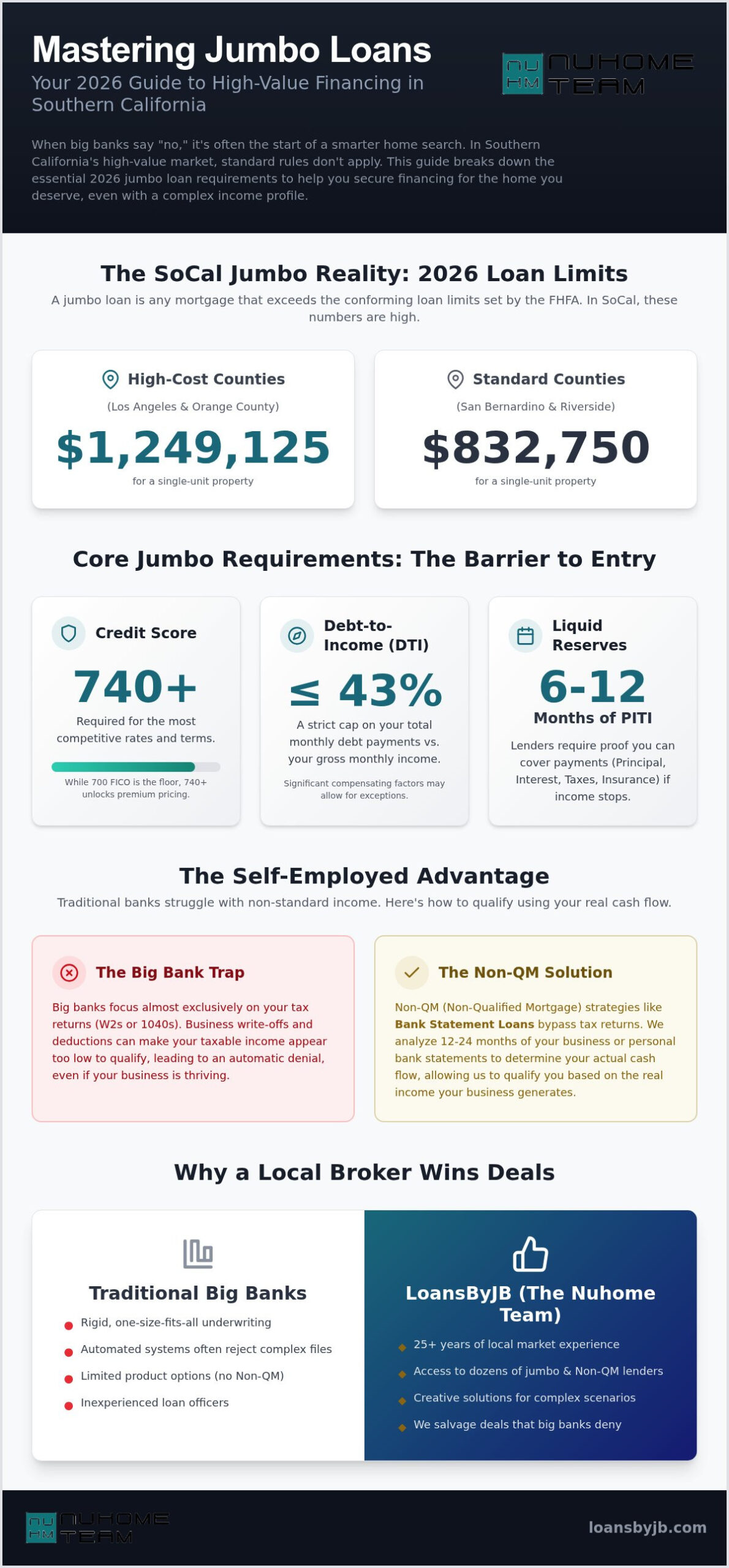
- Identify the 2026 loan limits for high-cost counties like Los Angeles and Orange County, which now reach $1,249,125.
- Master the specific Jumbo Loan Requirements in Southern California, focusing on the 740+ credit score target and the 43% DTI threshold.
- Leverage Non-QM strategies like bank statement loans to qualify based on actual cash flow rather than just tax returns.
- Use an “investor lens” to successfully navigate jumbo financing for multi-unit properties and complex residential scenarios.
- Discover why a local broker with 25 years of experience can salvage deals that traditional big banks reject.
The SoCal Jumbo Reality: 2026 Limits and Definitions
Big banks love to keep you in the dark. They use complex jargon to make you feel like you need their permission to buy a home. Here is the reality. A jumbo loan is just a mortgage that breaks the rules of standard conforming limits. In 2026, those rules are specific and the numbers are higher than ever. If your loan amount exceeds the ceiling set by the Federal Housing Finance Agency (FHFA), you’ve entered the jumbo zone. It’s a different world with different rules.
2026 Conforming vs. Jumbo Limits in SoCal
The numbers for 2026 are final. In standard counties like San Bernardino and Riverside, the baseline limit is $832,750 for a one-unit property. Move toward the coast and things change fast. In Los Angeles and Orange County, the high-cost limit jumps to $1,249,125. This Jumbo mortgage overview explains why these loans exist to bridge the gap in expensive markets like ours.
Don’t confuse your purchase price with your loan amount. You might buy a $1.4 million home in Claremont, put down a significant amount, and end up with a conforming “high-balance” loan instead of a true jumbo. High-balance loans are the middle ground. They offer some conforming flexibility but carry different pricing than a standard $600,000 mortgage. Knowing which bucket you fall into is the first step in meeting the Jumbo Loan Requirements in Southern California.
Why SoCal Borrowers Fall into Jumbo Territory
This market reality means you can’t rely on generic advice. If you aren’t prepared for the stricter underwriting that comes with these larger amounts, your deal will stall. You need a strategy that accounts for the gap between what you want to buy and what the standard limits allow. Big banks often freeze when a deal doesn’t fit their standard template. We don’t. You need to know the Jumbo Loan Requirements in Southern California before you even think about attending an open house.
Core Jumbo Loan Requirements: The Barrier to Entry
Big banks treat jumbo loans like an exclusive club. They set the bar high to keep people out, hoping you’ll just settle for a standard product that fits their automated systems. To win in this market, you need to know the entry fee. Meeting the Jumbo Loan Requirements in Southern California means proving you aren’t just a high earner, but a low risk. The standards are tighter, the scrutiny is deeper, and the paperwork is heavier. If you want the keys to a high-value property, you have to play by a different set of rules.
The Credit and Income Deep Dive
Your credit score is the first thing a lender looks at, and it dictates your entire deal. While some programs allow a 700 FICO, that’s just the floor. To unlock the most competitive pricing in 2026, you really need a 740 or higher. Falling into a lower tier doesn’t just raise your rate; it can trigger higher reserve requirements or lower loan-to-value limits. Income documentation is the next hurdle. W2 employees have it easy, but self-employed borrowers often face a wall of skepticism from traditional banks. For 2026 jumbo underwriting, your debt-to-income ratio is generally capped at a strict 43 percent unless you have significant compensating factors to push it higher. If your tax returns don’t reflect your true cash flow, it’s time to look at expert jumbo loan strategies that prioritize real-world income.
Liquidity and Asset Verification
Lenders don’t just care about what you earn; they care about what you’ve saved. You’ll need to prove you have 6 to 12 months of mortgage payments tucked away in liquid reserves. This includes principal, interest, taxes, and insurance (PITI). Banks want to know that if your income stops tomorrow, the mortgage still gets paid. Acceptable reserves typically include:
- Checking and savings accounts
- Brokerage accounts and stocks
- Vested portions of 401k or IRA accounts (often at a discounted value)
Be prepared for the 60-day paper trail rule. Every large deposit into your accounts must be sourced and documented. If you can’t prove where the money came from, the bank won’t count it. Additionally, because SoCal property values are so high, many lenders require a second independent appraisal for jumbo deals. They want two experts to confirm the home is actually worth the price tag before they cut a check for millions. This is why having a clean, transparent asset portfolio is critical to meeting Jumbo Loan Requirements in Southern California.
The 20 percent down payment myth is finally dying. While it remains the gold standard for the best rates, 2026 programs allow for 10 percent or 15 percent down if your credit and reserves are bulletproof. You don’t always need to tie up all your liquidity in the dirt, provided you have the right strategy in place.
The SoCal Investor Lens: Jumbo Loans for Complex Scenarios
Jumbo loans aren’t just for luxury hillside estates. In Southern California, they are tactical tools for serious real estate investors. If you’re looking at a multi-unit property in Los Angeles or Orange County, you’re almost certainly looking at a jumbo loan. Standard banks often choke on these deals. They see a four-unit building and try to apply a cookie-cutter residential template. We don’t. We use an investor lens to look at the carrying costs, the potential rental income, and the long-term exit strategy.
Meeting the Jumbo Loan Requirements in Southern California for an investment property is a steeper climb. You aren’t just proving your own stability. You’re proving the property’s ability to perform. We structure these deals to survive the scrutiny of 2026 underwriting by highlighting the strengths that automated systems ignore. When a big bank sees a “no” because of a complex income structure, we see a path to “yes.”
While navigating these requirements, investors often find that Simplified Commercial Lending offers the flexibility needed for rental properties by providing loan products that don’t require tax returns.
Jumbo Loans for Real Estate Investors
Non-owner occupied jumbo financing requires a different level of preparation. You’ll usually need a larger down payment, often 20 to 25 percent. Lenders will look closely at your experience and your cash reserves. While you can use a portion of the projected rental income to qualify, banks often apply a vacancy factor that can slash that income by 25 percent on paper. This is where many borrowers hit a wall. For those who can’t meet the strict DTI hurdles of a traditional jumbo, we often pivot to DSCR loans. These allow you to qualify based on the property’s cash flow rather than your personal tax returns. It’s about finding the right tool for the job.
Strategic Financing in Claremont and Rancho Cucamonga
Local sub-markets like Claremont and Rancho Cucamonga have their own rhythm. These areas are highly competitive. If you’re working with an out-of-state big bank, you’re already behind. Their loan officers don’t understand why a modest home in Claremont costs over a million dollars. They move at the speed of a glacier. Justin Brown and LoansByJB (The Nuhome Team) have spent over 25 years navigating these specific streets.
In a bidding war, speed and certainty are your only currency. We use our deep local knowledge to provide a real conversation advantage. We know the local appraisers and the specific market dynamics that drive value here. When you submit an offer backed by a local expert who understands the Jumbo Loan Requirements in Southern California, sellers listen. You aren’t just another file in a stack at a call center. You’re a serious buyer with a decisive plan to close.
Self-Employed and Non-QM Jumbo Strategies
Big banks hate entrepreneurs. They want steady W2s and boring tax returns. If you’ve spent years building a business in SoCal, your tax deductions are likely your best friend at tax time but your worst enemy when applying for a mortgage. Standard lenders see those deductions and slash your qualifying income to zero. We don’t play that game. Meeting the Jumbo Loan Requirements in Southern California as a business owner requires a “rebel expert” who knows how to look past the tax return to the actual health of your business. We find the flexibility in 2026 guidelines that institutional lenders ignore.
Qualifying Without a W2
Bank statement loans are the gold standard for SoCal wealth. Instead of tax returns, we use 12 or 24 months of business bank deposits to calculate your real income. This reflects the actual cash flow of your operation. Your CPA’s aggressive write-offs won’t stop you from buying that home in Orange County. In 2026, we also lean heavily on CPA-prepared Profit and Loss (P&L) statements. If your P&L shows a thriving business, that carries more weight in our underwriting than a two-year-old tax filing. It’s about proving you can afford the home today, not what you told the IRS two years ago.
Non-QM Jumbo Options
Non-QM stands for Non-Qualified Mortgage. It sounds technical, but it’s just a loan that doesn’t fit the rigid box of government-backed financing. Non-QM is the secret weapon for navigating the complex Jumbo Loan Requirements in Southern California without the W2 headache. For high-net-worth individuals, asset depletion is a game changer. If you have significant liquid assets but low taxable income, we can calculate a qualifying income based on those assets over the life of the loan. Interest-only jumbo options are another strategic tool. They keep your monthly carrying costs low, allowing you to keep your capital working in other investments.
For self-employed borrowers, the investor lens means qualifying you based on the strength of your business’s revenue and your personal liquidity rather than just the bottom line of a tax return.
Start your financial prep six months before you apply. Clean up your business deposits. Separate personal and business expenses completely. Large, unexplained transfers can kill a deal during the 2026 underwriting process. If you’re ready to stop letting your tax returns hold you back, talk to Justin Brown today about a custom Non-QM strategy.
Winning the Deal: Why LoansByJB (The Nuhome Team) Beats the Big Bank
Big banks are built for the average borrower. They love 20 percent down, standard W2 income, and perfect, boring files. If your scenario has even a hint of complexity, their automated systems will spit you out. You don’t need an algorithm. You need a real conversation with someone who understands why a $1.5 million home in Claremont isn’t a luxury mansion, but a standard family residence. In a market where high-value deals are the norm, navigating Jumbo Loan Requirements in Southern California requires a human advocate who can present your file to the right people.
Justin Brown and LoansByJB (The Nuhome Team) bring over 25 years of industry experience to every deal. This isn’t a call center in the Midwest. This is local expertise focused on the specific pressures of the SoCal market. When an appraisal comes in low or a title issue pops up, a retail bank will simply close your file and move to the next one. We pivot. We have direct access to wholesale jumbo investors that retail banks can’t reach. These investors are often more flexible than any “too big to fail” institution. They want jumbo paper, and they trust our vetting process to get it to them.
The LoansByJB (The Nuhome Team) Difference
We don’t just fill out forms. We optimize your loan structure to ensure it passes underwriting the first time. We look at every deal through an investor lens, even if it’s for your primary residence. This means identifying potential hurdles before the underwriter ever sees the file. It’s a proactive approach that saves time and protects your earnest money deposit. You can see how this compares to our 30-year fixed mortgage strategy, where we prioritize long-term stability and market hedging for our clients.
Your Next Steps in the SoCal Market
Speed is your only currency in a competitive market. A “soft” pre-qualification is worthless when you’re competing against multiple offers on a high-value property. You need a fully vetted pre-approval that proves you’ve already cleared the Jumbo Loan Requirements in Southern California. Start gathering your documents now to ensure a stress-free close. You’ll need two years of tax returns (or 12-24 months of bank statements), proof of liquid reserves for 6-12 months of payments, and clear documentation for all large assets.
Don’t let a rigid bank dictate your home-buying future. Get a real conversation started with LoansByJB (The Nuhome Team) today and secure the high-value financing your deal deserves.
Secure Your SoCal Future Today
The 2026 mortgage landscape doesn’t care about your past successes. It only cares about how well you fit into a specific box. But in a market like Los Angeles or Orange County, your life rarely fits a template. You’ve seen the numbers. You know that high-cost limits and strict credit tiers are just the beginning of understanding Jumbo Loan Requirements in Southern California. Now, you need a partner who knows how to navigate the friction between your financial reality and a lender’s rigid rules.
Justin Brown brings 25 years of local expertise to the table, right here in Claremont. We don’t just process files; we use specialized, investor-focused underwriting to find the “yes” that big banks miss. Whether you’re self-employed or scaling an investment portfolio, you deserve a decisive advocate who speaks your language and moves at your speed. The keys to your next home shouldn’t be held hostage by an algorithm.
Stop guessing and get the Jumbo financing you deserve; talk to Justin Brown today. You have the vision. We have the strategy to close the deal.
Frequently Asked Questions
What is the minimum down payment for a Jumbo loan in California in 2026?
You can secure a jumbo loan with as little as 10 percent or 15 percent down in 2026, depending on your credit profile. While 20 percent remains the industry benchmark for the best rates, it is no longer a hard requirement. Some specialized programs even allow for 5 percent down for borrowers with elite credit scores and deep reserves. We focus on finding the leverage that keeps your capital working elsewhere while securing the property.
Can I get a Jumbo loan if I am self-employed and have high deductions?
Absolutely. We qualify self-employed pros using bank statement programs that prioritize gross deposits over net taxable income. Traditional banks see your high deductions and freeze because your tax returns show low income. We bypass that by analyzing your actual cash flow over 12 to 24 months to meet the Jumbo Loan Requirements in Southern California. It is about your ability to pay, not your tax strategy.
How many months of cash reserves do I need for a $1.5 million loan?
For a $1.5 million loan, most lenders expect to see 12 months of mortgage payments in liquid reserves. This includes principal, interest, taxes, and insurance (PITI). These funds must be verified through a 60-day paper trail to prove they are seasoned and stable. While smaller loans might only require 6 months, higher loan amounts trigger stricter scrutiny to ensure you can weather a temporary financial storm without defaulting.
Are Jumbo loan rates higher than conforming mortgage rates in SoCal?
In 2026, jumbo rates are often surprisingly competitive, frequently sitting within 0.25 to 0.30 percentage points of conforming rates. Depending on the current appetite of wholesale investors, jumbo rates can sometimes be lower than high-balance conforming rates for borrowers with 740+ credit scores. Don’t assume a larger loan automatically means a higher cost. We shop multiple sources to find the best rate spread for your specific scenario.
Do I need two appraisals for a Jumbo loan in Los Angeles County?
Yes, lenders typically require two independent appraisals for loan amounts exceeding $1.5 million in Los Angeles County. This extra layer of security ensures the property value is supported by multiple expert opinions in high-velocity markets. It prevents over-leveraging on properties that might have volatile valuations. We coordinate these appraisals with local experts who understand the specific neighborhood dynamics that drive value in the SoCal region.
What is the difference between a High-Balance loan and a Jumbo loan?
A high-balance loan is a conforming mortgage that falls between the national baseline of $832,750 and the local high-cost ceiling of $1,249,125. Anything that crosses that $1,249,125 threshold in counties like LA or Orange is a true jumbo loan. Each category has different underwriting standards, so knowing which side of the line you fall on is critical for meeting the Jumbo Loan Requirements in Southern California effectively.
Can I use a Jumbo loan to buy a 4-unit investment property?
Yes, you can use jumbo financing for multi-family properties up to 4 units. In Southern California, even modest fourplexes often exceed conforming limits, making jumbo loans a necessity for local investors. We use an investor lens to evaluate the property’s potential rental income, allowing that cash flow to help you qualify. This strategy is essential for building a high-value portfolio in expensive sub-markets like the Inland Empire or San Gabriel Valley.
How long does it typically take to close a Jumbo loan with LoansByJB (The Nuhome Team)?
We typically close jumbo deals in 21 to 30 days. This speed is a decisive advantage in a market where sellers want certainty and quick execution. Because we have direct access to wholesale investors and a streamlined internal process, LoansByJB (The Nuhome Team) can move your file through underwriting while big banks are still stuck in the initial review phase. We prioritize results over corporate pleasantries to get you funded.
Need the mortgage math checked?
Talk through the loan before you guess.
Use the estimator, request a refinance quote, or book a call with The Nuhome Team. We will help you compare the options that actually fit the file.
This is not a commitment to lend. Approval, terms, and pricing depend on credit, income, assets, property, and program guidelines.