

What if your savings matter more than your pay stub suggests? An asset depletion loan La Verne borrowers ask about may allow a lender to count eligible assets when reviewing limited documented income, but assets don’t create automatic income or approval.
You may not need to withdraw the money. Depending on the program, a lender may use eligible assets to calculate a monthly income figure for qualification. Account types, documentation, and calculation rules can vary, so don’t move or cash out funds before you understand how the full file may be reviewed.
This article explains what lenders may look at, how asset-based review can differ from other non-QM loan options in California, and what information to gather before a mortgage conversation in La Verne. We’ll keep it practical: compare possible financing paths, identify questions about your accounts, and consider how your overall financial picture may affect the review. A clear picture of the rules can help you discuss next steps without making an uninformed withdrawal.
Key Takeaways
- An asset depletion loan La Verne borrowers consider may let a lender review eligible assets during underwriting, but it does not mean automatic income or approval.
- Account ownership, access to funds, restrictions, and account type may affect how a lender views assets. Gather account details before discussing financing.
- Compare asset-based review with conventional and DSCR financing based on your documented income, property use, and priorities.
- Prepare an inventory of assets, income, debts, and property details, including taxes, insurance, HOA dues, and other carrying costs.
- A focused review with LoansByJB can help you discuss your full financial picture and compare possible mortgage paths for a La Verne property.
What Does an Asset Depletion Loan Mean for La Verne Borrowers?
An asset depletion loan uses a lender’s review of eligible assets to help assess a mortgage application when documented income may not tell the full story. It doesn’t turn savings into automatic income, cash proceeds, or loan approval. The method and requirements depend on the lender and program.
For an asset depletion loan La Verne borrowers are considering, the key question is not just how much money appears in an account. A lender may also look at who owns the funds, whether they’re accessible, and what restrictions apply. That review happens as part of underwriting, alongside other parts of the borrower’s financial picture.
How is asset-based qualification different from income qualification?
With income qualification, a lender reviews documented income and applies program rules to assess whether it supports the mortgage request. With an asset-based review, a lender may also consider eligible assets as part of its assessment. The lender’s guidelines determine whether those assets count and how they are considered.
There’s no single calculation to assume. Programs can differ in the assets they accept, the documents they require, and the way they treat each account. One lender’s review may not match another’s. Ask for a plain-English explanation of which funds are being considered and how they affect the overall review.
Asset review also doesn’t mean you need to withdraw money. A lender may use account information for underwriting without treating the review as cash paid to you. Don’t sell investments or move retirement funds based on a rough estimate. First understand the lender’s requirements and consider any financial or tax questions with your CPA or attorney.
Who may want to explore this approach?
It may be worth discussing for a buyer with substantial assets but limited documented monthly income. A retiree or an investor might be in that position, but those labels alone don’t establish eligibility. The lender considers the whole application, including its documentation and program requirements.
Start by separating assets into clear groups: cash accounts, investment accounts, retirement accounts, and any funds with limits on access. Note the account owner and whether another person has a share or control. These details can help frame a useful conversation, but they don’t determine which assets a lender will accept.
La Verne property details matter too, but they don’t replace borrower and underwriting requirements. The home, loan purpose, and requested financing are part of the picture. A property’s location cannot make an asset eligible or turn an incomplete income record into an approval.
The practical next step is to compare this possible review with other mortgage paths, rather than assume one label solves the problem. A focused review can clarify what information is needed and whether another approach better fits the borrower’s income, assets, and property plans. The aim is a financing conversation based on documented facts, not guesswork.
How Might a Lender Review Assets for a Mortgage?
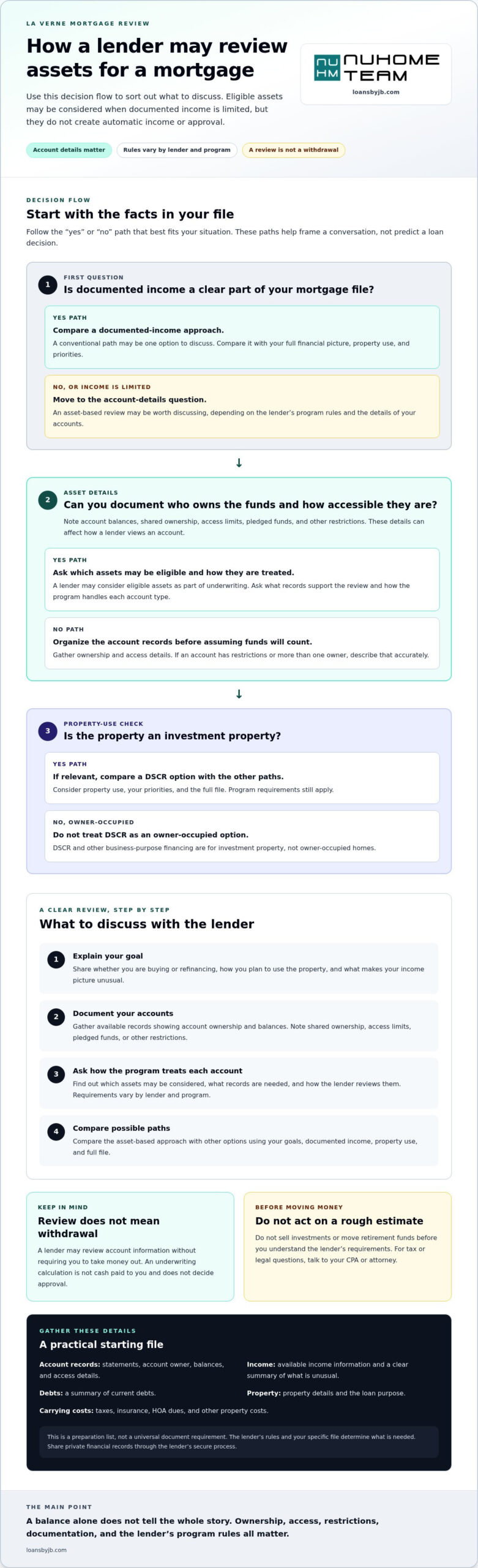
A lender’s review can start with your plans and then move to account records, program rules, and a comparison of possible paths. The goal is to understand what the lender may consider, not to assume that a balance will count or produce a loan decision.
Use a clear sequence. First, explain the property and financing you’re considering. Then organize account details and ask how the applicable program treats them. Asset treatment depends on the lender’s program rules and documented account details.
- Discuss your goal. Explain whether you’re buying or refinancing, how you plan to use the property, and what makes your income picture unusual.
- Document your accounts. Gather available records showing account ownership and balances. Note shared ownership, access limits, pledged funds, or other restrictions that may matter.
- Review the lender’s rules. Ask which assets may be considered, how they are treated, and what records support the review. Requirements depend on the lender and program.
- Compare paths. Once the review rules are clear, compare the asset-based approach with other financing options against your goals and full file.
An underwriting calculation is not the same as taking money out of an account. The lender may review account information without requiring a withdrawal. A calculation alone does not create cash for you or decide whether the mortgage will be approved.
What records may help start the review?
Useful starting records may include account statements, account-owner details, income information, a debt summary, and basic property and loan-purpose facts. This is a preparation list, not a universal document requirement. The lender’s rules and your specific file determine what documents are needed.
Share private financial records through the lender’s secure process. If an account has access limits or more than one owner, describe that accurately. Clear notes can help prevent confusion about what a statement shows.
Example only: How should an asset calculation be illustrated?
A numerical calculation needs two things first: the borrower’s actual documented figures and the lender’s established method. Neither is provided here, so inserting a balance, divisor, or result would create a made-up financial example and could mislead you.
Instead, keep the example framework simple. Record the borrower-provided account details separately from the lender’s stated assumptions. Then have the lender explain how its method applies to those details. Don’t treat an estimate as qualifying income or a loan decision.
Before sharing account records, prepare your questions about ownership, access, and documentation. That gives the lender a clearer basis to explain how the review may work for your file.
Should You Compare Asset Depletion With Conventional or DSCR Financing?
Yes. Compare how each path reviews your finances, the property’s intended use, and the full terms and conditions. There’s no universal winner. The right comparison depends on your goals and complete file, subject to underwriting and program guidelines.
An asset-based review may be worth discussing if documented income is the main challenge and you have assets that could matter under a lender’s rules. Conventional financing may fit when documented income supports the application and program requirements line up. DSCR financing is different. It’s business-purpose financing for investment property, not an owner-occupied home.
When might an asset-based review be worth discussing?
Look at the actual gap in your application. Is your income hard to document, uneven, or low compared with your available assets? If so, ask whether a lender may consider those assets and what records its program uses. An asset depletion loan La Verne borrowers discuss should be compared based on its specific rules, not on the name alone.
Get clear answers about how the lender views account ownership, liquidity, restrictions, and any planned withdrawals. Then compare the complete proposed terms and conditions, not qualification alone. Consider the loan’s costs, payment structure, property requirements, and the effect of using or keeping assets. Those details depend on the program and full file.
When could another mortgage path fit better?
Conventional financing may be a reasonable path to explore when income records support the application and the borrower and property meet program requirements. A 30-year fixed mortgage is one possible loan structure to compare. The structure by itself doesn’t answer whether the application fits. Review the full terms and required documentation.
DSCR financing may be relevant when the property is an investment property and the program evaluates that investment-property scenario. It is not for a home you plan to occupy. Review the property-use rules and the program’s requirements before treating it as an option. A DSCR loan should be compared with asset-based or conventional paths only when the intended property use fits.
Keep the comparison focused on four questions:
- What income, assets, or property factors does the program review?
- What documents and conditions apply to your file?
- Does the financing fit the property’s intended use?
- How do the full terms compare with your priorities?
Don’t choose based on the label or a single qualification estimate. A careful side-by-side review can show which questions need answers and which options fit your plans.
What Should La Verne Borrowers Prepare Before Applying?
Bring a clear picture of your finances and the property you have in mind. That gives a lender useful context to discuss whether an asset-based review or another mortgage path may fit. It does not replace the lender’s review of your full file.
For an asset depletion loan La Verne borrowers are considering, preparation means more than listing account balances. Include who owns each account, whether access is limited, and any planned withdrawals. Be ready to describe your income, debts, intended occupancy, and the property’s expected costs.
- Asset inventory: List your accounts by type and owner. Note shared ownership, access limits, or funds you expect to use.
- Income and debts: Gather a summary of income sources and regular debts. Include details that help explain how you manage monthly obligations.
- Property plans: Share the property location, intended use, purchase or refinance plans, and any known costs.
- Monthly budget: Consider the full cost of owning the property, not only the mortgage payment. Include La Verne property taxes, homeowners insurance, HOA dues, and other carrying costs that may apply.
A complete budget helps keep the conversation grounded. Property taxes and insurance can vary by home, and HOA dues depend on the property. Use the figures available for the home you’re considering, and leave room to discuss costs that are not yet clear.
Which questions can clarify lender assumptions?
Ask which accounts may be considered and how ownership, account type, restrictions, and access affect the lender’s review. Request a plain-English explanation of the calculation and the records needed to support it. Requirements can differ by program, so avoid treating a general example as a promise about your file.
Also ask what other mortgage paths may be worth comparing if the asset-based approach does not fit. That keeps the discussion focused on your goals, instead of forcing every borrower into the same box.
How can you prepare for a local financing conversation?
Share the property’s La Verne location, intended occupancy, purchase plans, and a realistic monthly budget. Be direct about account restrictions and any planned withdrawals. Clear information helps the lender frame the review around your actual plans.
Don’t move or liquidate assets just to make an application look simpler. First understand the program-specific guidance and how a change could affect your accounts. If the funds are in retirement accounts, talk with your CPA or attorney before making withdrawal decisions.
Put your questions and documents in one place, then discuss the full picture with a mortgage advisor. If you’re ready to compare your possible paths, book a mortgage call with LoansByJB.
How Can LoansByJB Help You Assess Your La Verne Options?
LoansByJB (The Nuhome Team) is a Southern California mortgage brokerage serving La Verne. I’m Justin Brown, Owner and Broker, with over 25 years of experience as a broker, lender, and investor. I work with borrowers who need a clear review of their finances and a practical comparison of possible mortgage paths.
An asset depletion loan La Verne borrower is considering still depends on lender rules and the full application. A useful conversation can help you understand what a lender may review, what questions remain open, and whether another path may be worth comparing. It can’t promise an outcome.
What should a tailored review explain?
A tailored review should connect the different parts of your file, not focus on one account balance in isolation. We can discuss how a lender may assess assets, income, debts, property details, and your goals, then explain how those pieces may affect the options being considered.
It should also make the lender’s assumptions clear. Which assets might be considered? What documents could support the review? How might account ownership or restrictions matter? The answers depend on the program and lender. The lender’s underwriting process determines how the full file is treated.
Depending on your circumstances, a comparison may include a conventional mortgage, a non-QM option, or another relevant path. Each has its own requirements and terms. We can help you review the differences in plain English, without predicting approval, rates, savings, or timing.
Bring the facts that help make the discussion specific: your account list, income sources, debts, property plans, and the questions you want answered. If something is unclear, say so. Guesswork belongs in trivia, not a mortgage file.
What is a sensible next step?
If your finances don’t fit neatly into a standard income picture, you don’t have to settle for a vague answer. A focused discussion can help identify what a lender would need to review and which financing paths may make sense to compare. Any option remains subject to underwriting and program guidelines.
For a complex file, book a calm, practical conversation with me. We can review your goals and financial picture, then discuss possible next steps without assuming that a particular program or outcome is available. Book A Call when you’re ready to talk through your La Verne mortgage options.
This article is for general education only and is not a commitment to lend. All loans are subject to credit approval, underwriting, property eligibility, and program guidelines. Rates and terms can change without notice. LoansByJB (The Nuhome Team), NMLS #1647915, CA DRE #02039443. Equal Housing Lender.
Take the Next Step With a Clear Plan
Your next move doesn’t have to be a withdrawal or a loan application. Start by deciding what you want the financing to do, which funds you prefer to keep untouched, and what monthly costs feel manageable. Those priorities can shape a more useful discussion about possible mortgage paths.
An asset depletion loan La Verne borrowers consider is only one part of that conversation. The lender’s rules and review of your full file still matter. Bring your questions, share the facts, and ask for clear explanations before making a major financial move.
LoansByJB serves La Verne and nearby Southern California communities. Justin Brown brings over 25 years of broker, lender, and investor experience, and The Nuhome Team offers plain-English guidance for complex financing scenarios. A discussion can help you weigh options without assuming a particular program or outcome is available.
When you’re ready to talk through your situation, Book A Call with The Nuhome Team. A clear next step starts with a good conversation.
Frequently Asked Questions
Can I qualify for an asset depletion loan in La Verne if I am retired?
Possibly, but being retired by itself doesn’t establish whether you qualify. A lender may review your documented retirement income, assets, debts, and the property you plan to finance under its program rules. For an asset depletion loan La Verne borrowers are considering, bring a clear record of income sources and account ownership so the review can focus on your full situation.
Do I have to withdraw my assets to qualify for an asset depletion mortgage?
Not necessarily. A lender may use eligible account information in its underwriting review without requiring you to take a distribution. But account access and program conditions can matter, so ask whether funds must remain available or be used for a specific purpose. Before moving or withdrawing retirement funds, talk with your CPA or attorney about possible tax effects.
Which assets might a lender consider for an asset depletion loan?
Depending on the program, a lender may review cash accounts, investment accounts, or retirement funds. That doesn’t mean every account will count in full, or at all. For example, an account shared with another owner or tied to a restriction may be treated differently from funds you control alone. Ask how the lender will assess each account in your file.
Is an asset depletion loan the same as a DSCR loan?
No. An asset-based review looks at a borrower’s eligible finances under lender rules, while DSCR financing focuses on an investment property’s income and expenses under its program guidelines. DSCR loans are business-purpose financing for investment property, not a home you plan to occupy. The property’s intended use helps determine which type of financing may be relevant.
Need the mortgage math checked?
Talk through the loan before you guess.
Use the estimator, request a refinance quote, or book a call with The Nuhome Team. We will help you compare the options that actually fit the file.
This is not a commitment to lend. Approval, terms, and pricing depend on credit, income, assets, property, and program guidelines.