

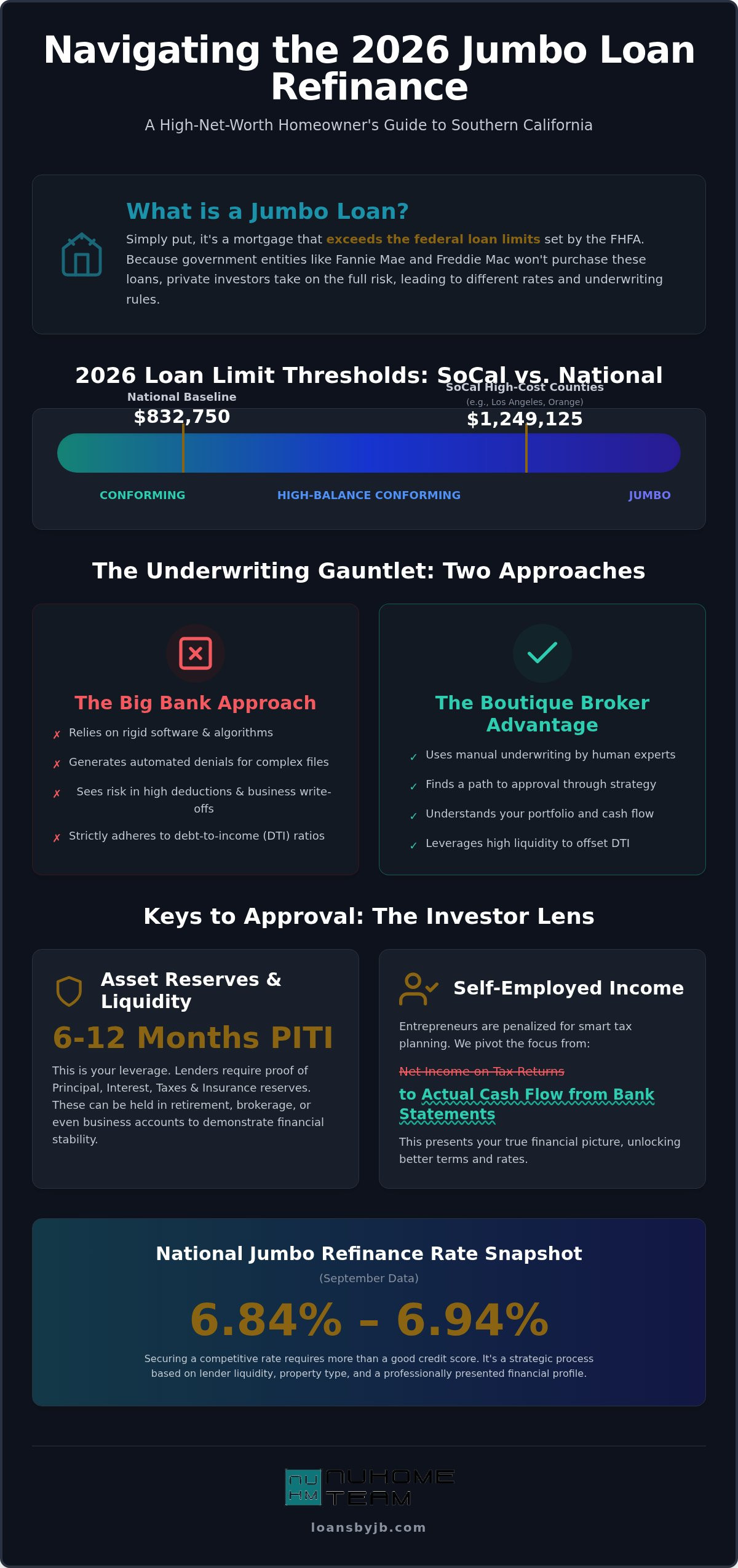
Your big bank’s automated “no” isn’t a reflection of your net worth. It’s a failure of their rigid software. For high-net-worth homeowners in Southern California, the standard “box” is simply too small for your financial reality. You’ve likely seen national jumbo loan refinance rates hover between 6.84% and 6.94% this September, but securing those numbers on your own terms requires more than just a decent credit score. It requires a strategy that treats you like an investor, not a number.
We know the frustration of dealing with lenders who can’t read a complex tax return or don’t understand the 2026 loan limit shifts. Whether you’re in Los Angeles facing the $1,249,125 threshold or San Bernardino at $832,750, you deserve a path to approval that prioritizes your results over corporate pleasantries. This guide will show you exactly how to navigate the 2026 jumbo market to lower your monthly payments and unlock cash-out liquidity. We’ll break down the current rate landscape, county-specific limits, and the manual underwriting secrets that the big banks won’t tell you.
Key Takeaways
- Master the 2026 shifts in county-specific loan limits to identify exactly when your mortgage crosses into jumbo territory across Southern California.
- Secure competitive jumbo loan refinance rates by presenting your financial profile through an investor lens that emphasizes liquidity over rigid debt ratios.
- Navigate the underwriting gauntlet by leveraging local expertise in high-value pockets like Claremont, Rancho Cucamonga, and the “commuter luxury” markets.
- Evaluate the spread between 30-year fixed mortgages and adjustable-rate options to determine the most strategic move for your specific jumbo debt.
- Learn why a boutique broker’s “real conversation” approach beats the automated denials and impersonal service of traditional big banks.
Understanding Jumbo Loan Refinance Rates and 2026 Limits
Traditional banks love to overcomplicate the basics. A jumbo loan is simply a mortgage that exceeds the federal limits set by the FHFA. If your loan amount is too big for Fannie Mae or Freddie Mac to buy, it’s a jumbo. In 2026, those baseline limits have shifted. Understanding how these thresholds impact jumbo loan refinance rates is the first step toward reclaiming your equity. You aren’t just a borrower; you’re an investor managing a significant liability.
For most of the country, the magic number is $832,750. Anything above that is non-conforming. However, Southern California isn’t “most of the country.” Our property values demand a more nuanced approach. High-cost counties see limits scale much higher, reaching up to $1,249,125 in areas like Los Angeles and Orange County. If you’re sitting on a massive mortgage, you need a strategy that matches the scale of your investment.
The 2026 Conforming vs. Jumbo Threshold
The $832,750 mark is the definitive line in the sand for 2026. If your balance drops below this figure, you move from jumbo territory into conforming territory, which often simplifies the paperwork. High-balance conforming loans act as a middle ground, offering a bridge for those in expensive markets who don’t quite hit the true jumbo ceiling. In Los Angeles and Orange Counties, any loan amount exceeding $1,249,125 is officially classified as a jumbo mortgage for 2026.
Why Jumbo Refinance Rates Diverge from Conforming
Jumbo loans don’t have the safety net of government backing. Because Fannie and Freddie won’t touch them, private investors take on the full risk. This lack of a federal guarantee means jumbo loan refinance rates aren’t tied to the same benchmarks as your neighbor’s standard 30-year fixed. Instead, rates fluctuate based on secondary market appetite and the specific liquidity of the lender you choose. Understanding Jumbo Loans requires recognizing that these are private-sector products driven by investor confidence.
Lender liquidity is the silent driver of your monthly payment. Some institutions have deep pockets for jumbo debt, while others tighten up when the market gets volatile. This creates a daily rate spread that can vary wildly between a local broker and a national bank. Your property type also dictates the price. A single-family home in Claremont usually commands a better rate than a high-rise condo in downtown LA. Lenders view condos as higher risk, which translates to a wider rate spread. Don’t let a big bank’s rigid software tell you what’s possible; the private market is always moving.
The Investor Lens: Clearing the Jumbo Underwriting Gauntlet
Big banks look at your tax returns and see risk. We look at your portfolio and see strategy. To secure the best jumbo loan refinance rates, you must view your primary residence through an investor lens. This means evaluating carrying costs and the total cost of capital; it’s not just about the monthly payment. Algorithms often fail high-net-worth borrowers because they can’t handle complexity. That’s where manual underwriting comes in. A human expert reviews your file to understand the logic behind your numbers. You need a clear exit strategy for your debt. Whether it’s a future sale or a cash-flow play, the underwriter needs to see the plan. A street-smart approach to liquidity often beats a perfect credit score in the eyes of a savvy investor.
Asset Reserves and Liquidity Requirements
Liquidity is your greatest leverage. For most jumbo files in 2026, 6-12 months of PITI (Principal, Interest, Taxes, and Insurance) reserves are non-negotiable. This doesn’t mean you need a mountain of cash in a checking account. You can use retirement accounts or even business funds to meet these requirements. High liquidity can often offset a debt-to-income ratio that slightly exceeds the standard 43% mark. If you have the assets, we can make the case for the approval. This financial stability is what helps you lock in the most competitive jumbo loan refinance rates available in the current market.
Self-Employed and Complex Income Presentation
Entrepreneurs often get penalized for being smart with their taxes. High deductions look great on April 15th but can kill a loan application at a retail bank. A seasoned mortgage broker acts as your advocate, translating your business success into a language underwriters understand. In 2026, we’ve seen a massive shift toward bank statement programs for jumbo refinancing. These programs allow us to use your actual cash flow rather than a net income figure buried under depreciation and write-offs. We turn your tax-return “weaknesses” into business-asset strengths. If your current lender is stuck on a single line of your 1040, it’s time for a real conversation about mortgage options designed specifically for self-employed borrowers.
Tactical Refinancing: When Does a Jumbo Move Make Sense?
Big banks tell you to wait for a full 1% drop in interest before you consider a move. That’s lazy advice. In the 2026 market, jumbo loan refinance rates are often more competitive than you’d expect, sometimes even undercutting conforming rates when institutional liquidity is high. Tactical refinancing isn’t just about a lower monthly bill. It’s about optimizing your total cost of capital. If the spread is narrow enough to reduce your interest expense while freeing up liquid reserves, you move. You don’t wait for a “perfect” moment that might never arrive.
The 30 year fixed mortgage remains the gold standard for stability, acting as a powerful financial hedge. However, savvy borrowers in Southern California often look at ARM options for jumbo debt if they plan to exit the property within seven years. You must also factor in the “break-even point” with precision. Jumbo appraisals and title fees are significantly higher than standard loans. Ensure your long-term savings or the utility of your cash-out liquidity outweighs these upfront costs.
Jumbo vs. Conforming Rate Spreads
Sometimes the best jumbo move is to avoid the jumbo label entirely. We often use a “second mortgage” strategy to keep your primary debt at the conforming limit while accessing the extra funds you need. This can lead to jumbo loan refinance rates that are effectively lower than a single massive loan. You should also calculate the real cost of Private Mortgage Insurance (PMI). In many cases, taking a slightly higher jumbo rate is cheaper than paying for PMI on a high-balance conforming loan. We run the numbers to find the path of least resistance for your wallet.
Refinancing for Leverage and Portfolio Growth
Smart investors use their primary residence as a private bank. By tapping into your home’s equity through a cash-out refinance, you can secure a jumbo loan for investment property California to expand your real estate holdings. This is the “investor lens” on debt. Low-rate debt isn’t just a liability; it’s a hedge against 2026 inflation. We also look at the strategic use of HELOCs in conjunction with your jumbo first mortgage. This gives you a revolving line of credit for quick acquisitions without disturbing your primary low-rate debt. It’s about building a fortress around your wealth.
Southern California Market Dynamics: Local Jumbo Nuances
Southern California isn’t a monolith. National averages for jumbo loan refinance rates don’t tell the whole story when you’re looking at a $1.5 million estate in Claremont or a luxury build in Rancho Cucamonga. These high-value pockets operate on their own logic. In 2026, we’ve seen the “commuter luxury” markets of San Dimas and Glendora explode. Borrowers there often find themselves in jumbo territory unexpectedly. You need a lender who understands that a home in La Verne isn’t the same as one in Ohio. Local market dynamics dictate your leverage.
Property taxes and Mello-Roos assessments are the silent killers of jumbo applications. In newer Inland Empire developments, these special taxes can add hundreds, or even thousands, to your monthly carrying costs. Big banks often miss these details in their initial automated quotes. By the time their rigid underwriting catches the actual debt-to-income (DTI) impact, it’s too late. We factor these local nuances into your strategy from day one. If you want to see how these local factors affect your specific numbers, get a custom scenario review today.
Appraisal Rigor in High-Value Neighborhoods
Appraisals are the biggest hurdle in the SoCal jumbo market. For properties valued over $1.5 million, most jumbo investors now require two independent appraisals. Big banks often send out-of-area appraisers who don’t understand the “micro-market” premiums in Downey or the San Gabriel Valley. They miss the value of unique architectural features or specific neighborhood prestige. This leads to low valuations that kill your refinance. We work with professionals who live and breathe SoCal real estate. They know the comps because they’ve seen the homes, not just the spreadsheets.
Condos and Non-Warrantable Projects
Refinancing a high-value condo in a Southern California urban center is a different beast. Traditional lenders run for the hills if they see HOA litigation or low financial reserves. These “non-warrantable” projects are common in 2026, but they shouldn’t stop your refinance. We access jumbo investors who specialize in these complex projects. While a big bank sees a reserve issue as an automatic denial, we see a project that needs a more sophisticated underwriting approach. Don’t let a poorly managed HOA prevent you from securing better jumbo loan refinance rates; there’s almost always a workaround for the right borrower.
For borrowers who are eyeing properties that need significant work, a homestyle renovation loan can roll your purchase price and upgrade costs into a single mortgage, giving you another powerful tool for manufacturing equity in Southern California’s high-cost market.
Boutique Broker Advantage: Winning the Jumbo Approval
Big banks are built on rigid software. If your financial profile doesn’t fit their narrow “box,” you get an automated denial. We don’t believe in the box. Justin Brown brings 25+ years of experience as a broker, lender, and investor to every file. He understands how to structure complex scenarios that leave corporate loan officers scratching their heads. We aren’t beholden to a single set of rules. LoansByJB (The Nuhome Team) accesses a massive network of jumbo investors, each with different risk appetites. If one door closes, we know exactly which one to open next. We act as the rebel expert, navigating the system to your advantage rather than just following a script.
Our approach starts with a real conversation. We don’t hide behind a portal or an 800-number. You get direct access to a seasoned advisor who understands the Southern California market from Claremont to Downey. This local expertise allows us to position your property and your income in the best possible light. We know which investors are currently hungry for jumbo debt and which ones have tightened their belts. This insider knowledge ensures you aren’t just applying for a loan; you’re executing a strategic financial move to lock in the best jumbo loan refinance rates available.
The Advocate vs. The Algorithm
An algorithm cannot see your compensating factors. It doesn’t understand why a self-employed entrepreneur has high deductions or how your significant cash reserves offset a high DTI. We do. We “sell” your complex file to a human underwriter by highlighting your strengths. For business owners who have been turned away by retail banks, exploring mortgage products for self-employed borrowers that beat the big banks can be the difference between an approval and a frustrating dead end. This advocacy is vital when jumbo loan refinance rates shift daily in a volatile 2026 market. A boutique firm offers a massive speed advantage. We move while big banks are still stuck in committee. You also protect your credit. A single pull with a broker gives you access to dozens of outlets, whereas shopping ten banks individually can wreck your score before you even start.
Preparing Your Investor-Grade Documentation
Winning a jumbo approval requires a clean, investor-grade presentation. We don’t just collect papers; we build a case. Our team helps you organize complex business returns and K-1s to ensure every cent of qualifying income is recognized by the lender. We aim for a “fully underwritten pre-approval” so you can move with total confidence. This level of preparation is what separates a successful refinance from a frustrating waste of time. You deserve a partner who speaks the language of high-net-worth finance. Talk to a Southern California jumbo expert at LoansByJB (The Nuhome Team) today and stop settling for the bank’s rigid limitations.
Master the 2026 Jumbo Market on Your Own Terms
The 2026 market doesn’t reward those who wait for a big bank’s permission. To win, you must navigate the specific county limits in Southern California and present your complex income through a lens that underwriters actually respect. Success requires more than just watching national jumbo loan refinance rates; it requires a street-smart strategy that leverages your liquidity and assets. Don’t let a rigid algorithm dictate your financial future when manual underwriting can turn an “impossible” file into a closed deal.
We specialize in the complex scenarios that traditional institutions ignore. With 25+ years of experience as a broker, lender, and investor, Justin Brown understands how to structure debt for maximum advantage. LoansByJB (The Nuhome Team) provides direct access to non-QM and bank statement jumbo programs tailored specifically for the Southern California luxury market. It’s time to stop being a number and start being an investor.
Secure your 2026 Jumbo Refinance strategy with LoansByJB (The Nuhome Team). You’ve built the equity; now it’s time to make it work for you.
Frequently Asked Questions
What is the jumbo loan limit for Southern California in 2026?
Limits depend entirely on your specific county. In 2026, the baseline conforming limit is $832,750, but high-cost areas like Los Angeles and Orange Counties reach up to $1,249,125. San Diego County sits at $1,077,550 while Ventura County is $1,035,000. Anything exceeding these local thresholds is classified as a jumbo loan. We track these shifts across Claremont and Rancho Cucamonga to ensure your debt is structured correctly from the start.
Are jumbo refinance rates higher than regular mortgage rates?
Not always. While jumbo loan refinance rates often carry a premium because they lack government backing, they can dip below conforming rates when private investor liquidity is high. As of September 2026, 30-year jumbo averages hover between 6.84% and 6.94%. The actual rate you secure depends on your portfolio strength and the investor lens we apply to your specific scenario. We find the most aggressive pricing available.
How many months of reserves do I need for a jumbo refinance?
You typically need 6 to 12 months of PITI reserves in liquid or semi-liquid assets. This cushion ensures you can cover payments if your income stream is interrupted. We help you leverage retirement accounts or business funds to meet these requirements without draining your primary cash flow. High-net-worth borrowers in Southern California often use these reserves as a powerful compensating factor to clear complex underwriting hurdles.
Can I get a jumbo refinance if I am self-employed?
Yes, and we specialize in these complex scenarios. Big banks often struggle with entrepreneurs who maximize tax deductions, but we use bank statement programs to qualify you based on actual cash flow. We look at your 12 or 24 months of deposits rather than just the bottom line on your tax returns. This approach turns your self-employment into a strategic strength for your jumbo refinance application.
What is the minimum credit score for a jumbo loan in 2026?
You should aim for a score of 700 or higher. While some specialized programs might consider scores in the high 600s, the most competitive jumbo loan refinance rates are reserved for those with 720+ scores. If your score is on the edge, we focus on other strengths like high reserves or significant equity. We use manual underwriting to tell the story that your credit report alone cannot communicate.
Is a 10% down payment (or 90% LTV) possible for a jumbo refinance?
It is possible, though 20% equity remains the industry standard. Some private investors allow for a 90% loan-to-value ratio if your credit and reserves are exceptionally strong. This flexibility allows you to keep more of your capital working in other investments while still securing high-balance financing. We navigate dozens of specific investor guidelines to find the highest leverage available for your Southern California property.
Can I do a cash-out refinance on a jumbo loan for an investment property?
Absolutely. We use DSCR loans and other investor-focused products to pull equity from your primary residence or existing rentals to fund further acquisitions. This is a core strategy for building a real estate portfolio in markets like Downey or San Dimas. We treat your home as a strategic asset, providing the liquidity you need to scale your investments without the rigid requirements of a retail bank.
Why do jumbo loans require two appraisals?
Risk management is the simple reason. For properties valued over $1.5 million, many jumbo investors require two independent valuations to confirm the collateral’s true worth. This prevents a single outlier appraisal from skewing the loan-to-value calculation. We work with local SoCal appraisers who understand the nuances of neighborhoods like Glendora and La Verne to ensure these valuations are accurate, fair, and pass the underwriting gauntlet.
Need the mortgage math checked?
Talk through the loan before you guess.
Use the estimator, request a refinance quote, or book a call with The Nuhome Team. We will help you compare the options that actually fit the file.
This is not a commitment to lend. Approval, terms, and pricing depend on credit, income, assets, property, and program guidelines.