

The lowest interest rate on the market is often the most expensive mistake a real estate investor can make. While most people hunt for a cheap monthly payment, the pros know that the best investment property loan is actually the one that protects your liquidity and closes before the competition even wakes up. In a 2026 market where California median home prices have hit $914,810, waiting for a big bank’s rigid underwriting to approve your deal is a recipe for a missed opportunity. You don’t need a lender who acts like a gatekeeper. You need a partner who understands that speed and structure beat a quarter-point discount every single time.
It’s frustrating to watch a perfect deal slip away because a traditional bank didn’t like the property’s condition or your self-employed status. We agree that the old way of financing is broken for modern scaling. This guide will show you how to stop rate-shopping and start ROI-shopping by leveraging investor-focused loan structures like DSCR and private money. We’ll break down the specific strategies to maximize your cash flow, secure funding for fixer-uppers, and scale your portfolio across Southern California without the typical red tape.
Key Takeaways
- Learn why strategic capital beats “cheap money” and how to identify the best investment property loan for your specific exit strategy.
- Scale your portfolio faster with DSCR loans that qualify based on property cash flow rather than your personal income or tax returns.
- Turn distressed properties into high-equity assets by leveraging specialized renovation financing like FHA 203k and Homestyle loans.
- Master Southern California market dynamics, including how to maximize lot density and ADU potential under AB-1123 in cities like Claremont and Downey.
- Discover how 25 years of local expertise helps you structure complex deals to pass underwriting the first time without the corporate runaround.
Beyond Interest Rates: Defining the Best Investment Property Loan for 2026
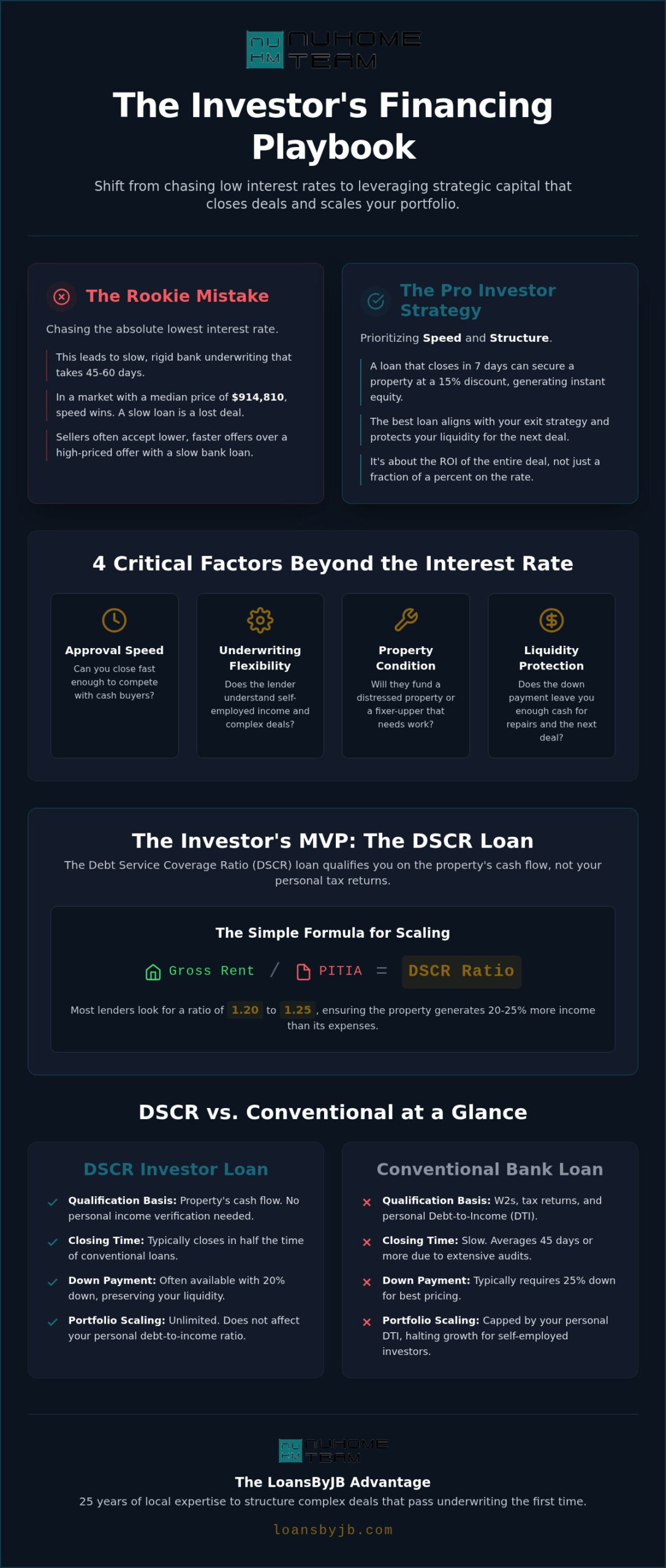
In 2026, chasing the lowest interest rate is a rookie move. With the national average for a 30-year fixed mortgage hovering around 6.82 percent, the era of “free money” is over. Success now depends on strategic capital. A loan that saves you a fraction of a percent but takes 60 days to close isn’t a deal. It’s a liability. The best investment property loan is the one that aligns with your exit strategy and protects your cash reserves. We focus on capital that moves as fast as the market does.
The ROI Equation in Real Estate Financing
Real wealth in real estate investing comes from smart leverage. High leverage can boost your internal rate of return (IRR) even if the interest rate looks high on paper. For many long-term plays, a 30-year fixed mortgage provides the ultimate hedge against inflation. It locks in your largest expense while California rents continue to climb. You must weigh the trade-off between a lower rate and closing speed. If a private money loan allows you to secure a property at a 15 percent discount because you can close in seven days, that “expensive” loan just made you six figures in equity instantly.
The Opportunity Cost of Conventional Underwriting
Big banks view you through a “Banker Lens.” They want stacks of W2s and perfect debt-to-income (DTI) ratios. We use an “Investor Lens” that prioritizes the deal’s potential. Conventional underwriting often drags on for 45 days or more. In competitive Southern California markets like Downey or Glendora, a 45-day close is an eternity. Sellers will often take a lower cash offer over your “low-rate” bank loan because they value certainty.
Rigid DTI requirements also kill portfolio growth for self-employed investors. If you rely on traditional banks, your growth stops the moment your tax write-offs lower your “official” income. Finding the best investment property loan means looking beyond the big banks. You need structures that allow you to scale based on property performance rather than your personal tax returns. Consider these factors when choosing your next loan:
- Approval Speed: Can you beat out cash buyers?
- Underwriting Flexibility: Does the lender understand self-employed income?
- Property Condition: Will the lender fund a “junker” that needs work?
- Liquidity: Does the down payment requirement leave you with enough reserves for repairs?
DSCR Loans: The Heavyweight Champion of Cash Flow Investing
Traditional banks love W2 employees. They hate complexity. If you are a self-employed investor, your tax write-offs often make you look poor on paper, even if your bank account says otherwise. This is where the Debt Service Coverage Ratio (DSCR) loan becomes the best investment property loan for your portfolio. Instead of digging through two years of tax returns, lenders look at one thing: can the property pay for itself? If the monthly rental income covers the mortgage, taxes, insurance, and HOA fees, you are in the game. It is that simple.
To calculate your ratio, divide the gross monthly rent by the total monthly debt service (PITIA). A ratio of 1.0 means the property breaks even. Most lenders in 2026 look for a 1.20 or 1.25 to ensure a safety net, though some programs allow for lower ratios if you have strong cash reserves. Because these loans don’t count against your personal debt-to-income ratio, you can scale your portfolio to ten, twenty, or fifty properties without hitting a “ceiling.” This asset-based approach is a fundamental part of Investment Property Financing for serious players who value speed over red tape.
DSCR vs. Conventional Investment Loans
DSCR loans typically close in nearly half the time of a conventional mortgage because there is no personal income to audit. While a conventional loan might offer a slightly lower rate, it often requires a 25 percent down payment to get the best pricing. In contrast, many DSCR programs allow for a 20 percent down payment. That 5 percent difference keeps more liquidity in your pocket for your next acquisition. Choosing the best investment property loan requires looking at the total cost of capital. Paying a 1 percent rate premium is a strategic trade-off that buys you privacy and the ability to scale without limits.
Optimizing DSCR for Short-Term Rentals
Southern California is a goldmine for short-term rentals (STRs), but traditional banks rarely understand the income volatility. We use market data from tools like AirDNA to justify the loan coverage based on projected STR income rather than conservative long-term lease averages. When setting up an STR, you must watch your prepayment penalties. Structuring a 3-year step-down penalty gives you the flexibility to refinance or sell once the property is stabilized and interest rates shift.
Managing vacancy factors in high-demand markets like Big Bear or Palm Springs is critical for approval. A smart DSCR structure accounts for seasonal dips while still maintaining your leverage. If you are tired of jumping through bank hoops, it is time to see how a DSCR loan can unlock your next deal. This flexibility makes it the heavyweight champion for anyone focused on immediate cash flow and long-term equity growth.
Renovation and Fix-and-Flip Loans: Financing the Equity Play
Junkers aren’t just eyesores; they’re equity goldmines waiting for the right capital structure. In a market where inventory is tight and prices are at record highs, you can’t always find a turnkey winner. You have to build one. Finding the best investment property loan for a distressed asset requires looking at the After-Repair Value (ARV) rather than just the current purchase price. If you can buy at 70 percent of ARV, you’ve won before the first hammer swings. Traditional banks usually run from peeling paint and leaky roofs. We don’t. We see the spread.
Investors often get overwhelmed by the variety of investment property loan options available for renovations. Choosing the right path depends entirely on your holding period. If you plan to keep the property as a long-term rental, you need a structure that rolls construction costs into a permanent mortgage. If you’re flipping, you need raw speed and a lender who understands construction draws. We prioritize the “Investor Lens” to ensure your capital isn’t tied up in red tape while your holding costs tick away.
The FHA 203k and Homestyle Advantage
Stop managing two separate loans for one house. The FHA 203k loan and Fannie Mae Homestyle programs allow you to buy and renovate with a single closing. This means one set of fees and one interest rate. In 2026, guidelines have expanded to cover everything from cosmetic kitchen refreshes to major structural repairs. You’ll need to vet your contractors early. Lenders require licensed pros with a proven track record to ensure the project stays on schedule. This is the best investment property loan for investors who want to maximize their cash-on-cash return by forcing appreciation from day one.
Hard Money for Tactical Speed
Sometimes, the best deal is the one that closes in 10 days. In competitive spots like Claremont or Rancho Cucamonga, sellers won’t wait for a 30-day conventional appraisal. Hard money and private money loans prioritize the asset over the borrower’s credit score. Expect to pay 1.5 to 3 points upfront and interest rates ranging from 8 to 14 percent. It sounds steep, but it’s the price of winning the bid. Most of these are interest-only structures designed for a 6 to 12 month exit. Your goal is simple: get in, fix it, and refinance into a 30-year fixed once the property is stabilized. Speed is your greatest leverage.
Navigating the Southern California Market: Local Financing Strategies
Southern California isn’t the Midwest. A “high-balance” loan here is just a typical Tuesday. In cities like Downey or Glendora, property values often push you into Jumbo territory before you even finish the home inspection. The best investment property loan in this region isn’t found at a national branch office. It is found where local market knowledge meets aggressive leverage. You have to account for high entry costs while factoring in specific local burdens like Mello-Roos and varying property tax assessments. If you don’t structure the debt to handle these carrying costs, your “deal” will bleed cash from month one.
Density and ADU Strategies
AB-1123 has changed the game for density in SoCal. You can now maximize lot potential by adding ADUs on vacant lots or existing assets in cities from Upland to San Dimas. We don’t just finance the purchase. We help you finance the construction of the ADU simultaneously. Smart investors use projected ADU rent to qualify for a higher loan amount. This allows you to build equity and cash flow on a single lot that traditional lenders would treat as a simple single-family residence. Stop looking for more land. Start looking for more density on the land you already have.
To support these development goals, you can explore Commercial Loan Origination and Interest Fees options from Evoque Lending to ensure your project is fully funded.
Non-QM Loans for Complex Income
If you are a business owner or a 1099 contractor, you are the “rebel” of the mortgage world. Traditional banks want to see a clean W2. We want to see your actual success. Non-QM loans allow us to use 12 or 24 months of bank statements to prove your ability to repay. We look at your deposits, not your tax-deductible expenses. For high-net-worth individuals, asset depletion loans allow you to use your total net worth as qualifying income. This is the best investment property loan structure for the self-employed investor who is tired of being sidelined by rigid, outdated underwriting rules.
Local expertise matters when the stakes are this high. You need a partner who knows the difference between a deal in Claremont and a deal in Rancho Cucamonga. If you are ready to stop guessing and start scaling, contact us today to structure your SoCal investment deal. We specialize in the complex scenarios that big banks simply can’t handle.
The LoansByJB Advantage: Why Experience is the Best Collateral
Automated mortgage portals and call center scripts are where good deals go to die. They can’t see the potential in a fixer-upper in Claremont or understand why a self-employed investor in Downey has fluctuating bank statements. In the high-stakes 2026 market, the best investment property loan isn’t just a set of terms on a page. It is the result of a deal structured by someone who has spent 25 years in the trenches. We don’t just process applications. We have real conversations about your long-term wealth strategy. Our goal is to ensure your financing plan actually survives the underwriting process the first time.
The Nuhome Team approach is built on a foundation of advocacy. We have seen every market cycle and every “impossible” scenario. This deep history allows us to act as a proactive guide. We call out industry flaws and hidden traps before they cost you a deposit. When you work with us, you get an “Investor Lens” on your capital. Because Justin Brown is an investor himself, he evaluates your loan through the eyes of a partner, not just a broker. We know what it takes to protect your liquidity while scaling a portfolio in Southern California’s competitive high-balance market.
A Straight-Shooter Consultation
Expect results, not corporate pleasantries. We provide a results-oriented financing plan that cuts through the noise of traditional banking. If a deal doesn’t make sense, we’ll tell you. If there’s a better way to leverage your assets, we’ll find it. Justin Brown’s background as a broker, lender, and investor changes your outcome because he understands the pressure of a closing deadline. You don’t need a “yes man.” You need a seasoned advisor who knows how to navigate the rules to your advantage. If you are ready to execute on a property, a personalized strategy session is your first step toward a successful close.
Your Southern California Investment Partner
We live and breathe the street-level data in La Verne, San Dimas, and Upland. This local expertise is vital when you are dealing with complex zoning or density plays like the ADU strategies we discussed earlier. Being a “rebel expert” means we know exactly which rules can be flexed and which lenders are hungry for SoCal paper. We bridge the gap between your ambitious goals and the rigid requirements of the financial world. Whether you are eyeing a multifamily unit or a tactical flip, we have the local connections to make it happen. Start your investor loan conversation with LoansByJB today.
Finding the best investment property loan shouldn’t feel like a battle against your own lender. It should feel like a strategic partnership. We are here to remove the barriers that big banks have spent decades building. Let’s look at your portfolio, identify the hurdles, and build a financing structure that actually works for you.
Stop Waiting and Start Scaling Your Portfolio
Success in the 2026 real estate market requires more than just finding a property. It requires a financing structure that moves as fast as you do. We’ve shown that the best investment property loan isn’t the one with the lowest teaser rate; it’s the one that protects your liquidity and allows you to scale without bank-imposed ceilings. Whether you’re leveraging DSCR for immediate cash flow or utilizing AB-1123 for density plays in Southern California, your capital must be as strategic as your exit plan.
Don’t let rigid underwriting or slow closing times kill your next deal. With 25+ years of experience and a specialized DSCR and Non-QM desk, we understand the nuances of the local market from Claremont to Downey. We bridge the gap between complex borrower profiles and aggressive investment goals. Ready to see what your next deal looks like with the right leverage? Get an Investor-Focused Loan Quote from LoansByJB. Your next move starts with a straight-shooter conversation and a plan designed for results. Let’s get to work.
Frequently Asked Questions
What is the minimum down payment for an investment property loan in 2026?
You need at least 20 percent down for most investment property loans in 2026. While some conventional programs might allow 15 percent, the pricing hits usually make it a bad move for your ROI. Putting 20 to 25 percent down secures the most aggressive rates and keeps your monthly cash flow healthy. If you are looking at renovation loans, your down payment is often calculated based on the purchase price plus the construction budget.
Can I get an investment property loan with no income verification?
Yes, you can secure financing without traditional income verification. DSCR loans focus entirely on the property’s rental income rather than your personal paycheck or tax returns. For self-employed investors, bank statement loans allow us to verify your ability to repay using 12 or 24 months of deposits. These options bypass the rigid debt-to-income ratios that typically stop portfolio growth at big banks. This is often the path to the best investment property loan for active investors.
How does a DSCR loan differ from a conventional mortgage?
Conventional mortgages audit your personal finances, including your W2s and tax returns. DSCR loans audit the property. A DSCR loan won’t show up on your personal debt-to-income ratio; this means you can scale your portfolio without hitting a bank’s “personal limit.” Conventional loans offer slightly lower rates but come with a 45-day closing headache. DSCR loans prioritize speed and flexibility, often closing in half the time of a traditional bank loan.
Is a 15-year or 30-year mortgage better for a rental property?
The 30-year fixed mortgage is almost always the superior choice for rental properties. It maximizes your monthly cash flow and acts as a powerful hedge against inflation. A 15-year mortgage might save you interest over the long haul, but it chokes your liquidity with a much higher monthly payment. In the 2026 market, keeping your cash reserves liquid is more important than paying off a low-interest debt early. Focus on cash-on-cash returns instead.
What credit score is needed for the best investment property loan rates?
You generally need a 740 credit score to unlock the best investment property loan rates. While the technical minimum for many programs is 620 or 660, your interest rate and down payment requirements will be significantly higher at those levels. If your score is below 700, expect to put more cash down to offset the lender’s risk. We focus on structuring deals that work even if your score isn’t perfect, but 740 remains the gold standard.
How do I finance a fix-and-flip in Southern California?
Use hard money or private money loans to win bids in competitive markets like Claremont or Downey. These lenders value the property’s After-Repair Value (ARV) over your personal income. You can typically close in 7 to 10 days; this is vital when competing against cash buyers. Expect to pay higher interest rates for this tactical speed, then refinance into a long-term loan once the renovation is complete and the property is stabilized.
Can I use a HELOC to buy another investment property?
Yes, using a HELOC on your primary residence or an existing rental is a savvy way to fund your next down payment. It allows you to tap into your “dead equity” without refinancing your entire first mortgage at a higher 2026 rate. This strategy provides the cash you need to act quickly on new opportunities. Just ensure the new property’s cash flow can handle the additional debt service of the HELOC before you pull the trigger.
What happens if the property’s rent doesn’t cover the mortgage (DSCR < 1)?
If the rent doesn’t cover the mortgage, you are looking at a “no-ratio” or low-ratio loan. Most lenders prefer a ratio of 1.20 or higher, but we can still fund deals where the DSCR is below 1.0 if you have strong cash reserves or a high credit score. You may be required to put 25 to 30 percent down to mitigate the risk. This is common for properties with high appreciation potential but low immediate yield.
Need the mortgage math checked?
Talk through the loan before you guess.
Use the estimator, request a refinance quote, or book a call with The Nuhome Team. We will help you compare the options that actually fit the file.
This is not a commitment to lend. Approval, terms, and pricing depend on credit, income, assets, property, and program guidelines.