

Your tax write-offs may be good for your business and bad for a standard mortgage application. If your returns don’t show the income you actually use to run your life, getting a mortgage pre-approval for self-employed Southern California can feel like an uphill fight, especially when sellers expect a clear, credible offer.
You’re right to question whether a basic pre-approval tells the whole story. For self-employed buyers, the loan strategy matters: S-Corp and LLC income, business expenses, and cash flow can all affect how a lender evaluates your file. The right documentation and loan option can make a difference.
This guide will show you how to prepare for pre-approval, organize the records lenders may review, and understand when traditional income documentation or a Non-QM bank statement loan may fit. You’ll also learn what helps make a pre-approval letter more credible in a competitive SoCal offer. LoansByJB brings more than 25 years of mortgage experience to complex self-employed scenarios, with a practical, investor-focused approach. Get clear on your options before you start making offers.
Key Takeaways
- Prepare your entity records and tax documents before applying so lenders can assess how your business is structured.
- Compare traditional income review with bank statement and other Non-QM options to find an approach that fits your financial documentation.
- Build a mortgage pre-approval for self-employed Southern California around the right loan structure and a complete, well-organized application.
- Learn what makes a pre-approval more credible when you’re competing for a home in Southern California’s high-cost markets.
- See how an investor-focused review can consider property carrying costs alongside income and credit, with LoansByJB bringing more than 25 years of experience to complex mortgage scenarios.
Why Standard Banks Fail Self-Employed Southern California Buyers
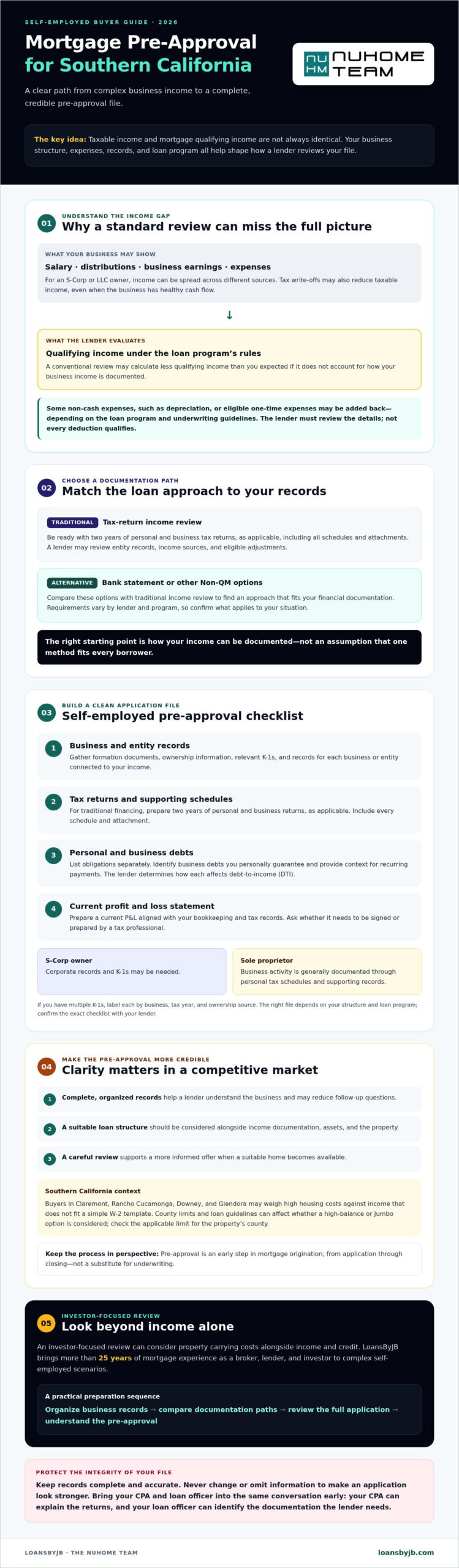
A strong business doesn’t always look strong on a mortgage application. Traditional underwriting often relies on documented income patterns that are easier to read for W-2 employees. If you own an S-Corp or LLC, your income may be spread across salary, distributions, and business earnings. A standard review can miss that context and leave you with a lower qualifying income than you expected.
Tax deductions create another snag. Write-offs may reduce taxable income, but mortgage qualification is based on income calculated under the lender’s rules. That gap can make a conventional application feel like a dead end, even when the business has healthy cash flow. A more useful mortgage pre-approval for self-employed Southern California starts by identifying how your income can be documented, not by assuming one method fits every borrower.
The Tax Return Trap
Taxable income and mortgage qualifying income aren’t always identical. Depending on the loan program and underwriting guidelines, certain non-cash expenses, such as depreciation, or eligible one-time expenses may be added back when calculating income. Don’t assume every deduction qualifies. The lender must review the details and apply the rules for that loan.
Bring your CPA and loan officer into the same conversation early. Your CPA can explain how your returns reflect the business; your loan officer can identify what documentation the lender needs. Keep records complete and accurate. Never change or omit information to make an application look stronger.
SoCal Market Reality
In places like Claremont, Rancho Cucamonga, Downey, and Glendora, buyers may be weighing high housing costs against income that doesn’t fit a simple W-2 template. A slow or incomplete review can make it harder to act confidently when a suitable home comes up. A credible pre-approval depends on more than a letter: it should be based on a careful review of your income, assets, and the loan structure you’re considering.
Loan size matters, too. County limits and loan guidelines can affect whether a buyer considers a high-balance option or a Jumbo loan for Southern California. Check the applicable limits for the property’s county rather than relying on an outdated figure.
The mortgage origination process runs from application through closing, so a pre-approval is an early step, not a substitute for underwriting. A local broker familiar with the area’s business structures can help clarify what a lender needs and which income documentation may fit. LoansByJB brings more than 25 years of experience as a broker, lender, and investor, with local expertise in Claremont, Rancho Cucamonga, and Downey. That context can help self-employed buyers move forward with a clearer plan.
The 2026 Self-Employed Pre-Approval Checklist
A clean file can help a lender understand your business without a trail of follow-up questions. For a mortgage pre-approval for self-employed Southern California, organize the documents around how your income is earned, how the business is structured, and which loan path you’re considering. Requirements vary by lender and program, so confirm the exact checklist before submitting.
- Step 1: Gather business entity records. Collect formation documents, ownership information, and relevant K-1s. Include records for each business or entity connected to your income.
- Step 2: Prepare tax returns. If you’re pursuing traditional financing, be ready to provide two years of personal and business returns, as applicable. Make sure all schedules and attachments are included.
- Step 3: Review debts. List personal obligations separately from business liabilities. Note which business debts you personally guarantee and provide context for recurring payments. The lender will determine how each item affects debt-to-income (DTI).
- Step 4: Update your profit and loss statement. Prepare a current P&L that aligns with your bookkeeping and tax records. Ask your lender whether it must be signed or prepared by a tax professional.
Entity-Specific Documentation
An S-Corp owner may need corporate records and K-1s, while a sole proprietor generally documents business activity through personal tax schedules and supporting records. The right file depends on your structure and loan program. If you have multiple K-1s, label each by business, tax year, and ownership source so the underwriter can follow the income trail. A lender may also ask for evidence that the business is active, such as applicable license or registration records. Verify what applies to your business and location rather than assuming every borrower needs the same document. For general mortgage guidance and consumer rights for mortgage applicants, see the CFPB’s mortgage resources.
The P&L Power Play
A recent P&L gives the lender a current view of revenue and expenses that an older tax return can’t show. It may help explain improving business performance, but it doesn’t automatically replace tax returns or establish qualifying income. The lender decides how much weight it carries under the chosen program.
Keep it accurate and consistent. Common red flags include missing periods, expenses that don’t match bookkeeping, unexplained revenue swings, and figures that conflict with tax documents. Don’t inflate projections or relabel expenses to improve the application. Ask your tax professional to reconcile discrepancies before submission. If your income comes from several entities, discussing documentation options with LoansByJB’s mortgage team may help you prepare a clearer file.
Beyond Tax Returns: Bank Statement and Non-QM Solutions
Your tax returns aren’t the only possible way to document income. For some self-employed borrowers, a bank statement loan can use 12 to 24 months of personal or business deposits to help calculate qualifying income. It’s a documentation alternative, not a shortcut around underwriting: lenders still assess the source and consistency of deposits, business expenses, credit, assets, and other parts of the application.
That flexibility is why Non-QM loans can be a strategic fit for entrepreneurs whose tax returns don’t reflect their full cash flow. Non-QM isn’t automatically a last resort or a sign of poor credit. It’s a different approach to documenting a borrower’s ability to repay, with terms and requirements that vary by lender and program. The right fit depends on the whole file, not a label.
How Bank Statement Loans Work
Personal statements may suit an owner who regularly transfers business income into personal accounts. Business statements can make more sense when deposits and expenses stay in the company account. The lender may apply an expense factor to business deposits to estimate the portion available as income. That calculation isn’t universal, so ask how expenses, transfers, and unusual deposits will be treated before choosing an account history.
More flexible documentation doesn’t guarantee a faster closing than an FHA or conventional loan. A complete, consistent file can help avoid preventable questions. Gather every requested statement, keep pages unaltered, and be ready to explain large or unusual deposits.
The Investor Strategy
Look beyond the tax return, but keep the property’s carrying costs in view. An investor lens means assessing the payment alongside taxes, insurance, maintenance, and realistic rental income, not just asking whether a lender will approve the loan. For a primary home with an accessory dwelling unit or a multi-unit property, projected or existing rent may be considered under the specific loan guidelines. Don’t assume every dollar of rent will count toward DTI.
For an investment property, a DSCR loan may focus on the property’s rental income relative to its debt obligations rather than relying on personal tax returns in the same way as some other programs. Requirements still apply. Some lenders may also assess eligible assets as part of a qualification approach sometimes called asset depletion. Ask what assets count and how the program calculates income; availability and rules vary.
Use these distinctions to shape your mortgage pre-approval for self-employed Southern California. LoansByJB specializes in complex self-employed scenarios, including Non-QM and bank statement lending. The aim is to match documentation and loan structure to your actual situation, then evaluate the property’s costs before you commit.
Navigating Southern California’s Competitive 2026 Market
A pre-approval letter has to stand up to scrutiny, not just look impressive in an offer package. In August 2026, Southern California’s median home price was $900,000, up 2.9% year over year, while regional sales were down 4.8% compared with August 2025. Buyers may have more listings to consider than during the recent frenzy, but strong preparation still matters when the right property draws competing offers.
For a mortgage pre-approval for self-employed Southern California, ask what the lender has actually reviewed, what remains outstanding, and whether the loan amount fits the property and county. In Los Angeles and Orange Counties, a Jumbo loan may be relevant, but 2026 limits and requirements vary by county and loan program. Verify current limits before making an offer instead of relying on a number from an older listing or article.
Winning Multiple-Offer Wars
A basic pre-qualification may rely on information you’ve reported, while a more thoroughly reviewed pre-approval may include document and income checks. Ask your mortgage professional what has been verified and what conditions remain. You can also ask whether they’re prepared to answer the listing agent’s questions about your financing. A direct, accurate conversation can help clarify the strength of the file, but no letter guarantees acceptance or closing.
Don’t remove a loan contingency just to make an offer look like cash. That can expose you to financial risk if financing falls through. Understand each contingency with your real estate professional before deciding what to include or waive. If an appraisal comes in below your offer, know in advance whether you can cover a potential gap and how that choice affects your budget. Never commit funds you can’t afford to lose.
Specific Local Nuances
Compare the full carrying cost, not only the mortgage payment. Check property taxes and any Mello-Roos or other assessments tied to the specific property. For an older San Dimas home that needs work, an FHA 203k renovation loan may be worth exploring if you meet program requirements.
Local familiarity can help a mortgage professional understand the area, but verify their actual knowledge and communication process. LoansByJB lists local expertise in Claremont, Rancho Cucamonga, and Downey; don’t assume that means an office in Upland. In 2026, California inventory stood at 3.7 months in August, and active listings were forecast to rise about 10% for the year, while mortgage rates were expected to remain sideways to higher through year-end. Plan around the home and payment you can manage, not a rate prediction. Discuss your Southern California mortgage options with LoansByJB.
The LoansByJB Advantage: An Investor Lens on Your Mortgage
A mortgage decision shouldn’t stop at a credit score or a single tax-return figure. For a self-employed buyer, the loan structure needs to fit the way income is earned and the way the property will be used. LoansByJB brings more than 25 years of experience as a broker, lender, and investor to complex scenarios, including self-employed borrowers whose finances don’t fit a standard W-2 profile.
That investor perspective asks practical questions: What will the property cost to carry? How might expenses change if income fluctuates? If it’s an investment, what’s the plan for holding or eventually selling it? These questions don’t replace lender qualification rules. They help you assess whether the proposed financing makes sense for your goals, not just whether an application can move forward.
Personalized Strategy Sessions
Start with a clear conversation about your business structure, income records, debts, assets, and intended property use. A primary residence, a long-term rental, and a fix-and-flip project call for different financing considerations. LoansByJB specializes in Non-QM scenarios and offers options including Jumbo loans, DSCR loans, and Fix and Flip loans. The right program depends on the full picture and its applicable requirements.
Before submitting a file, organize documents and flag anything that needs explanation: multiple income sources, business expenses, unusual deposits, or a recent change in earnings. Clear records can reduce avoidable questions, but no lender can promise an approval or guarantee that underwriting won’t request more information. The goal is to present an accurate, coherent application and address issues directly.
Your Southern California Partner
LoansByJB’s local expertise includes Downey and Rancho Cucamonga, as well as Claremont. That regional familiarity can help frame questions around the property and its carrying costs, while a personalized review can help identify which financing paths may fit. You should expect a straight answer about documentation, program requirements, and what remains uncertain. No magic tricks. Just a strategy built around the facts of your file.
If you’re preparing for a mortgage pre-approval for self-employed Southern California, bring your questions about income documentation and property plans into the conversation early. Explore mortgage options with LoansByJB and learn what information may help shape a financing strategy with Justin Brown.
Build a Pre-Approval That Fits Your Business
Your business income deserves a careful review, not a one-size-fits-all formula. The right mortgage pre-approval for self-employed Southern California starts with complete records, a clear picture of your business structure, and a loan approach suited to how you document income. Bank statement and other Non-QM options may be worth exploring when tax returns don’t tell the full cash-flow story.
Look beyond approval alone. Make sure the financing fits the property’s carrying costs and your plans for it. LoansByJB brings more than 25 years of experience as a broker, lender, and investor, specializes in complex Non-QM scenarios, and has local expertise in Southern California communities including Claremont, Rancho Cucamonga, and Downey.
Get a clear view of your options before you make an offer. Get your self-employed pre-approval started with LoansByJB. With an informed plan and the right documentation, you can move forward with greater confidence.
Frequently Asked Questions
Can I get a mortgage in Southern California with only one year of self-employment?
Possibly, but options may be limited. The research for this guide says most lenders look for a two-year self-employment history, though requirements vary by lender and loan program. Ask what documentation could support your application with one year in business, and whether prior work history is relevant under the program. For a mortgage pre-approval for self-employed Southern California, clarify the timeline early, whether you’re buying in Claremont, La Verne, San Dimas, Upland, Rancho Cucamonga, Glendora, or Downey.
How much of a down payment is required for a bank statement loan in 2026?
Bank statement loans often call for a down payment in the 10% to 20% range, according to the 2026 research brief, but that’s not a guaranteed requirement for every borrower or lender. The amount may depend on the loan program, property use, credit profile, and other parts of your application. Ask for the lender’s current down-payment and reserve requirements for your specific scenario before setting a purchase budget.
Do bank statement loans have higher interest rates than conventional mortgages?
They may have different, and sometimes higher, pricing than conventional mortgages, but there’s no single rate that applies to every borrower or program. Compare written loan terms, including the rate, fees, down payment, and payment structure, rather than judging by loan type alone. Ask how the lender calculates qualifying income from deposits and what documentation is required. LoansByJB specializes in complex Non-QM scenarios, but eligibility and terms depend on the individual application.
What is the maximum loan amount for a self-employed Jumbo loan in LA County?
There isn’t one universal maximum for every Jumbo loan. The applicable conforming loan limit depends on the county and year, while a lender’s Jumbo maximum depends on its program and your financial profile. Because current 2026 county limits need to be verified, don’t rely on an older figure. Ask the lender to confirm the applicable Los Angeles County limit and its own maximum for your property type and loan scenario.
Can I use business funds for my down payment and closing costs?
Possibly, but the lender must determine whether the funds are eligible and properly documented. Business money may need to be shown as available to you, and removing it could affect the company’s cash flow or financial standing. Don’t transfer funds or assume they can be used without checking first. Ask what records are needed to document ownership, source, and any withdrawal, and whether the funds affect your business-income analysis.
What happens if my business took a loss last year due to one-time investments?
The lender will review the loss and determine how it affects qualifying income under the selected program. Some expenses, such as depreciation or eligible one-time items, may be considered for add-back under applicable guidelines, but not every expense qualifies. Gather the tax return, a current profit and loss statement, and records explaining the investment. Have your tax professional and mortgage professional review the same figures so the explanation is accurate and consistent.
How does a DSCR loan differ from a self-employed bank statement loan?
A bank statement loan generally uses personal or business deposits to help evaluate a self-employed borrower’s qualifying income. A DSCR loan is designed for an investment property and focuses on the property’s rental income relative to its debt obligations, subject to program rules. The distinction is what income source is being assessed. Neither option means “no review”; ask about documentation, property requirements, and how the lender evaluates the full application.
Is a 30-year fixed mortgage still the best option for self-employed borrowers?
Not automatically. A 30-year fixed mortgage may suit buyers who value a predictable principal-and-interest payment over a longer term, but the best fit depends on your budget, plans, loan eligibility, and how long you expect to keep the property. Compare it with other available structures, including a 15-year fixed mortgage or an adjustable-rate mortgage. Review total carrying costs and ask the lender to explain how each option fits your income pattern and goals.
Need the mortgage math checked?
Talk through the loan before you guess.
Use the estimator, request a refinance quote, or book a call with The Nuhome Team. We will help you compare the options that actually fit the file.
This is not a commitment to lend. Approval, terms, and pricing depend on credit, income, assets, property, and program guidelines.