

The property alone shouldn’t choose the loan. A rental held for steady income and a property bought for a short-term project may call for different financing, depending on the full file. An investor focused mortgage broker Claremont CA can help compare possible loan paths before you commit.
It’s reasonable to be unsure where to start, especially when income, property condition, or your investment plan doesn’t fit a simple checklist. The Nuhome Team looks at the borrower, the property, and the planned exit together, then explains options in plain English, including real estate investor loans in Southern California.
This article explains what investor-focused mortgage guidance should cover, what details to gather, and how to tell a long-term rental plan from a short-term project financing need. Bring the property details, your financing goals, and the plan for the investment. That gives the conversation a useful place to start.
Key Takeaways
- Use the property, borrower profile, financing purpose, and planned exit to frame the loan discussion.
- Ask which financing paths fit your rental, renovation, or bridge plan, and what details support each option.
- Organize property, borrower, and project information before the conversation to make the deal easier to assess.
- An investor focused mortgage broker Claremont CA can help compare possible loan paths for a specific investment scenario.
- Learn how Justin Brown’s Southern California mortgage and real estate experience informs The Nuhome Team’s approach to complex investor files.
What should an investor-focused mortgage broker in Claremont help you assess?
An investor-focused mortgage broker should assess the borrower, property, financing purpose, and planned exit together. That full picture helps frame a useful discussion of possible real estate investor loans in Southern California, instead of starting with a loan type before understanding the deal.
The Nuhome Team can discuss multiple loan-program paths, rather than limit the conversation to one bank’s menu. That matters when your income, property, or investment plan needs more explanation than a standard application allows.
Why does an investment property need a different financing conversation?
A home you plan to live in and a property you plan to rent or improve serve different purposes. Business-purpose options such as DSCR, bridge, and hard money loans are for investment property, not owner-occupied homes.
The intended use is only one part of the picture. Borrower finances, property details, and program rules can all affect which options are worth discussing. No one loan type fits every investor, and a program’s name alone doesn’t tell you whether it fits your file.
Start with the plan. Is the property meant to produce rental income, or do you expect to renovate and sell it? How you plan to hold or exit the investment helps shape the financing conversation. A broker can explain which loan paths may fit and what information is needed to assess them, subject to underwriting and program guidelines.
What does local Claremont experience add?
Local coverage gives you a direct point of contact familiar with Southern California investment scenarios. The Nuhome Team serves Claremont and nearby communities. That keeps the discussion focused on the property and plan you bring forward, without relying on broad claims about local prices, rents, or demand.
Justin Brown, Owner and Broker, has more than 25 years of Southern California mortgage and real estate experience. For a complex file, that experience can help make the discussion more specific: what is known about the borrower, what needs clarification about the property, and which financing paths merit consideration.
A clear conversation should leave you with practical next steps, not a pile of loan labels. Bring the property details and your intended use. Then discuss what information may help assess possible paths for your Claremont-area investment.
How can you evaluate whether a broker understands your investment deal?
A broker should be able to explain how your property, plans, borrower details, and possible financing paths fit together. Start with the facts, then ask why a loan option merits discussion and what information supports it. Any option remains subject to underwriting and program guidelines.
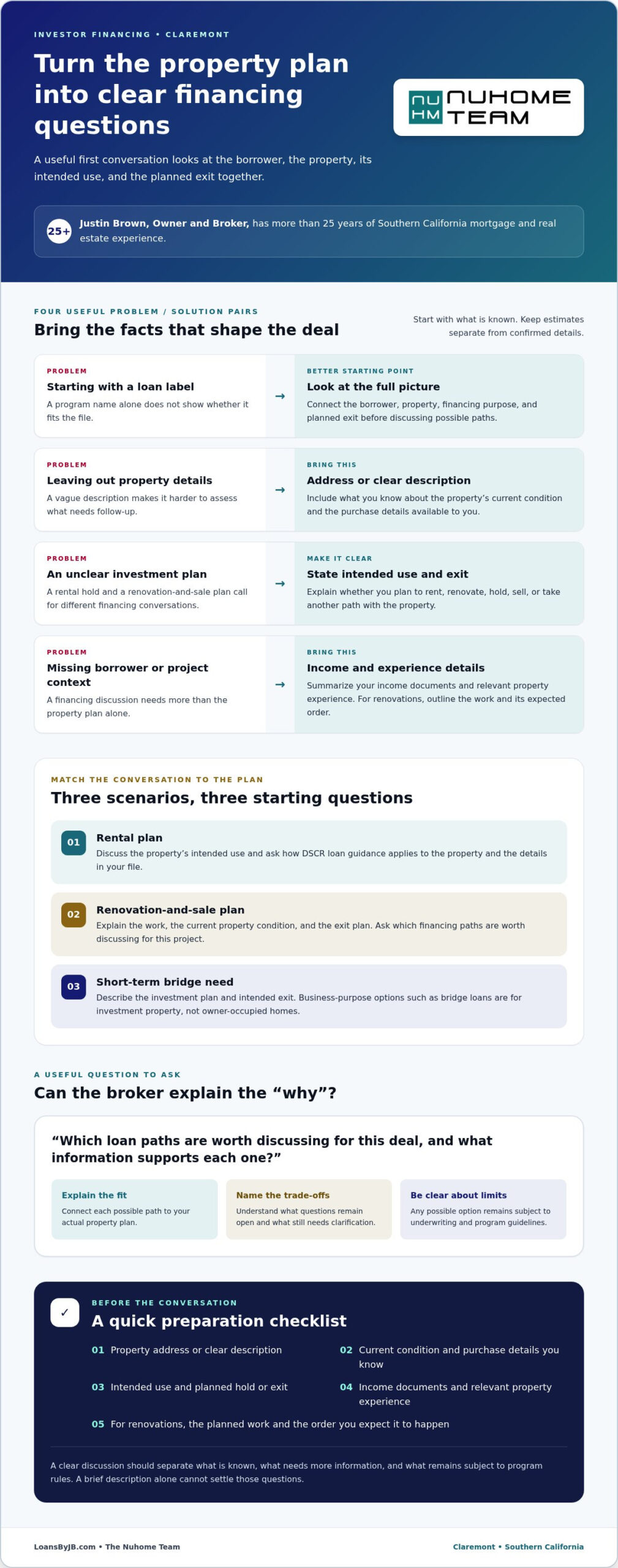
A useful first investor loan conversation turns your property plan into clear financing questions, not a promise of approval.
- Describe the property. Share its address or a clear description, including what you know about its current condition.
- Explain its intended use. Say whether you plan to rent it, renovate it, or use another investment plan.
- Summarize your borrower profile. Be ready to explain your income documentation and relevant property experience accurately.
- State your intended exit. Explain whether you plan to hold the property, sell it, or take another path.
Then ask: “Which loan paths are worth discussing for this deal, and what information supports each one?” A useful answer should connect the options to your actual plan. If a detail is missing, the broker should identify the question, not gloss over it.
What information should you bring to an initial discussion?
Bring the property address or description, its intended use, and the purchase details you know. Summarize your income documents and any experience managing or owning investment property. If you’re planning renovations, outline the work and the order you expect it to happen. Keep estimates and confirmed details separate. A clear account helps shape the discussion, but it does not establish eligibility.
How should the broker explain the financing path?
Look for plain English. The broker should explain why a path may fit, what trade-offs it brings, and which questions still depend on underwriting. Ask how the proposed structure relates to your hold or exit plan. If rental financing is under consideration, ask how DSCR loan guidance applies to the property and the details in your file.
For example, a rental plan and a renovation-and-sale plan may call for different financing conversations. The broker should make clear what facts led to each possible path, rather than treating a loan label as a recommendation. That’s especially useful if your income or property has details that need more than a quick checkbox review.
Pay attention to how the broker handles uncertainty. A solid discussion names what is known, what needs more information, and what remains subject to program rules. No one can settle those questions based on a brief description alone.
Before moving forward, make sure you can explain the proposed path in your own words. You should know what facts support considering it, what questions remain open, and which details need follow-up. That gives you a clearer basis for deciding what to explore next.
Which financing conversation fits a rental, renovation, or bridge scenario?
Start with what you plan to do with the property. A rental, a renovation project, and a short-term bridge need different financing discussions because the property’s use, condition, and your exit plan all matter. The right path depends on the full file and program guidelines.
Use this comparison to frame the conversation. It’s a starting point, not a promise that a specific loan will fit.
| Scenario | Financing conversation | Key details to discuss |
|---|---|---|
| Long-term rental | DSCR or another rental-property option | Property use, rental plan, borrower profile, and program rules |
| Property needing renovation | Renovation financing or investment-property funding | Current condition, planned work, project order, and intended exit |
| Short-term financing need | Bridge, hard money, or private money options | Why short-term funds are being considered, property details, and exit plan |
When might a rental-property financing discussion include DSCR?
DSCR loans are one option The Nuhome Team offers for investment-property financing. If you’re considering a rental, discuss the property’s intended use and the information the program may review. Requirements can vary, so don’t assume a certain rent figure, borrower profile, or property detail settles eligibility.
Compare the rental plan with other relevant facts in your file. Ask what program rules apply and what details are still needed to assess the option. For program-specific information, review DSCR loans in California.
When might renovation or short-term financing enter the discussion?
Property condition can change the conversation. A home that needs work may call for a discussion about renovation funding, while a short-term investment plan may bring bridge, hard money, or private money options into view. The project sequence matters too. Explain what work is planned and how you expect to move from purchase through renovation and toward your intended exit.
These are possible discussion paths, not automatic solutions. Bridge and hard money loans are business-purpose financing for investment properties, not owner-occupied homes. The details of the property, borrower, and plan remain subject to underwriting and program guidelines.
Keep the distinctions clear. Rental financing centers on the planned rental use and the program’s review of the file. Renovation financing centers on the property and planned work. A bridge or private-capital discussion centers on the short-term purpose and how you plan to exit. One deal may raise more than one question, but the label alone doesn’t answer it.
An investor focused mortgage broker Claremont CA should connect the proposed financing discussion to your actual plan, explain what information supports it, and be clear about what remains uncertain. That’s how you compare paths without treating a possible option as a sure thing.
How can you prepare a Claremont investment deal for a broker conversation?
Put the deal facts in one short summary before you discuss financing. Include the property, intended use, purchase status, condition, borrower details, project plan, and expected exit. A clear summary helps an investor focused mortgage broker Claremont CA spot missing details and frame useful questions.
What belongs in a simple investment deal summary?
Keep it factual. Separate what you know from what you still estimate. A useful summary can include:
- Property: Address or description, property type, and known condition.
- Plan: Intended use, such as rental or renovation, and current or planned occupancy.
- Purchase status: Whether you’re considering a property, under contract, or already own it, along with purchase details you know.
- Borrower details: A plain summary of income documents and relevant property experience.
- Project and exit: Planned work, the expected order of the work, and whether you plan to hold, sell, or pursue another exit.
Label estimates as estimates. For example, distinguish a contractor’s early scope from work that has been fully defined. Don’t smooth over a gap to make the deal sound simpler. The broker can help identify which open questions may matter to the financing discussion.
How should you organize the information?
Start with the property and purpose. Then add borrower and project details. Finish with the exit plan. This order makes it easier to see how the parts connect, and it helps keep an early conversation focused on the deal rather than scattered paperwork.
Example only. An investor describes a Claremont property planned for rental use, notes its current condition, summarizes available income records, and explains the intended hold plan. The investor marks renovation items as preliminary where the scope is still being worked out. This example uses no invented financial figures. Any numeric example requires verified, approved inputs before publication.
Use the conversation to clarify financing questions, not to make tax or legal decisions. Ask your CPA or attorney about tax treatment, ownership structure, contracts, and other legal matters.
Who does this approach fit, and who may need another conversation?
This preparation fits investors weighing financing for a rental, renovation, or another investment property plan. It’s also useful if income or property details are complex. Explain the full scenario, including unusual documentation, property condition, or project steps. Missing context can make a deal sound very different from what it is.
If you plan to live in the home, say so at the start. Owner-occupied purchases require a different loan-purpose discussion. Business-purpose DSCR, bridge, hard money, and fix-and-flip loans are for investment properties, not owner-occupied homes.
Bring the summary to a conversation with The Nuhome Team and ask which details matter most for the next step. If you’re ready to discuss a Claremont investment scenario, book a call about your investment deal.
How does The Nuhome Team approach investor financing in Claremont?
As an experienced investor focused mortgage broker Claremont CA, The Nuhome Team starts with the property, borrower, investment purpose, and planned exit. Justin Brown, Owner and Broker, brings more than 25 years of Southern California mortgage and real estate experience to these discussions. The goal is clear guidance about possible loan paths, not a promise of approval, rates, or timing.
A broker can discuss more than one financing path, rather than work from a single bank’s menu. Working with an investor focused mortgage broker Claremont CA, clients gain access to multiple loan programs and clear explanations of their options in plain English. That can help make a complex income or property scenario easier to discuss, while final eligibility remains subject to underwriting and program guidelines.
What makes the conversation locally relevant?
The Nuhome Team serves Claremont and surrounding Southern California communities. Local experience provides context for a conversation about a specific property and plan. It does not predict a property’s value, rental income, or financing outcome.
For an investor, useful local context means discussing the actual address, property condition, intended use, and borrower details. Those facts matter more than broad claims about an area. As a dedicated investor focused mortgage broker Claremont CA, The Nuhome Team is licensed as NMLS #1647915 and CA DRE #02039443.
What is a practical next step for an investor?
Bring a short summary of the property and what you plan to do with it. Include the purchase status, current or planned occupancy, known condition, income documentation, and your expected exit. If a bridge loan may be part of the discussion, explain why you’re considering short-term financing and how it relates to your investment plan. Bridge loans are business-purpose loans for investment property, not owner-occupied homes.
Be direct about details that are still estimates or questions. A useful discussion can sort confirmed facts from open items and identify which financing paths may merit review. No early conversation replaces a full review of the file.
If you’re weighing an investment property in Claremont, Book A Call to discuss the property plan and borrower details with LoansByJB (The Nuhome Team). Bring what you have. You don’t need to turn the first conversation into a polished presentation.
This article is for general education only and is not a commitment to lend. All loans are subject to credit approval, underwriting, property eligibility, and program guidelines. Rates and terms can change without notice. LoansByJB (The Nuhome Team), NMLS #1647915, CA DRE #02039443. Equal Housing Lender.
Make your next financing decision with a clear plan
Your next step doesn’t need to be a perfect loan choice. It needs to be a clear question about the property and the decision you’re trying to make. Are you comparing ways to hold a rental, fund planned work, or manage a short-term investment? Naming that decision can help keep the financing discussion focused.
Before you speak with an investor focused mortgage broker Claremont CA, write down what matters most to your plan and what details are still uncertain. That gives you a practical starting point, especially if your income or property situation needs more explanation. The goal is to understand possible paths and their conditions, not to assume an outcome before the file is reviewed.
If you’re ready to discuss your investment property financing, Book a Call with The Nuhome Team. Bring the questions you have, even if you’re still sorting out the plan. A clear conversation can help you decide what to explore next.
Frequently Asked Questions
Is a mortgage broker the same as a lender?
No. A mortgage broker helps connect a borrower with loan programs from lenders, while a lender offers financing from its own menu. A broker’s broader access gives you more paths to discuss, but it doesn’t mean every program will fit every borrower or property. For a Claremont investment, ask why a specific option merits review and what details could affect eligibility.
Can a mortgage broker help with an investment property if I am self-employed?
Yes. The Nuhome Team handles complex and self-employed scenarios, including investor files. Be ready to describe how your income is documented and explain any unusual changes or gaps in the records. The investor focused mortgage broker Claremont CA conversation can help identify relevant questions, but documentation needs and eligibility depend on the full file and program guidelines.
Are DSCR, bridge, and hard money loans for owner-occupied homes?
No. These are business-purpose financing options for investment property, not owner-occupied homes. If you plan to live in the property, state that at the start so the loan-purpose discussion matches your plan. If the property is an investment, explain whether you intend to rent, renovate, or use another investment approach. Program eligibility depends on underwriting and applicable guidelines.
How do I verify a California mortgage professional’s license?
Use NMLS Consumer Access to look up a mortgage professional or company by name or NMLS number. The Nuhome Team’s identifiers are NMLS #1647915 and CA DRE #02039443. Check that the results match the business you’re speaking with, especially if you’re comparing names or records. This is a practical step before sharing detailed financial documents.
Need the mortgage math checked?
Talk through the loan before you guess.
Use the estimator, request a refinance quote, or book a call with The Nuhome Team. We will help you compare the options that actually fit the file.
This is not a commitment to lend. Approval, terms, and pricing depend on credit, income, assets, property, and program guidelines.