

A jumbo approval isn’t just about earning more or making a larger down payment. Lenders look at how your income, assets, debts, reserves, and property plans fit together. If you’re researching how to get approved for jumbo loan financing, start by checking the conforming loan limit for the property’s county. For 2026, the Federal Housing Finance Agency set a baseline conforming limit of $832,750 for a one-unit home, with a ceiling of $1,249,125 in designated high-cost areas.
It’s understandable to feel unsure about what lenders will require, especially if your income varies, you’re self-employed, or your finances don’t fit a standard template. A complex financial profile doesn’t automatically rule out jumbo financing. Preparing clear records and choosing a loan structure that fits your situation can help lenders assess the full picture.
This guide explains what jumbo lenders review, which documents to organize, and how to prepare for underwriting. You’ll also learn how to prevent common delays and compare financing paths against your finances and property plans. LoansByJB’s Justin Brown brings more than 25 years of experience as a broker, lender, and investor, with an approach that considers the borrower’s full scenario.
Key Takeaways
- Compare your requested loan amount with the limit for the property’s county to determine whether jumbo financing may apply.
- Understand how lenders consider credit history, documented income, assets, recurring debts, and property details together.
- Self-employment or a complex financial profile doesn’t automatically rule out jumbo financing. Organized records can help explain your finances.
- Use a practical preparation sequence to organize your application and reduce preventable delays.
- Learn how to get approved for jumbo loan financing by matching your financial picture with a loan structure suited to your property plans.
How to Get Approved for a Jumbo Loan Starts With Knowing What Counts
Start with two details: the loan amount you need and the county where the property is located. A jumbo mortgage exceeds the applicable conforming loan limit. The Federal Housing Finance Agency (FHFA) publishes those limits, which can change by year and vary by county. For 2026, the FHFA baseline limit for a one-unit property is $832,750, while designated high-cost areas may have higher limits. Check the current FHFA county table for the correct year and property type.
The purchase price alone doesn’t determine whether a mortgage is jumbo. Your down payment affects the amount you borrow, and it’s the requested loan amount, compared with the limit for the property’s county, that matters. A higher-priced home may qualify for a conforming loan if the mortgage amount stays within the applicable limit. A lower-priced property may require a jumbo loan if the amount borrowed exceeds its county’s limit.
How county loan limits affect a Southern California jumbo loan
Southern California doesn’t have one shared conforming limit. A borrower buying in Los Angeles County may face a different limit from someone buying in Orange, Riverside, or San Bernardino County. If you’re considering a property in Claremont, La Verne, San Dimas, Upland, Rancho Cucamonga, Glendora, or Downey, identify its county and check the FHFA’s current figures for the correct year and property type. Use the official county table rather than relying on an older figure or a regional estimate.
What jumbo status does, and does not, tell you about approval
Jumbo status identifies a loan-size category. It doesn’t determine approval. Because jumbo loans exceed conforming limits, they generally follow underwriting criteria outside the standard conforming framework. Requirements can differ by lender and program, so there isn’t one checklist that applies everywhere. For a basic explanation of the distinction, see the Jumbo mortgage overview.
To understand how to get approved for jumbo loan financing, look beyond the loan label. Lenders may assess credit history, documented income, assets, recurring debts, and the property. They may also apply lender-specific overlays, which are additional requirements beyond baseline criteria. The loan category tells you which financing lane you’re in; the complete application shows how your financial picture fits the program. For more context, explore this jumbo mortgage overview.
What Jumbo Lenders Review Before Approving Your Application
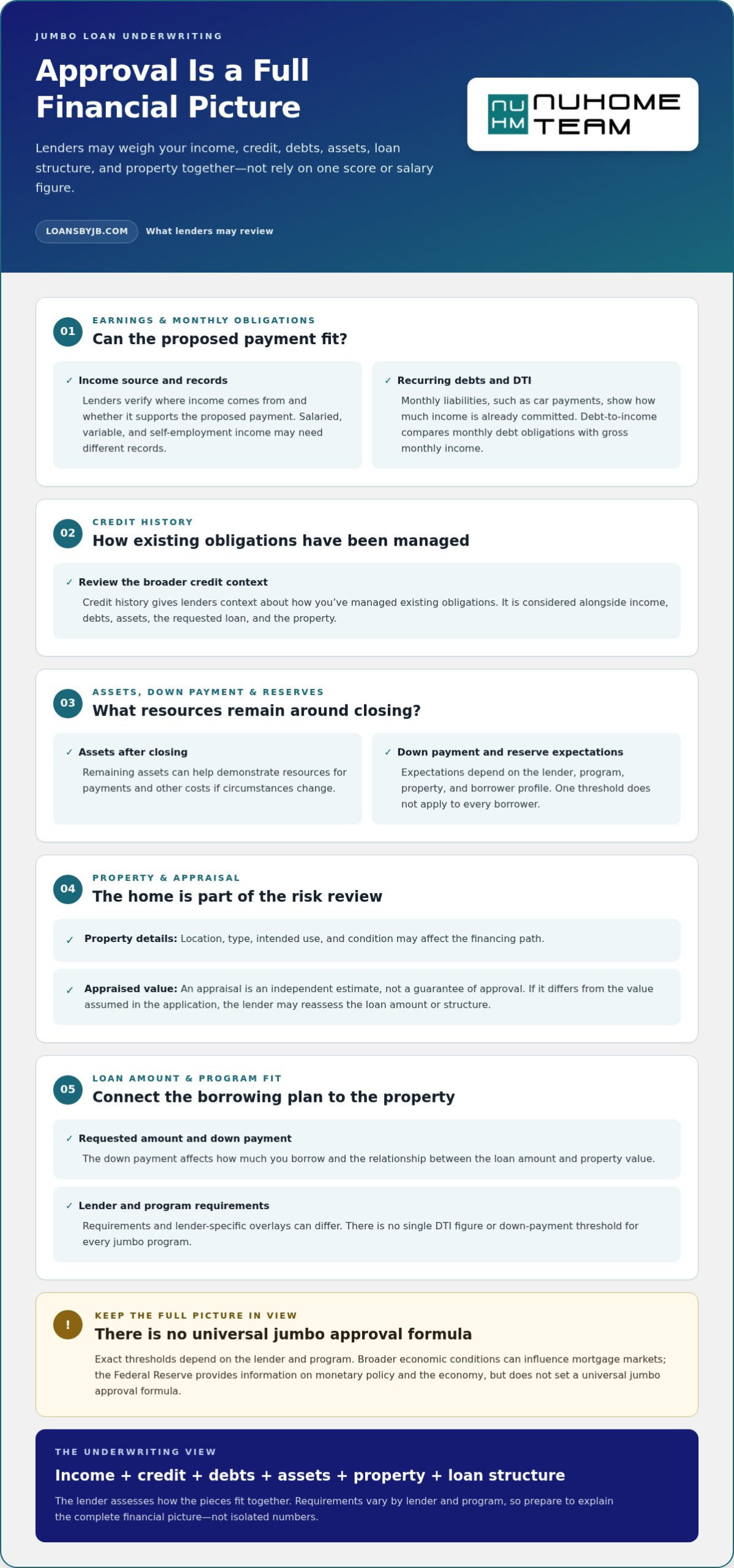
A jumbo application is reviewed as a complete financial picture, not on the basis of a single score or salary figure. Lenders may consider your credit history, the source and documentation of your income, your assets and recurring debts, the requested loan amount, and the property. Specific requirements depend on the program and lender.
Income, credit, debts, and cash reserves
The lender will verify where your income comes from and whether it supports the proposed payment. Salaried income, variable earnings, and self-employment income may require different records. Your credit history gives context about how you’ve managed existing obligations. Recurring debts, such as car payments and other monthly liabilities, help show how much of your income is already committed.
Lenders often compare monthly debt obligations with gross monthly income using debt-to-income, or DTI. This helps them assess whether the proposed mortgage fits alongside your existing payments. There isn’t one DTI figure for every jumbo program. Cash reserves matter as well. Assets remaining after closing can help demonstrate that you have resources for payments and other costs if circumstances change. Down payment and reserve expectations depend on the lender, program, property, and borrower profile.
Property value, appraisal, down payment, and loan structure
The property is part of the lender’s risk review. Its location, type, intended use, and condition may affect the financing path. An appraisal provides an independent estimate of value, but it doesn’t guarantee approval. If the appraised value differs from the amount assumed in the application, the lender may reassess the loan amount or structure.
Your down payment affects both the amount borrowed and the relationship between the loan amount and property value. Options vary by lender and program, so don’t assume one down-payment threshold applies to every borrower. The requested loan amount, property details, available assets, and loan structure all need to be considered together.
In short: jumbo underwriting may weigh credit history, verified income, recurring debts and DTI, assets and post-closing reserves, down payment, loan structure, and appraised property value. Exact thresholds depend on the lender and program. Broader economic conditions can influence mortgage markets. The Federal Reserve System provides information on monetary policy and the economy, but it doesn’t set a universal jumbo approval formula.
When preparing for jumbo financing, be ready to explain how the pieces fit together rather than presenting isolated numbers. A tailored review can connect your income, assets, and property plans before you select a structure. Explore jumbo financing guidance as you prepare.
Can You Get Approved With Self-Employment Income or a Complex Financial Profile?
Being self-employed, holding substantial assets, or earning income from several sources doesn’t automatically rule out jumbo financing. It does make a clear paper trail especially important. Lenders assess whether your records meet the requirements of a particular program, and documentation options differ across jumbo lenders.
Traditional documentation may include personal and business tax returns, income statements, and other records that help show earnings over time. Some programs may consider alternatives, such as bank statements, but availability and calculation methods vary. Alternative documentation can help present income that doesn’t fit a standard paystub pattern, but it may come with different eligibility rules and doesn’t guarantee approval. The aim is to match the evidence to a program that can evaluate it.
Preparing a clear file when you are self-employed
Arrange personal and business records in a consistent timeline. Keep tax returns, business financial statements, bank records, and explanations for major income changes easy to follow. Qualifying income may be calculated differently depending on the program, so reported business revenue isn’t necessarily the same as income used to qualify. A concise, factual explanation of a change from one year to the next can make the file easier to understand. For more detail, read this jumbo loan guide for borrowers without a W-2.
Using substantial assets or nontraditional income thoughtfully
Assets can strengthen the overall financial picture by showing resources available for a down payment, closing, or future expenses. A large account balance doesn’t automatically establish qualifying income, though. Be ready to document where the assets are held, who owns them, and whether they’re accessible, in line with the program’s requirements.
Some borrowers explore an asset-based approach or a non-QM loan when conventional income documentation doesn’t reflect their finances well. These are program-specific paths, not features of every jumbo loan. Documentation rules and trade-offs differ, and neither option guarantees a particular result.
Disclose income sources and major financial changes early. This may include a recent shift in business earnings, a new source of income, or a substantial change in assets. Early clarity gives the lender a more complete picture and can help prevent questions from surfacing late in the process. If you’re working out how to get approved for jumbo loan financing with a nontraditional profile, focus on consistent records and a structure that reflects how your finances actually work.
How to Prepare a Jumbo Loan Application: A Practical Checklist
An organized file makes it easier for the lender to assess your finances and property without avoidable back-and-forth. Use this sequence to prepare. Your lender will specify the documents and requirements for your loan program and situation.
- Confirm the loan category. Compare the requested loan amount with the current conforming limit for the property’s county and type.
- Review your finances. Look at income, recurring debts, available assets, and the funds you expect to use for the purchase.
- Gather records. Collect current documents that support your income, assets, liabilities, and identity. Keep explanations with the records they relate to.
- Assess the property. Organize the property details available to you and allow time for the appraisal and any property-document requests.
- Discuss the loan structure. Consider how the requested amount, down payment, property plans, and financial profile fit the program being considered.
Documents to organize before applying
Commonly requested documents may include identification; income records such as pay statements, tax returns, or business records; bank and investment statements; records of recurring debts; and property or purchase documents. Business owners may need relevant business records alongside personal financial documents. Keep copies current, and check that dates, amounts, and explanations are consistent. This is a starting point, not a fixed document list for every application.
Actions that can help prevent avoidable underwriting delays
Respond promptly to document requests. If a large deposit, transfer between accounts, or unusual transaction appears in your records, be ready to explain it and provide supporting documents. During underwriting, avoid opening new credit, taking on major debt, moving funds, or changing jobs without first understanding how the change could affect your application. If a change is unavoidable, disclose it and keep the related records.
Coordinate the purchase timeline with the financing review, appraisal, and property-document milestones. Preapproval can provide an early assessment based on the information reviewed at that stage. It isn’t a final loan commitment or a substitute for full underwriting, which may involve further verification and property review.
Quick checklist: Confirm the loan category, review your finances, gather current supporting records, prepare for property review, and discuss a suitable loan structure. Exact requirements depend on the lender, program, and borrower scenario.
LoansByJB helps borrowers assess jumbo financing in light of their documented finances and property plans. Explore jumbo loan guidance as you prepare your application.
Build Your Jumbo Approval Strategy With a Southern California Mortgage Broker
A strong jumbo application starts before the paperwork reaches underwriting. The goal is to connect how you earn, what assets you can document, the property you plan to buy or refinance, and the lender guidelines that may fit the complete picture. That review can be useful when your finances don’t fit a standard template.
LoansByJB is a Southern California mortgage brokerage led by Justin Brown, who brings more than 25 years of experience as a broker, lender, and investor. The team considers the borrower’s full scenario before shaping a financing approach. That means looking at the details behind the numbers, not just the requested loan amount.
When a tailored lender review can make a difference
Self-employment, income from multiple sources, substantial assets, or a higher-value property can make an application less straightforward. Lender overlays differ, so one lender’s review may not represent every possible path. A personalized assessment can help identify guidelines that align with your documented finances and property plans. It doesn’t bypass underwriting or promise approval; it helps you approach the process with a clearer strategy.
Property plans matter, too. For an investment property, an investor-informed perspective can take carrying costs into account alongside the financing and consider how the property fits your longer-term plans or potential exit strategy. Those details add context to the application and help frame the loan structure around your intended use of the property.
Your next steps toward a well-prepared application
Before discussing your scenario, write down the basics: the target property and its intended use, the loan amount you’re considering, your income sources, the assets you expect to use, and your purchase or refinance timing. Note any recent changes in income, employment, or financial commitments. This concise summary gives the review a practical starting point and helps surface questions early.
If you’re considering how to get approved for jumbo loan financing, don’t treat a complex profile as an automatic no. Instead, match your application carefully to suitable guidelines. LoansByJB provides residential and investment mortgage financing, including jumbo loans, and can help you discuss options in light of your income, assets, and property goals.
Bring your scenario into focus and take the next step with a conversation about jumbo financing. Discuss your jumbo loan scenario with LoansByJB.
Turn Your Jumbo Loan Plan Into a Stronger Application
Checking the county’s conforming limit is the first step. From there, lenders assess the full picture: documented income, credit, debts, assets, property details, and loan structure. A well-organized file can make that picture easier to evaluate, especially when self-employment or varied income needs additional context.
Getting clear on how to get approved for jumbo loan financing isn’t about finding one universal formula. It means preparing consistent records and matching your financial profile and property plans to suitable lender guidelines. Preapproval can help you plan, but full underwriting determines the final outcome.
LoansByJB focuses on complex loan scenarios and tailored mortgage guidance. Justin Brown brings more than 25 years of experience as a broker, lender, and investor, and the team has guided borrowers through thousands of transactions. That experience helps bring the moving parts of your scenario into one focused conversation, without promising a particular result.
Ready to discuss your goals, documents, and possible financing paths? Talk through your jumbo loan strategy with LoansByJB.
Frequently Asked Questions
What credit score do you need to get approved for a jumbo loan?
There isn’t one credit score that guarantees jumbo approval. Many lenders set minimums in the 700 to 720 range, while a score of 740 or higher may help borrowers qualify for more favorable rates. Each lender and program sets its own criteria, and credit is only one part of the review. Income, debts, assets, down payment, and property details also help shape the decision.
How much income do you need to qualify for a jumbo loan?
There isn’t a universal income minimum. Lenders consider whether your documented income can support the proposed mortgage alongside existing monthly debts and other housing costs. They may assess this through your debt-to-income ratio, but qualifying limits depend on the lender and program. For buyers in Southern California, including Claremont, La Verne, San Dimas, Upland, Rancho Cucamonga, Glendora, and Downey, the property and requested loan amount also affect the review.
Can you get a jumbo loan if you are self-employed?
Yes. Self-employment doesn’t automatically disqualify you. Lenders may review personal and business tax returns, business financial records, and other documents to understand your income and its consistency. Some programs may consider alternative documentation, such as bank statements, but lenders and jumbo programs don’t all accept the same methods. If you’re exploring how to get approved for jumbo loan financing, organize your records in a clear timeline and explain major income changes upfront.
How much down payment is required for a jumbo loan?
Down payment requirements depend on the lender, program, property type, and borrower profile. Some jumbo programs may allow down payments around 10%, while 20% or more is often preferred for stronger terms. These are general ranges, not universal rules. A lender may also consider your credit, income, reserves, and intended property use. Compare options based on the full loan structure, not just the amount due upfront.
What documents are needed for a jumbo loan application?
Common requests include identification, income records, bank or investment statements, details of recurring debts, and property or purchase documents. If you’re self-employed, the lender may also request personal and business tax returns, business records, or other evidence of earnings. Keep documents current and consistent, and be ready to explain unusual deposits or transfers. Exact file requirements depend on the lender, loan program, and your financial situation.
Is a jumbo loan harder to get approved for than a conforming mortgage?
Jumbo loans can involve more demanding underwriting, but approval isn’t automatically out of reach. Because jumbo financing exceeds applicable conforming loan limits, lenders may apply different requirements and review income, credit, assets, debts, reserves, and the property closely. Standards vary, so one lender’s decision may not represent every possible option. An organized application and a loan structure aligned with your finances can help the lender assess your full picture.
How long does jumbo loan approval take?
There’s no fixed approval timeline for every jumbo loan. Timing can depend on how quickly you provide requested records, how complex your income or assets are, and how long the appraisal and property review take. Missing documents, unexplained transactions, or changes to your finances may lead to follow-up questions. Respond promptly and coordinate financing milestones with your purchase timeline. Preapproval is an early assessment, not final underwriting approval.
Need the mortgage math checked?
Talk through the loan before you guess.
Use the estimator, request a refinance quote, or book a call with The Nuhome Team. We will help you compare the options that actually fit the file.
This is not a commitment to lend. Approval, terms, and pricing depend on credit, income, assets, property, and program guidelines.