

A low credit score can make getting a mortgage harder, but it doesn’t automatically make it impossible. If you’re looking for a home loan with bad credit, conflicting score requirements and broad claims about FHA loans can make it tough to know where you stand. A past hardship doesn’t tell the whole story a lender will review.
Lenders assess more than your score. They’ll also look at your income, existing debts, savings, down payment, and the property you want to buy. The right path depends on how those pieces fit together, your eligibility, and each lender’s requirements.
This guide explains what lenders may assess, which options, including FHA, VA, and non-QM loans, may be worth discussing, and how to prepare a stronger application. Justin Brown of LoansByJB brings more than 25 years of broker, lending, and investing experience to complex mortgage scenarios. For borrowers in Southern California, a personalized review can help clarify practical next steps, including whether to apply now or first work on strengthening your credit profile.
Key Takeaways
- A home loan with bad credit may still be worth exploring. Lender requirements and your full application matter, not just one score.
- Prepare to discuss your credit history, income, debts, available funds, and the home you plan to buy.
- Compare FHA, VA, and fixed-rate mortgage paths against your circumstances, and verify current lender requirements before choosing.
- Review your credit reports, gather supporting records, and dispute only information you believe is genuinely inaccurate.
- A personalized conversation with a Southern California mortgage broker can help clarify which options and next steps fit your situation.
Can You Get a Home Loan With Bad Credit? Start With the Full Picture
Yes, it may be possible to get a home loan with bad credit. A low score can complicate approval, narrow your options, or affect the terms available, but it doesn’t decide every application on its own. Lenders review the borrower, the loan program, the property, and their own requirements before making a decision.
A credit score is one signal in your file, not the complete mortgage underwriting decision. Lenders may weigh it alongside your ability to repay, available funds, and whether the property meets the program’s criteria. Strength in one area can provide useful context, but it can’t erase every concern or guarantee approval.
What does bad credit mean in a mortgage application?
There’s no single score that defines “bad credit” for every mortgage. Scoring models and lender requirements can differ by loan program and lender, so confirm current criteria before relying on a specific cutoff. Some lenders may review mortgage-specific credit reports and scoring methods rather than treating a score shown in a consumer app as the only measure.
The number is only part of the story. A low score may reflect late payments, collections, bankruptcy, or a short credit history. Those situations aren’t identical. An underwriter may consider what happened, how recently it happened, whether accounts are current, and whether you’ve established a reliable payment pattern since. The broader concept of subprime lending helps explain why lenders assess risk, but it shouldn’t be treated as a label that automatically determines your mortgage eligibility.
Which parts of your finances can offset credit concerns?
Lenders may also examine income stability and documentation, monthly debt obligations, down payment, savings or other reserves, and your history of paying housing costs. Together, these details help show whether the proposed payment appears manageable and whether you have resources to handle changes or unexpected expenses. The loan program and property matter, too.
Consider a hypothetical borrower with a low score after a past hardship, steady documented income, manageable monthly debts, savings, and a consistent record of paying rent. Those strengths could make the overall file more compelling than the score alone suggests. They still wouldn’t guarantee approval. The lender must assess the complete application against its requirements.
Start with the full picture, not a guess based on one number. For a useful first review, be ready to describe what caused the credit issue, whether it’s resolved, and what your finances look like now. That gives you a better basis for discussing realistic next steps.
How Mortgage Underwriting Reviews Credit, Income, Debt, and the Property
Mortgage underwriting is a complete-file review. The lender considers whether your finances support the proposed payment and whether the loan program can be used for the property you want to buy. Underwriting weighs the borrower, the funds, and the property together because no single detail tells the whole risk story.
Credit history can show payment patterns and unresolved obligations. Income records help the lender assess whether your earnings are documented and dependable for the loan being considered. The underwriter also reviews debts, available funds, and the home itself. For example, a recent late payment may prompt questions about what changed, while clear income records and manageable obligations help explain the broader file. Neither guarantees a particular result.
How do income, debt, and available funds affect qualification?
Debt-to-income ratio, or DTI, compares your recurring monthly debt payments with your gross monthly income. In plain terms, it helps show how much of your income is already committed before the proposed housing payment. Lenders may calculate or assess it differently across programs, and other parts of the file can matter. There isn’t one ratio that fits every mortgage.
Documented income and recurring debts help lenders judge repayment capacity. A down payment and reserves may also support the application by showing funds available for the purchase and after closing, but they don’t automatically cancel out credit concerns. If you’re self-employed, ask how the lender will assess your income and which records it needs. Be prepared to explain large deposits or other funds that may need documentation.
Why do the property and loan program matter?
Eligibility can depend on the property’s type, condition, intended occupancy, and the rules of the selected loan program. FHA and VA may be worth exploring when your circumstances fit their requirements; neither is a shortcut around lender review. HUD offers background on FHA loan programs, but confirm current details with the lender evaluating your application.
If you’re considering a home that needs work, renovation financing adds another layer. The property’s condition and planned repairs may affect which path is practical. The guide FHA 203k Loan: The 2026 Guide to Turning Fixer-Uppers into Equity covers that topic in more detail.
One more factor can change the answer: lender overlays. A lender may set stricter requirements than a program’s published baseline, including its own credit criteria. That’s why general program guidelines don’t promise that a particular lender will approve your file. A conversation about your income, debts, funds, credit history, and target property can help narrow down what to verify. For a personalized review of a complex scenario, consider speaking with a mortgage professional.
FHA, VA, or Fixed-Rate Mortgage: Which Bad-Credit Path Is Worth Exploring?
No single mortgage path fits every borrower with credit challenges. Compare the loan’s purpose and requirements with your eligibility, finances, and target property. Treat published program standards as a starting point, not a promise. Lenders can apply stricter requirements, and underwriting still reviews your complete application.
| Mortgage path | May fit | Key review factors | Questions to verify |
|---|---|---|---|
| FHA | Borrowers exploring a government-backed option who meet program and lender requirements. | Credit history, down payment, income, debts, property, and lender overlays. | What current FHA and lender criteria apply to my credit profile and down payment? |
| VA | Borrowers who meet VA eligibility requirements. | Eligibility, credit history, repayment capacity, property, and lender requirements. | Am I eligible, and what additional credit standards does this lender use? |
| 30-year fixed-rate mortgage | Borrowers who want a fixed interest rate over the loan term and meet the lender’s criteria. | Credit, income, debts, funds, property, and the lender’s specific guidelines. | What credit and documentation requirements apply, and how would the payment be structured? |
When might an FHA loan be worth discussing?
FHA loans are designed to support homebuyers who may not fit every conventional lending profile. Current published FHA guidance generally allows a 3.5% down payment with a credit score of at least 580; scores from 500 to 579 generally require 10% down. These are program standards, not an approval guarantee. Lenders may set stricter credit requirements, and they assess the rest of your application, too. Confirm current details with HUD and the lender reviewing your file.
If the home needs repairs, ask whether renovation financing is relevant. LoansByJB offers FHA 203k Renovation Loans; the property and planned work still need to meet applicable requirements.
Could VA or a fixed-rate option fit your situation?
Start with eligibility. VA financing is for borrowers who qualify under VA rules, and the lender may have additional requirements. Don’t assume a low score alone settles the question. Verify eligibility and ask how the lender evaluates your credit, debts, income, and property.
A 30-year fixed mortgage describes the interest-rate structure, not looser credit standards. The rate is fixed, but qualification still depends on the lender’s review. For a home loan with bad credit, compare the full requirements and ask which details in your file need clarification. If military eligibility or renovation needs apply, review those program-specific questions before settling on a path.
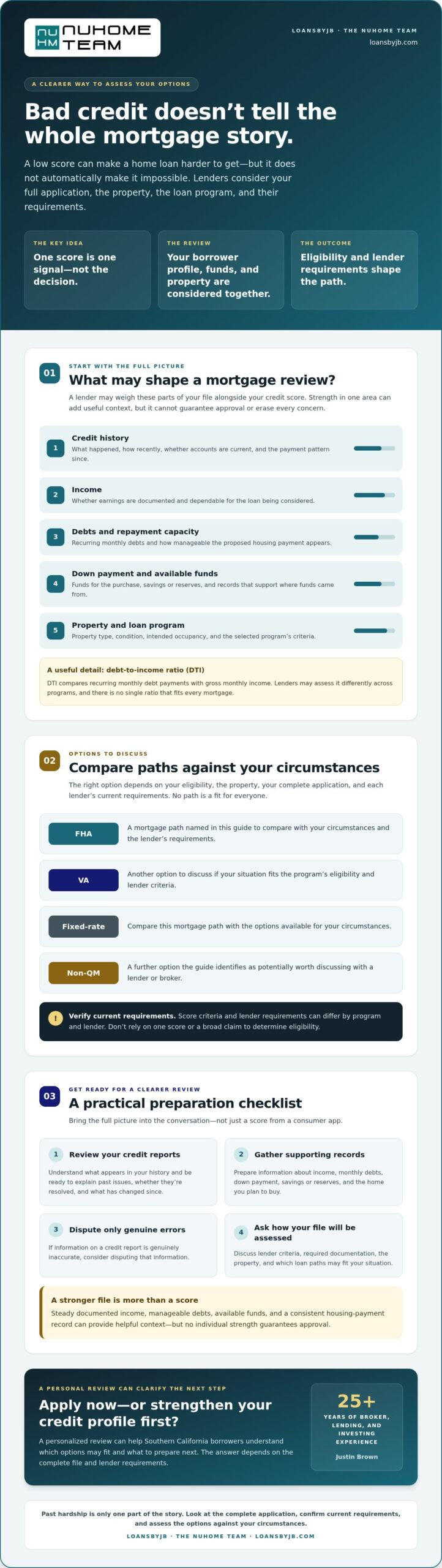
How to Prepare for a Bad-Credit Mortgage Conversation
A focused first conversation starts with organized facts, not a perfect credit score. Work through the steps in order: review your credit reports, gather financial records, list your debts, clarify available funds, then compare mortgage paths that may fit. This helps a mortgage professional identify questions to investigate instead of guessing from one number.
What should you gather before speaking with a mortgage professional?
Bring income records, asset statements, debt details, and brief explanations of major credit events. That’s the core document checklist for an initial review. Depending on your situation, useful records may include pay statements, tax documents, bank or investment statements, and current balances and monthly payments for debts. Note your housing-payment history, too, and whether you expect to live in the home or use it another way.
Documents vary by income type and loan program. A salaried employee and a self-employed borrower may need different records to show how income is earned and documented. You don’t need to predict every requirement. Start with what you have, flag gaps, and ask which additional documents apply to your circumstances.
Which credit moves may help, and which can backfire?
Read your credit reports carefully. If you find information that’s genuinely inaccurate, dispute that specific item with the reporting agency and keep copies of your dispute and supporting records. Don’t challenge accurate negative history just because it hurts your application. Keep paying bills on time, and make a clear list of any accounts that are past due or in collections so you can discuss them honestly.
Paying down debt may improve your overall financial picture, but it doesn’t guarantee a particular credit-score change or mortgage decision. Before closing an account, opening new credit, making a major purchase, or moving substantial funds between accounts, ask how the change could affect your application and what records you should retain. Avoid taking on new debt or making major financial moves without professional guidance.
Before the conversation, write down your goals, target timing, and questions. Be ready to explain past hardships plainly, including what changed and whether the issue is ongoing. The discussion may reveal that one program deserves a closer look, that more information is needed, or that preparing further first makes sense. A personalized mortgage review can help you sort through your credit history, finances, and possible paths without assuming the outcome in advance.
Find a Realistic Home Loan Path With a Southern California Mortgage Broker
A useful mortgage conversation should replace guesswork with clear questions. Be ready to explain what you hope to buy, when you want to move, which credit events concern you, how you earn income, and what funds you may have available. You don’t need to arrive with a perfect file. You do need an honest picture of it.
Ask which financing options may fit your circumstances, which program and lender requirements need current verification, and what documents would help assess your application. Clarify when credit may be reviewed and what the next steps could look like. These answers can help you understand whether to explore a path now or prepare further first. They aren’t a promise of approval or specific terms.
What should you ask before moving forward?
Talk through the property as well as your finances. Ask how the home’s type, condition, and intended use may affect eligibility. Look beyond the mortgage payment, too: property taxes, insurance, maintenance, and other housing expenses can shape whether a purchase fits your budget. A realistic plan accounts for the full cost of owning the home, not just the loan.
If a credit event, income change, or unusual source of funds needs explanation, ask what records could help clarify it. For a home loan with bad credit, getting specific about requirements and timing is more useful than relying on a generic score threshold or a blanket online claim.
How can an experienced broker help with a complex file?
A broker can discuss how your goals, credit history, income, available funds, and property plans may line up with financing options they offer. That’s especially useful when your situation doesn’t fit a simple template. LoansByJB takes a personalized, investor-focused approach to complex scenarios. Justin Brown brings more than 25 years of broker, lender, and investor experience to those conversations.
LoansByJB is a Southern California mortgage brokerage. If you’re in the region, ask about your specific situation and the options that may be relevant, including FHA, VA, fixed-rate, or non-QM financing where appropriate. The goal is a clear review of what needs checking and what could come next, not an assumption that every applicant or property will qualify.
Ready to talk through your goals, credit events, and possible next steps? Talk through your mortgage scenario with LoansByJB.
Take the Next Step With a Clearer Plan
A low credit score can make mortgage approval more challenging, but it isn’t the only factor lenders review. Your income, debts, available funds, loan program, and chosen property all help shape the full application. FHA, VA, and fixed-rate options may be worth discussing, depending on your circumstances and lender requirements.
Before you apply for a home loan with bad credit, gather your financial records, review your credit reports, and be ready to explain past setbacks. Ask which requirements need verification and what steps could strengthen your application. A straightforward conversation can help you understand whether to explore a mortgage now or prepare further first.
LoansByJB offers personalized guidance for complex financing scenarios in Southern California. Justin Brown brings more than 25 years of broker, lender, and investor experience to reviewing the broader borrower and property picture. There’s no need to assume the outcome before your situation is understood.
Talk through your mortgage scenario and take a practical next step. Your credit history is part of the story, not the whole story.
Frequently Asked Questions
Can I get a home loan with bad credit?
Yes, it may be possible to get a home loan with bad credit, but approval depends on more than your score. Lenders may also review your payment history, documented income, monthly debts, available funds, the property, and the loan program. Their own requirements can be stricter than a program’s baseline. Review your full financial picture and ask a mortgage professional which options and current requirements may fit your circumstances.
What credit score do you need to buy a house in 2026?
There’s no single score required for every mortgage in 2026. Under current FHA guidance, a score of 580 or higher generally allows a 3.5% down payment; scores from 500 to 579 generally require 10% down. Many conventional lenders set a 620 minimum, while VA has no minimum score set by the VA, though lenders set their own standards. Confirm current program and lender rules before applying.
Can you get an FHA loan with bad credit?
Possibly. FHA guidelines generally allow borrowers with scores from 500 to 579 to apply with a 10% down payment, and borrowers with scores of 580 or higher may qualify for the 3.5% down-payment standard. These are not approval guarantees. Lenders can impose stricter credit requirements and review income, debts, funds, and property eligibility. Ask the lender to verify current FHA guidance and its own requirements for your file.
Does applying for a mortgage hurt your credit score?
A mortgage application usually involves a lender checking your credit, which can create a hard inquiry and may affect your score. The impact varies by credit profile and scoring model. If you’re comparing lenders, ask how they handle credit checks and try to make inquiries within a focused shopping period; some scoring models group mortgage inquiries for rate-shopping purposes. Avoid opening new credit or taking on debt while your application is being reviewed.
How can I improve my chances of getting a mortgage with bad credit?
Start by checking your credit reports and disputing only information you believe is genuinely inaccurate. Keep bills current, organize income and asset records, list monthly debts, and document available funds. Explain significant credit events clearly and include supporting records. Paying down debt may strengthen your overall application, but it doesn’t guarantee a score increase or approval. Before closing accounts, opening credit, or moving substantial funds, ask how the change could affect your application.
Can I get a home loan after bankruptcy?
It may be possible, but the answer depends on the bankruptcy type, when it was filed or discharged, your recovery since then, the loan program, and the lender’s requirements. There isn’t one waiting period that applies to every borrower and mortgage. Gather your bankruptcy records and current credit information, then ask lenders to verify applicable program rules and overlays. Be prepared to explain what caused the hardship and how your finances have changed.
Should I wait to buy a house if my credit is bad?
Not necessarily. A review can help you compare applying now with taking time to address credit issues, reduce debts, or build savings. Consider your income stability, monthly obligations, available funds, timing, and the full cost of owning the property. In Southern California, LoansByJB serves borrowers in Claremont, La Verne, San Dimas, Upland, Rancho Cucamonga, Glendora, and Downey. A personalized discussion can help clarify next steps without promising approval.
Need the mortgage math checked?
Talk through the loan before you guess.
Use the estimator, request a refinance quote, or book a call with The Nuhome Team. We will help you compare the options that actually fit the file.
This is not a commitment to lend. Approval, terms, and pricing depend on credit, income, assets, property, and program guidelines.