

Refinancing your entire mortgage to tap cash right now is one of the most expensive financial mistakes you can make. If you’re sitting on a primary rate below 4%, surrendering it feels completely backwards. You worked hard to secure that low monthly payment. Resetting the clock on your entire balance just to access cash makes zero sense. That is why a fixed-rate home equity loan has become the smart homeowner’s most effective strategic play.
You shouldn’t have to sacrifice your legacy financing just to fund an ADU, expand your living space, or wipe out double-digit consumer debt. A standalone second mortgage extracts the liquidity you need without disturbing a single term of your existing first lien. You bypass the runaway payment shocks tied to variable-rate HELOCs, sidestep the rigid underwriting roadblocks of traditional retail banks, and lock in a predictable payoff schedule. Here is your roadmap to pulling cash from your property while keeping your low primary rate fully protected.
Key Takeaways
- Keep your low-rate first mortgage completely intact while pulling cash, using blended-rate calculations that beat a full refinance every time.
- Lock in predictable monthly payments with a standalone home equity loan to eliminate the runaway interest spikes tied to variable credit lines.
- Calculate your true borrowing power using Combined Loan-to-Value (CLTV) formulas and see whether your equity qualifies for rapid automated valuation.
- Channel trapped property wealth into high-ROI moves like ADU construction or wiping out expensive revolving balances for good.
- Prepare the exact asset and income documentation required to clear underwriting hurdles and sidestep traditional retail bank roadblocks.
Home Equity Loan vs. Cash-Out Refinance: Why Rate Preservation Wins
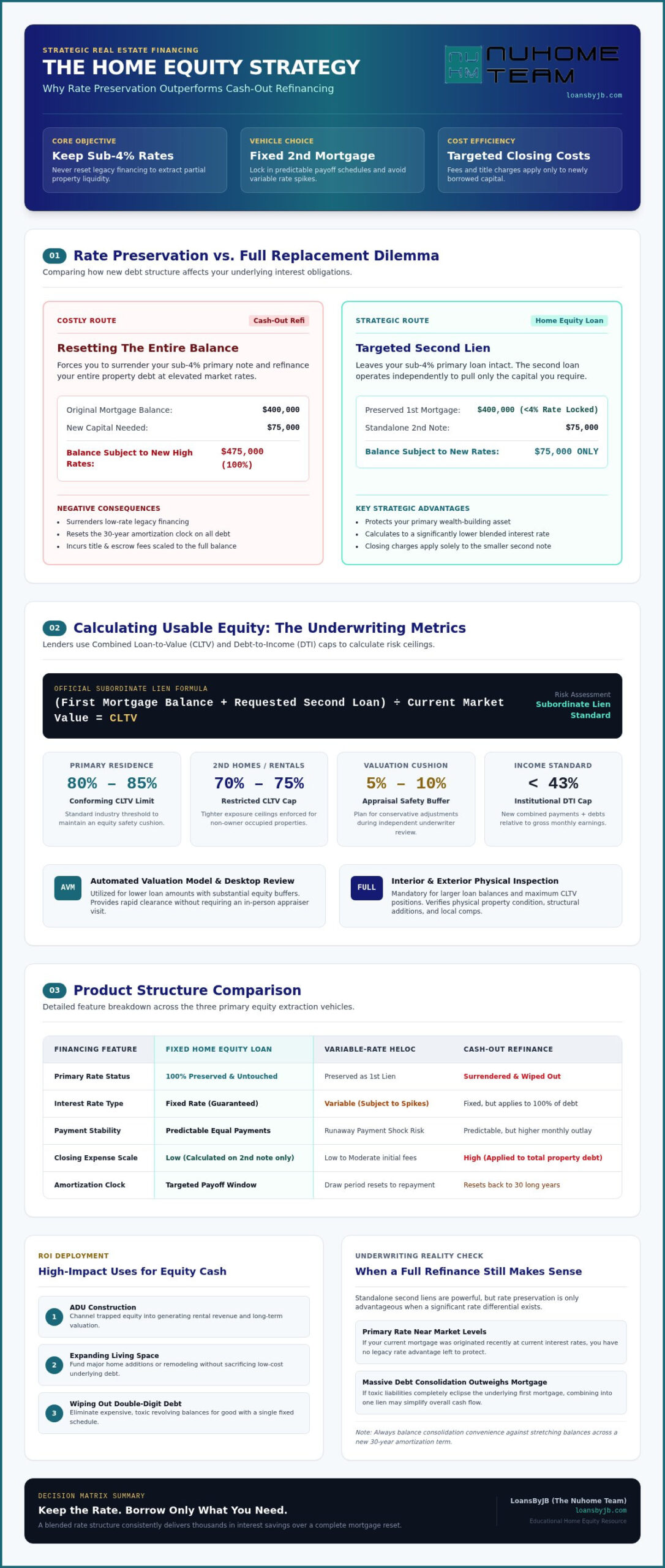
Retail lenders love pushing cash-out refinances. It wipes out your current balance, resets your mortgage clock, and generates massive loan volume for them. But replacing your entire primary mortgage to pull cash is financial malpractice when your current note sits below 4%. You give away your single greatest financial asset just to access a fraction of your equity.
A standalone second lien operates independently. By leveraging a fixed home equity loan structure, your low-rate first mortgage remains completely untouched. You leave that cheap legacy debt in place. You only borrow the cash you actually need. That strategic separation drastically slashes upfront closing expenses, because lender fees, title policies, and escrow charges apply solely to the smaller second note rather than your entire property debt.
The Blended Rate Advantage Explained
Do not look at secondary interest rates in isolation. Calculate your effective blended rate across your entire debt stack. When you hold a substantial low-rate balance on your first lien, adding a smaller, higher-rate second lien results in a weighted-average interest cost that beats an entirely new full mortgage rewrite.
Why pay current rates across $400,000 when you only need $75,000? Cash-out refinances force you to surrender your rate on every single dollar you owe. A standalone home equity loan isolates higher borrowing costs exclusively to the new capital. Unless your cash-out requirement dwarfs your remaining first mortgage balance, rate preservation saves thousands in unnecessary interest charges over the life of your debt.
When a Full Refinance Still Makes Sense
Standalone second mortgages are powerful, but they are not universal. If you bought or refinanced recently and your primary mortgage already carries a rate near current market levels, a full replacement loan might make sense. In that position, you have no legacy rate advantage to protect.
Massive debt consolidation is another exception. If you are rolling massive, toxic liabilities into your property that eclipse your underlying mortgage balance, consolidating everything under one lien simplifies your cash flow. Just consider the amortization clock. A cash-out refi stretches newly borrowed cash across thirty long years. Keeping tiered notes keeps your primary payoff schedule moving forward while assigning a targeted, predictable payoff window to your equity cash-out.
Calculating Usable Equity: LTV Limits, Appraisals, and Debt Ratios
Big retail banks make equity math sound simple. They tell you to subtract what you owe from what your home is worth. That is only half the story. Real underwriting hinges on strict risk formulas: Combined Loan-to-Value (CLTV) thresholds, conservative property valuations, and debt-to-income (DTI) caps. If you don’t calculate these numbers correctly upfront, your application hits a brick wall before underwriting even opens your file.
Your true borrowing ceiling is governed by subordinate lien guidelines. As outlined in the FTC guide on home equity loans and HELOCs, your property acts as collateral behind your primary note. Understanding how secondary lenders measure risk protects you from false expectations.
Mastering the Combined Loan-to-Value Formula
CLTV measures the total debt secured against your property relative to its appraised value. Lenders calculate it using a direct formula:
- Formula: (First Mortgage Balance + Requested Second Loan) / Current Market Value = CLTV
- Conforming Limit: Most second-lien programs cap CLTV between 80% and 85% on primary residences to maintain a safety cushion.
- Occupancy Variations: Second homes and rental properties face tighter caps, often topping out at 70% to 75% CLTV.
Valuations dictate your ultimate borrowing power. Underwriters frequently run automated valuation models (AVMs) or desktop reviews for lower loan amounts with substantial equity buffers. Larger balances demand full interior and exterior physical inspections. When planning your numbers, build in a 5% to 10% value cushion to absorb any conservative appraisal adjustments.
Managing DTI and Verification Barriers
Equity alone will not get your deal funded. Underwriters test your cash flow by adding your new second-lien payment to all current debts, comparing that total against your gross monthly income. Most institutional guidelines look for a back-end DTI under 43%, though select portfolio programs stretch higher for prime credit profiles.
This is where standard retail banks fail entrepreneurs and independent contractors. Rigid W-2 algorithms decline strong borrowers simply because write-offs reduce their net taxable income. Rather than accepting a quick denial, working with an experienced team like LoansByJB allows you to package complex files through alternative documentation programs, unlocking your capital with a customized home equity loan structured around your actual cash flow.
Home Equity Loan vs. HELOC: Fixed Stability Against Variable Lines
Homeowners often view home equity lines of credit (HELOCs) and closed-end second mortgages as identical tools. They aren’t. Choosing between them comes down to how much interest rate volatility you can stomach. A HELOC operates like a credit card backed by your roof, offering variable borrowing power. A standalone fixed second mortgage delivers a lump sum with zero rate surprises down the road.
Retail banks market HELOCs aggressively because initial rates look attractive and low interest-only payments feel comfortable. What they gloss over is the payment shock waiting around the corner. When central bank policies shift or your draw period closes, your budget takes the hit. Matching your debt structure to your project timeline keeps your household balance sheet secure.
The Mechanics of Fixed Home Equity Loans
Clarity drives peace of mind. Taking a traditional home equity loan means locking in a fixed interest rate and a permanent monthly payment from day one. You receive the total balance upfront as a single wire transfer. Every monthly installment amortizes principal alongside interest, chipping away at what you owe right out of the gate.
This predictability matters when deploying capital into defined expenses. If you are financing a structured accessory dwelling unit (ADU), building an addition, or paying off high-interest balances, fixed terms eliminate monetary policy guesswork. For property improvements, following official IRS home equity interest deduction rules also protects potential tax write-offs, provided the funds substantially upgrade the home securing the note.
Understanding HELOC Flexibility and Draw Vulnerabilities
Revolving lines work best when project costs remain unpredictable. If you are managing phased renovations where contractor invoices trickle in over twelve to eighteen months, a HELOC lets you draw only what you need, paying interest exclusively on outstanding balances.
That flexibility carries substantial traps:
- Prime Rate Adjustments: HELOC rates float above benchmark indices. When the Prime Rate rises, your borrowing costs spike immediately.
- Draw Expiration Shocks: Most lines feature a 10-year draw window with interest-only options. Once that window shuts, the loan resets into a compressed 10- or 20-year fully amortizing repayment schedule, often doubling the monthly bill overnight.
- Credit Line Freezes: Lenders reserve the legal right to slash or freeze unused credit limits if property values soften in your neighborhood.
If you prefer certainty, choosing a closed-end home equity loan locks the door on market swings and guarantees your monthly obligation never moves an inch.
High-Impact Uses for Home Equity: Remodeling, Debt, and Wealth Creation
Too many retail institutions treat home equity like a personal slush fund for vacations or luxury purchases. That is a dangerous mindset. Your property equity represents accumulated net worth, not free spending money. Tapping it only makes sense when the capital generates measurable financial return, builds long-term wealth, or permanently eliminates toxic liabilities.
Financing Additions, ADUs, and Value-Add Renovation
Cosmetic upgrades look nice, but structural expansions build real balance-sheet equity. Adding livable square footage or building a detached Accessory Dwelling Unit (ADU) accomplishes two critical goals: it expands your functional footprint and creates immediate rental revenue without forcing you into an overpriced housing market.
Financing choices depend on your current property status. If you are buying a fixer-upper or overhauling an unlivable space, structured FHA 203k loans allow you to bundle acquisition and rehab costs into a single lien. But if you already hold significant equity in a stable home, taking a standalone home equity loan avoids disturbing your primary rate while providing the upfront liquidity required to fund construction contractors.
High-Interest Debt Restructuring and Tax Implications
Stop letting idle property equity sit unproductive while high-rate debt drains your monthly cash flow. Schedule a strategic equity review with LoansByJB to evaluate your borrowing power and structure a sustainable path forward.
Securing a Home Equity Loan: Qualification Steps and Local Underwriting
Preparation beats frustration every single time. Big retail banks rely on rigid algorithms that flag minor documentation gaps and stall applications for weeks. Getting approved for a closed-end second lien requires proactive planning before your file ever hits an underwriter’s desk. Start by pulling your credit reports, clearing any unresolved reporting errors, and confirming your property title is clean.
Gather your documentation package early. Compile two years of tax returns, recent W-2s or 1099s, sixty days of bank statements, and your latest primary mortgage statement. Having these verified upfront speeds up processing, accelerates valuation scheduling, and prevents underwriting bottlenecks from dragging out your timeline.
Overcoming Common Underwriting Roadblocks
Standard bank loan officers run for the exits when a file doesn’t fit a standard retail box. Real properties and real lives come with complexities. Overcoming them requires strategic structuring:
- Self-Employed and 1099 Income: Write-offs that slash your tax burden can trigger retail underwriting declines. Non-QM and bank statement programs evaluate true cash flow rather than bottom-line taxable income.
- Title and Permit Complications: Past mechanic’s liens, solar contracts, or unpermitted garage conversions can derail automated approvals. Resolving title issues early keeps the loan moving.
- High-Value Subordination: Structuring a second lien behind existing jumbo mortgages requires lenders comfortable with higher total exposure. Specialized wholesale channels handle subordinate financing behind high-balance first notes without friction.
Selecting Your Financing Partner in Southern California
Walking into a local retail branch often means dealing with a junior processor handcuffed by corporate red tape. A dedicated mortgage broker operates with wholesale flexibility, matching your specific credit and income profile to the right lending program.
Local expertise makes a tangible difference. Evaluating property values from Claremont and Glendora out to Rancho Cucamonga requires real market familiarity, not an out-of-state call center. With over 25 years of hands-on experience navigating complex financing hurdles, LoansByJB structures custom second-mortgage options tailored to complex borrower profiles. Complete a comprehensive file review, protect your primary rate, and secure the right home equity loan for your long-term goals.
Put Your Home Equity to Work Without Sacrificing Your Low Rate
Surrendering a low-rate primary mortgage through an expensive cash-out refinance makes zero financial sense. You worked hard to secure that legacy rate. A standalone home equity loan lets you tap accumulated property wealth while leaving your primary note completely untouched. You extract immediate liquidity, insulate your household budget from variable rate shocks, and lock in a predictable amortization schedule that systematically reduces principal from day one.
Whether you’re planning an ADU build or restructuring high-interest liabilities, success comes down to smart loan structuring. Traditional retail banks rely on rigid formulas that frequently leave qualified homeowners stranded. Backed by over 25 years of brokerage experience navigating complex lending hurdles across Southern California communities, we deliver direct access to specialized second-mortgage and HELOAN wholesale programs designed around your real financial picture.
Take charge of your balance sheet today. Explore your custom equity loan options with LoansByJB and put your equity to work on your own terms.
Frequently Asked Questions
What is the main difference between a home equity loan and a HELOC?
A home equity loan provides a lump-sum payout with a fixed interest rate, whereas a HELOC functions as a variable revolving line of credit. With a closed-end loan, your monthly principal and interest payments remain identical for the entire loan term. A HELOC features a variable rate that fluctuates with prime market benchmark changes, typically starting with an interest-only draw period followed by a higher amortizing repayment phase.
Can I get a home equity loan if I currently have a low first mortgage rate?
Yes, you can secure a standalone second mortgage without changing a single term on your primary low-rate mortgage. A second lien sits subordinate behind your original financing. Your existing 3% or 4% rate stays fully intact while you access cash through a separate note. This rate-preservation strategy prevents you from wiping out legacy financing, which is the costly mistake caused by traditional cash-out refinances.
How much equity do I need to qualify for a home equity loan?
Most lenders require you to retain at least 15% to 20% equity in your home after accounting for all loans. Underwriters calculate your Combined Loan-to-Value (CLTV) by adding your first mortgage balance to your requested secondary loan. In competitive Southern California markets like Claremont, San Dimas, and Glendora, maximum CLTV thresholds typically cap at 80% to 85% for primary residences, leaving a protective property cushion.
Is the interest on a home equity loan tax deductible in 2026?
Interest is tax-deductible only if you spend the loan proceeds to buy, build, or substantially improve the property securing the note. Under IRS guidelines, using loan proceeds to fund room additions, structural renovations, or ADU construction qualifies up to federal acquisition debt caps. If you use the cash for consolidating credit card debt or paying personal expenses, that interest is non-deductible. Always verify specific deductions with your tax advisor.
What credit score is required to secure a fixed home equity loan?
Most conventional programs look for a minimum credit score of 620 to 680, though higher scores secure more favorable underwriting terms. Because second liens take subordinate collateral positions, underwriters evaluate your complete risk profile thoroughly. If your credit profile is non-traditional or you run a business in Rancho Cucamonga or Upland, working with a mortgage broker provides access to specialized portfolio programs that evaluate real cash flow rather than rigid cutoffs.
How long does it take to close on a home equity loan from application to funding?
Standalone home equity loans typically close within two to four weeks depending on property valuation requirements. If your file qualifies for an automated valuation model or desktop appraisal, processing moves fast. Properties requiring full interior appraisals or complex title clearance can extend that window slightly. Providing complete tax documents, bank statements, and mortgage records upfront accelerates the process so underwriting can complete a full review without unnecessary delays.
Need the mortgage math checked?
Talk through the loan before you guess.
Use the estimator, request a refinance quote, or book a call with The Nuhome Team. We will help you compare the options that actually fit the file.
This is not a commitment to lend. Approval, terms, and pricing depend on credit, income, assets, property, and program guidelines.