

What if the first time homebuyer loan with the lowest down payment isn’t the best fit for you? It’s easy to focus on how much cash you need upfront, but your income, credit, monthly payment, mortgage insurance, closing costs, and the home you want all affect the decision.
Buying in Southern California can make those trade-offs feel sharper. Local home prices don’t automatically put homeownership out of reach, but they make it especially important to compare the full cost of a loan, not just its minimum down payment. Conventional, FHA, and VA loans have different requirements, and down payment assistance programs may have eligibility rules and availability that change.
This guide explains how to compare those loan paths, what lenders evaluate, and how to prepare a practical buying plan. You’ll learn which financing routes may fit your situation, which documents and costs to plan for, and what to check before relying on an assistance program. That preparation can help you have a more focused conversation with a mortgage professional.
Key Takeaways
- A first time homebuyer loan isn’t one universal product. Buyer and assistance program definitions can vary.
- Compare conventional, FHA, and VA options by eligibility, upfront cash, mortgage insurance, and property fit.
- Build a realistic budget that includes the full monthly payment, closing costs, prepaid items, reserves, and ongoing home expenses.
- Prepare in sequence: set your budget, gather documents, discuss financing, seek preapproval, then search for a property.
- Use a mortgage conversation to compare available loan structures with your income, funds, goals, and intended property.
What Is a First-Time Homebuyer Loan, and Who Can Use One?
A first time homebuyer loan is mortgage financing for someone buying a home, not one universal product or an automatic benefit. Buyers may use conventional financing or government-backed options such as FHA and VA loans, subject to the requirements of the program and lender. Down payment assistance is separate from the mortgage. It may help with upfront expenses, but it doesn’t replace the loan or guarantee approval.
“First-time buyer” doesn’t mean the same thing in every program. Some assistance programs may look at prior homeownership over a specified period, while others consider household circumstances, income, intended occupancy, or the property. Someone who owned a home in the past may meet one program’s definition but not another’s. Check the current rules for each program before relying on eligibility.
Does buying your first home require a special mortgage?
No. A first-time buyer may qualify for conventional financing, an FHA loan, or a VA loan, depending on their circumstances. Each option has different rules. For general background on FHA financing, see this overview of an FHA insured loan.
Keep two questions separate: Do you qualify for a mortgage, and do you qualify for assistance? A lender evaluates your financial picture, including income, debts, assets, credit history, and the property. First-time buyer status alone doesn’t determine approval or which loan fits your needs.
What should Southern California first-time buyers know first?
Local home prices affect how much you may need to borrow and whether the resulting payment fits your budget. They don’t change what a mortgage type means. Start with a monthly payment you can sustain, then work backward to a realistic purchase range. Don’t set your target based only on the largest loan amount you might qualify for.
Estimate more than principal and interest. Include property taxes, homeowners insurance, possible mortgage insurance, and ongoing maintenance. Leave room for other household expenses and changes in your finances, too. A realistic budget gives you a better basis for comparing loan options.
Before building a purchase plan around assistance, check the program’s current availability and requirements. Then review your finances and the property with a mortgage professional. A personalized comparison can connect the loan structure to your income, funds, and goals instead of relying on a broad online estimate.
How First-Time Homebuyer Loans Work: Qualification, Cash, and Property
A first time homebuyer loan is assessed as a complete transaction, not just a credit score or down payment. The lender reviews whether your finances support the proposed payment, whether your funds are documented, and whether the property and loan structure meet the selected program’s rules. Requirements vary by program, lender, and borrower, so treat early estimates as a starting point rather than a decision.
The lowest down payment doesn’t automatically make a home affordable. Compare the cash needed to close with the ongoing costs you’ll carry. Plan for these categories separately:
- Down payment: The portion of the purchase price you pay upfront.
- Closing costs: Transaction and lender-related charges shown during the loan process.
- Prepaid items: Costs collected in advance, such as certain property-related expenses.
- Reserves: Funds you may need to retain after closing, depending on the loan and underwriting.
Each category serves a different purpose. Don’t assume funds set aside for one can cover another without checking how the transaction is structured.
What do mortgage lenders evaluate?
Lenders review documented income and recurring debts to assess your ability to manage the proposed payment. They also examine credit history and available funds under the rules for the loan being considered. Be ready to document where your income and assets come from, and to explain financial details that may need context. An online estimate can’t account for every part of this review.
Preapproval is an initial review based on the information available at the time. It can help clarify a potential budget, but it isn’t final approval. The lender still needs to verify details and assess the specific property and transaction.
How do the home and offer affect financing?
The property matters, too. Lenders may consider whether it meets the selected program’s requirements, how it will be occupied, and what the appraisal indicates. The contract terms and condition of the home can affect the financing path. A property that needs substantial repairs may require additional review or a different loan structure.
If you’re considering a fixer-upper, explore whether an FHA 203k renovation loan may be relevant, subject to current program and lender requirements. Conventional financing has its own guidelines. Conventional mortgage loans offer a general comparison point.
Before making an offer, discuss your income, funds, goals, and the property with a mortgage professional. A personalized review can help you understand which financing structures may fit. Learn more about mortgage guidance from LoansByJB.
Conventional, FHA, and VA First-Time Buyer Loans Compared
There’s no universal winner. The right first time homebuyer loan depends on your eligibility, available cash, credit profile, property, and the payment you can sustain. Use this comparison to narrow your options, then confirm current requirements with a lender. Program rules and underwriting can change.
| Loan type | Intended borrower and eligibility | Down payment and mortgage insurance | Property considerations |
|---|---|---|---|
| Conventional | Borrowers who meet the lender’s and loan program’s financial and property requirements. | Some first-time buyers may qualify for down payments as low as 3%. Mortgage insurance generally applies when required by the loan terms, including for some buyers with less than 20% down. Confirm current terms. | Property and occupancy must meet the requirements for the specific loan. Review conventional mortgage loans for a general overview. |
| FHA | Borrowers who meet FHA program rules and lender underwriting. A 580 minimum score is listed for 3.5% down; lower scores may require a larger down payment. | Down payment may be as low as 3.5% for borrowers who meet applicable requirements. FHA mortgage insurance includes upfront and annual premiums. | The borrower and property must meet FHA requirements. Check current program guidance and lender criteria. |
| VA | Eligible veterans, service members, and other qualifying borrowers under VA rules. First-time buyer status alone does not establish eligibility. | Many eligible buyers may purchase with no down payment. A funding fee may apply, though exemptions may be available in certain circumstances. | Confirm VA eligibility, occupancy rules, and property requirements with current VA guidance and your lender. |
When might conventional financing make sense?
Conventional financing may suit buyers whose credit, income, funds, and target property align with lender requirements. Down payment options vary, so don’t assume one minimum applies to every borrower. Compare the full monthly payment and mortgage insurance terms, including whether and when insurance may be removed under the applicable loan rules. For payment stability, see this 30-year fixed mortgage guide.
When might FHA or VA financing be worth exploring?
FHA may be worth exploring if its down payment structure and underwriting rules fit your finances and the home. VA financing is tied to service-related eligibility, so it isn’t available to every first-time buyer. Check your status before building a plan around it. Eligible buyers can learn more in this VA loan guide for California buyers.
Compare more than the upfront amount. Ask how each option affects your total payment, mortgage insurance or fees, cash needed to close, and choice of property. Verify the details with current program guidance and lender underwriting.
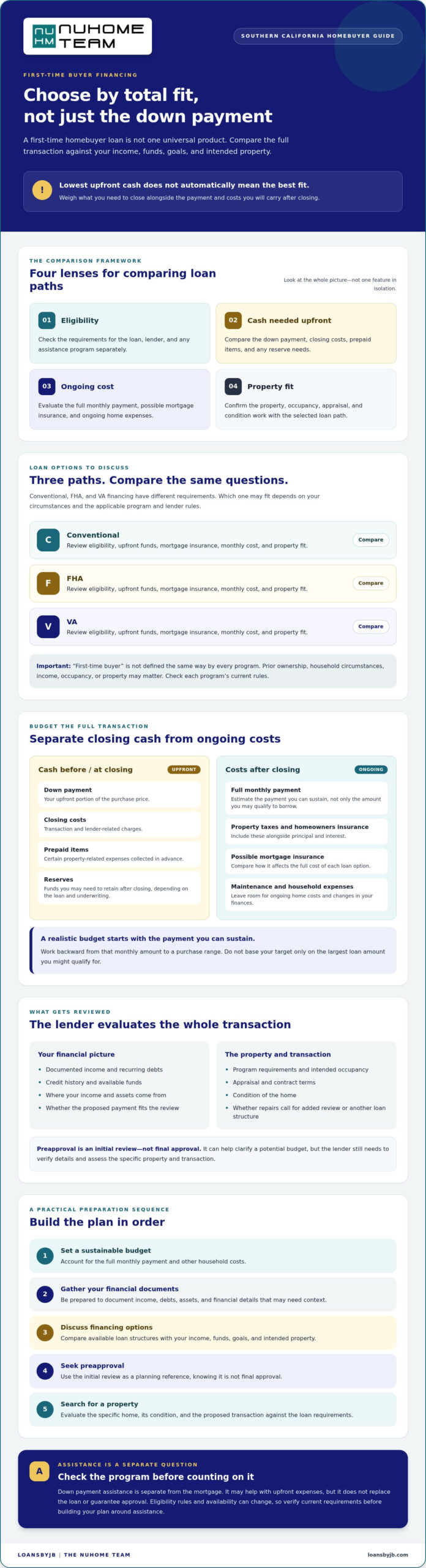
How to Prepare for a First-Time Homebuyer Loan in Southern California
A clear plan can make the first time homebuyer loan process easier to manage. Work through these steps before touring homes. The order matters: set your budget first, then look for properties that fit it.
- Build a sustainable budget. Estimate a monthly housing payment that leaves room for your other priorities. Include principal and interest, property taxes, homeowners insurance, possible mortgage insurance, and maintenance.
- Gather your documents. Collect recent income records, asset statements, details about recurring debts, and identification. This is a starting list, not a universal checklist. Ask your mortgage professional what they need for your situation.
- Discuss your financing. Share your goals, available funds, income details, and circumstances that could affect your application. Raise irregular income and recent employment or financial changes early. Clear information helps your mortgage professional discuss potentially suitable loan paths.
- Seek preapproval. An initial review can help clarify a possible price range, but it isn’t final approval. Keep your budget grounded in what feels manageable, not only the maximum a lender may consider.
- Search for a property. Once you understand the likely financing path and budget, focus on homes that fit both. The property and its condition can affect which loan options are available. For buyers exploring homeownership opportunities in other regions such as West Michigan, you can visit AW Homes of Bellabay Realty to learn more about navigating residential property purchases.
What should you gather before talking with a mortgage professional?
Start with recent pay or income records, statements for accounts holding your funds, a list of debts and monthly payments, and identification. If your income varies, organize records that help explain it. Confirm the exact document list with your mortgage professional, since requirements depend on the loan and your circumstances.
How can you set a realistic purchase budget?
Compare two numbers: the monthly payment you’re comfortable carrying and the amount a lender may approve. They aren’t always the same. Plan for cash to close and funds you want to keep available after closing, too. Don’t assume every dollar you have should go toward the purchase.
In Southern California, including Claremont, La Verne, San Dimas, Upland, Rancho Cucamonga, Glendora, and Downey, check current state and local assistance information directly with the relevant housing agency. Confirm eligibility, funding availability, application timing, and program conditions before including assistance in your plan. Rules and funding can change, and assistance is separate from mortgage approval.
For a financing conversation tailored to your income, funds, and goals, connect with LoansByJB as you prepare your next steps.
Choose Your Loan Path and Take the Next Step With LoansByJB
A sound mortgage choice matches the loan to the whole purchase, rather than chasing one attractive feature. First confirm which programs you may qualify for. Then compare the total monthly payment and cash needed to close, check whether the property meets the loan’s requirements, and review the documents and underwriting steps still ahead.
A mortgage broker can discuss available financing structures in relation to your income, funds, credit history, intended property, and goals. LoansByJB, also known as The Nuhome Team, works with conventional fixed-rate, FHA, and VA mortgage scenarios in Southern California. Justin Brown brings more than 25 years of experience as a broker, lender, and investor. That background can inform conversations about loan structure and property carrying costs, but it can’t guarantee approval, a particular payment, or savings.
What should you ask before choosing a mortgage?
Bring specific questions. Clear answers make it easier to compare options on equal terms:
- Which available loan options fit my documented income, funds, credit history, and intended property?
- What costs, conditions, and underwriting steps remain before closing?
- What could change the proposed payment, including loan terms, taxes, insurance, or mortgage insurance?
- How might the choice affect the cash I need upfront and the funds I want to keep available afterward?
Ask about conventional fixed-rate, FHA, or VA financing if those routes may fit your circumstances. VA financing depends on service-related eligibility, and FHA and conventional loans have their own requirements. Confirm current program rules and lender conditions rather than relying on a general estimate.
How do you start a personalized loan conversation?
Share your buying timeline, target area, available funds, and biggest concerns. Mention income changes, credit questions, or property features you’re considering. These details help shape a useful discussion about potential routes and questions to resolve. They don’t guarantee preapproval, final approval, or a specific loan outcome.
LoansByJB’s investor-informed approach considers how a proposed structure relates to the property and its carrying costs, alongside your broader financial picture. Compare trade-offs rather than looking at the monthly payment or down payment in isolation. That gives you a more grounded basis for deciding what to explore.
Ready to discuss your situation? Discuss your first-home financing options with LoansByJB.
Make Your Next Homebuying Move With a Clear Plan
The right first time homebuyer loan fits the full picture: your eligibility, available funds, sustainable payment, and intended property. Compare conventional, FHA, and VA options by total costs and requirements, not just the down payment. Organize your documents and confirm current program rules before making decisions about assistance or loan terms.
A personalized conversation can help turn those questions into practical next steps. Justin Brown brings more than 25 years of experience as a broker, lender, and investor, and LoansByJB reports guiding clients through thousands of transactions. That experience can inform a comparison of available financing paths, without promising approval or a particular outcome. NMLS #1647915.
Bring your income and asset details, timeline, target area, and questions about payment or property fit. Start a focused discussion about your options with LoansByJB. You don’t need every answer before you begin. A clear first conversation can help you move forward with more confidence.
Frequently Asked Questions
What is the easiest loan to get as a first-time homebuyer?
There’s no single easiest loan for every buyer. FHA financing may suit some borrowers because it allows a lower down payment under qualifying conditions, while conventional or VA financing may fit others better. Approval depends on your income, debts, credit, funds, property, and lender requirements. Compare total payment and property rules, not just entry requirements. A mortgage professional can review your situation and help identify options to explore.
Can I get a first-time homebuyer loan with a low down payment?
Yes. Eligible first-time buyers may find low-down-payment options, though the minimum depends on the loan and borrower. Some conventional loans allow down payments as low as 3% for first-time buyers, and FHA down payments may be as low as 3.5% for qualifying borrowers. Eligible VA borrowers may be able to buy with no down payment. Confirm current rules with a lender, and budget separately for closing costs and other expenses.
Do first-time homebuyers need a 20% down payment?
No. A 20% down payment isn’t a universal requirement. Some conventional programs allow less, and FHA or VA financing may offer other qualifying paths. A smaller down payment can mean mortgage insurance or other loan-related costs, depending on the program and terms. Compare the full monthly payment, cash needed to close, and funds left afterward. The best choice depends on your finances and the home, not a single percentage target.
How much income do I need to qualify for a first-time homebuyer loan?
There’s no single income figure that guarantees qualification. Lenders consider documented income alongside recurring debts, credit history, available assets, the proposed payment, and loan rules. The same income can support different loan amounts depending on those factors and the property. Gather income and debt records before discussing a budget. A mortgage professional can help assess a potential range, but only underwriting can determine whether a specific application qualifies.
Can I use an FHA loan to buy my first home in California?
Yes, you may use an FHA loan to buy a first home in California if you and the property meet current program and lender requirements. A down payment of 3.5% may be available to qualifying borrowers with a credit score of at least 580; underwriting terms may vary. FHA loan limits vary by county. Buyers in Southern California should verify the applicable limit and property requirements before making an offer.
Can I qualify for a VA home loan as a first-time buyer?
Possibly, if you meet VA service-related eligibility requirements and lender underwriting standards. First-time buyer status alone doesn’t qualify you for a VA loan. The VA doesn’t set a minimum credit score, but lenders may have their own requirements. Many eligible borrowers can purchase with no down payment, though other costs may apply. Confirm your VA eligibility and review the property and occupancy rules before relying on this option.
Are there first-time homebuyer assistance programs in California in 2026?
Yes. California and local agencies have offered assistance, but eligibility, funding, and application windows vary. As of September 2026, the CalHFA Dream for All application portal had closed on March 16, 2026. CalHFA MyHome and local programs may have separate requirements and availability. Check directly with CalHFA and the relevant housing agency for current status. Southern California buyers should verify local rules before including assistance in their purchase plan.
Need the mortgage math checked?
Talk through the loan before you guess.
Use the estimator, request a refinance quote, or book a call with The Nuhome Team. We will help you compare the options that actually fit the file.
This is not a commitment to lend. Approval, terms, and pricing depend on credit, income, assets, property, and program guidelines.