

The biggest lender name isn’t always the best fit for an investment deal. Searching for “CrossCountry Mortgage alternative for investors Upland” is really about finding financing that fits the property, the numbers, and your plan for getting out.
If standard mortgage underwriting doesn’t line up with your income or investment strategy, the next step may feel unclear. Start your comparison with the deal, not the lender’s size. A long-term rental, a renovation, and a time-sensitive purchase can each call for a different financing approach.
This guide compares investor-focused options, including DSCR, renovation, hard money, fix-and-flip, and non-QM loans. You’ll see how a financing discussion can account for rental income, carrying costs, and your exit strategy, plus what property and financial details to prepare. LoansByJB, the Nuhome Team, brings an investor perspective shaped by Justin Brown’s more than 25 years of experience as a broker, lender, and investor. Use that perspective to compare financing paths for your Upland property and goals.
Key Takeaways
- A CrossCountry Mortgage alternative for investors Upland can mean a different financing structure, not automatically a better lender.
- Compare conventional, DSCR, renovation, hard money, and non-QM approaches against the property’s intended use and your investment plan.
- Assess rental assumptions, carrying costs, timing, and exit strategy before weighing loan structures.
- Prepare property details, borrower finances, rental estimates, and intended use. Use current, property-specific figures for taxes, insurance, rent assumptions, and property requirements.
- LoansByJB brings an investor lens to financing conversations, with attention to carrying costs and the plan for exiting the investment.
Why Upland Investors Compare CrossCountry Mortgage Alternatives
A financing conversation should start with the deal, not the logo. Investors need to understand how a loan structure fits the property’s intended use, expected cash flow, and purchase or renovation timeline. That’s why searching for a CrossCountry Mortgage alternative for investors Upland can be less about switching brands and more about finding an approach that fits the transaction.
An alternative doesn’t automatically mean a better lender. It means comparing financing approaches and assessing how their terms, underwriting focus, and process align with your plan. A mortgage loan is secured by real estate, but the loan structure and transaction details determine how well it fits an investment strategy.
Loan fit depends on more than the property address. Borrower finances, occupancy, property condition, and transaction structure all matter. A long-term rental, a property needing work, and a purchase with a tight decision window each raise different questions. Bring those details into the financing discussion early instead of comparing lenders on name recognition alone.
Investor-focused financing matches the underwriting discussion to the property and investment plan. Explain how you intend to use the property, what assumptions support its projected cash flow, and how you expect to exit. Not every investor needs a specialized loan, and no single structure fits every Upland deal.
What investors should compare beyond lender name
Look at the substance of the financing conversation. Are rental-income assumptions considered alongside expected property costs? Does the analysis include carrying costs while the property is vacant, being repaired, or awaiting a future sale? Is your intended exit clear? These questions help show whether the proposed structure addresses the investment itself.
Brand scale and recognition can provide context, but they don’t tell you whether a specific financing structure suits your transaction. Compare the approach, not just the institution. The right fit depends on the borrower, property, occupancy, and investment strategy.
Why Upland property details belong in the financing discussion
Start with the asset. Record its current condition, planned work, and intended use, whether you plan to rent it, occupy it, or pursue another strategy. Then build realistic operating assumptions. Expected rent, recurring property expenses, and the time needed to complete work can all affect your cash-flow and carrying-cost analysis.
Upland is the setting, but the individual property drives the analysis. Use current, property-specific figures for expected rent, local taxes, and insurance, and account for requirements that apply to the property. Bring those assumptions into the financing discussion and revise them if the property or plan changes. Clear inputs make it easier to compare structures on fit and execution rather than a headline feature.
Investor Loan Options an Upland Buyer Can Compare
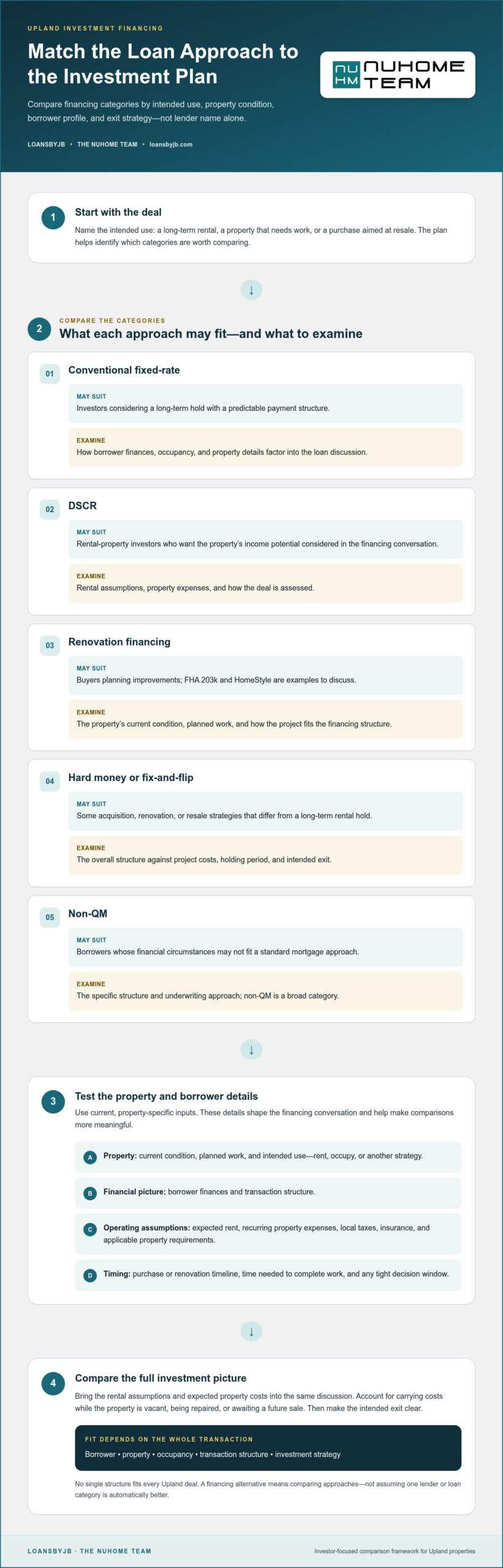
Start with what the financing needs to do. A long-term rental, a property that needs work, and a purchase intended for resale can point to different loan categories. The categories below are a starting point for comparison. Fit depends on the borrower, property, occupancy, transaction structure, and underwriting.
| Financing category | May suit | Trade-off to consider |
|---|---|---|
| Conventional fixed-rate | Investors considering a long-term hold with a predictable payment structure. | Review how borrower finances, occupancy, and property details factor into the loan discussion. |
| DSCR | Rental-property investors who want the property’s income potential considered in the financing conversation. | Rental assumptions and property expenses matter. Understand how the deal is assessed. |
| Renovation | Buyers planning improvements, including scenarios to discuss under FHA 203k or HomeStyle renovation categories. | Account for the property’s current condition, planned work, and how the project fits the financing structure. |
| Hard money or fix-and-flip | Some acquisition, renovation, or resale strategies where the plan differs from a long-term rental hold. | Weigh the overall structure against project costs, holding period, and intended exit. |
| Non-QM | Borrowers whose financial circumstances may not fit a standard mortgage approach. | This is a broad category, so the specific structure and underwriting approach matter. |
Match financing categories to the investment plan
For a rental you expect to hold, compare conventional fixed-rate financing with a DSCR loan. Focus on how each approach considers the property and your borrower profile, rather than which label sounds more investor-friendly. A DSCR structure puts rental economics at the center of the discussion, while conventional financing may suit a different borrower-property combination. Explore the details in this DSCR loan guide.
If the property needs substantial work, FHA 203k and HomeStyle renovation loans are specific financing approaches to consider. For a short-term acquisition and resale plan, compare hard money and fix-and-flip options rather than assuming a long-term rental structure is the right tool. The planned exit matters, as do the time and cost involved in completing the project.
When speed, condition, or income documentation changes the comparison
Hard money and fix-and-flip financing can suit particular projects, while non-QM covers a wider range of nonstandard borrower circumstances. Neither category is a universal shortcut. Consider how a proposed structure addresses the property’s condition, your financial profile, carrying costs, and exit plan.
A product name alone doesn’t establish fit or terms. To compare a CrossCountry Mortgage alternative for investors Upland, map each category to your intended use and weigh the trade-offs against the actual deal. LoansByJB’s investor-focused mortgage approach considers financing in the context of carrying costs and exit strategy.
How to Evaluate a CrossCountry Mortgage Alternative in Upland
A useful comparison follows the deal from idea to exit. Don’t begin with a rate or lender name alone. Start with the property’s use and financing objective. Define the plan, assess the asset, compare loan structures, and then review what execution requires. This gives you a consistent basis for evaluating a CrossCountry Mortgage alternative for investors Upland without assuming one lender or loan type fits every deal.
- Define the plan. State whether you’re purchasing or refinancing, your intended use, and how you expect to exit. A long-term hold and a renovation followed by resale call for different questions.
- Assess the property. Record the property type, occupancy plan, current condition, and renovation scope. Note details that could affect rental use or the work required before the property can serve its purpose.
- Compare structures. Discuss which financing categories may align with the borrower, property, and transaction. Ask how the structure treats rental income, ongoing costs, and the assumptions behind your plan.
- Review execution needs. Consider what information, documentation, and project details the financing conversation requires. Identify questions about timing and transaction steps without treating an estimated schedule as guaranteed.
Keep loan fit separate from rate or fee comparisons. First understand how a proposed structure evaluates the deal and whether it supports your intended use. Then compare financial details using the same property facts and assumptions. If the inputs differ, the comparison may not be like for like.
Build a deal snapshot before comparing lenders
Put the essentials on one page: purchase or refinance purpose, property type, intended occupancy, and renovation scope. Add current, property-specific estimates for rent and ongoing expenses, and note where the figures came from. Record your planned hold period or exit strategy as an expectation, not a guaranteed result. A clear snapshot keeps discussions focused and helps reveal whether a proposed structure addresses the important parts of your plan.
Assess the advisor’s investor lens
Listen for whether carrying costs and the exit strategy are part of the loan-structure discussion, not afterthoughts. LoansByJB brings an investor perspective to these considerations. Justin Brown has more than 25 years of experience as a broker, lender, and investor, useful context when discussing how financing relates to an investment plan. Experience doesn’t promise approval or performance, and it doesn’t replace a clear review of your deal.
Keep your comparison grounded in facts you can update: property condition, realistic operating assumptions, borrower details, and intended use. This gives each financing conversation a fair test. You can then weigh fit, execution needs, and financial terms separately instead of letting a product label make the decision.
Prepare for Investment Property Financing in Upland, California
A focused financing discussion starts with a clear picture of the deal. Organize property facts, borrower information, rental assumptions, and intended use before comparing options. Complete information makes the conversation more useful, though it doesn’t guarantee approval or a particular loan structure. It gives the team a stronger basis for discussing the scenario.
- Document the property. Gather purchase or refinance details, property type, current condition, and planned improvements. Note what work is needed and how it relates to your investment plan.
- Prepare borrower information. Organize available income, asset, liability, and rental documentation relevant to your situation. Identify the proposed ownership structure and intended occupancy for discussion with the mortgage team.
- Build realistic operating assumptions. Estimate rent and ongoing expenses using current information specific to the property. Keep the source and date of each estimate so you can revisit figures that change.
- State the objective. Explain whether you plan to hold the property as a rental, renovate it, or pursue another use. Describe any target hold period or exit plan as an intention, not a guaranteed outcome.
Organize the property and borrower information
Make the details easy to review. For a purchase, keep the transaction information together; for a refinance, clarify the purpose and the property’s current status. Include available records for planned improvements and rental activity. If you’re considering a long-term fixed-rate structure, review how it fits your holding plan using this 30-year fixed mortgage guide. Your intended use and borrower profile still shape the discussion.
Check Upland deal assumptions without relying on generic estimates
Broad averages can hide property-level differences. Verify expected rent for the specific home, then account for relevant taxes, insurance, and other operating costs using current figures. Confirm property requirements that could affect the transaction or planned use. If California or municipal requirements may apply, include them in your current review rather than building a financing plan around assumptions.
Keep a short list of open questions: Which expense figures need updating? Does the property’s condition affect the plan? Are rental estimates grounded in current, property-specific information? This turns an initial estimate into a working deal snapshot, not a promise of future cash flow.
For investors comparing a CrossCountry Mortgage alternative for investors Upland, these preparation steps keep the discussion tied to the actual property and purpose. LoansByJB serves Upland and surrounding Southern California communities, including Claremont, La Verne, San Dimas, Rancho Cucamonga, Glendora, and Downey. The team brings an investor perspective to carrying costs and exit strategies. Discuss your Upland investment loan strategy with your property details and assumptions organized.
Explore an Investor-Focused Mortgage Alternative with LoansByJB
LoansByJB, the Nuhome Team, is a Southern California mortgage brokerage serving Upland investors with financing conversations grounded in the deal. The team offers financing options that include conventional fixed-rate, DSCR, renovation, hard money, fix-and-flip, and non-QM loans. The aim is to connect the structure under discussion to the property and investment plan, not to promise eligibility, approval, pricing, or a particular result.
An investor lens puts two practical questions on the table: what will it cost to carry the property through the planned ownership period, and what is the intended exit? A long-term rental, renovation project, and purchase aimed at resale can have different financing needs. Naming those differences early makes the comparison more specific and the next steps clearer.
What a focused financing conversation should cover
Bring four essentials into the discussion: the property’s purpose, your borrower profile, realistic cash-flow assumptions, and your preferred exit. Then compare relevant financing categories against the actual transaction instead of treating a product label as the answer. The conversation can also clarify what information is available, what underwriting questions remain, and which details may shape the next step.
- Property purpose: Describe the planned use and any work the property needs.
- Borrower profile: Summarize relevant financial details and the proposed ownership structure.
- Cash-flow assumptions: Share the basis for expected rent and ongoing property expenses.
- Preferred exit: Explain whether you expect to hold, refinance, or sell, while treating the plan as an intention rather than a certainty.
This structure keeps the conversation anchored to execution. For example, if projected rental income depends on completing improvements first, make that sequence clear. If the investment depends on a future sale, discuss how the anticipated holding period and carrying costs relate to the financing approach. These details help frame the questions without implying that any loan category guarantees a particular outcome.
Take the next step on your Upland investment plan
Before starting a conversation, write down the property address, transaction goal, current condition, intended use, and assumptions behind your cash-flow plan. Justin Brown brings more than 25 years of broker, lender, and investor experience to LoansByJB. That background informs the team’s attention to carrying costs and exits, while each financing scenario still depends on its details and underwriting.
If you’re weighing a CrossCountry Mortgage alternative for investors Upland, bring your deal summary and compare structures around what you’re trying to accomplish. Discuss your Upland investment property financing with LoansByJB.
Put Your Upland Investment Plan in Motion
Turn your financing comparison into a clear deal brief. Write down what you want the property to do, the assumptions behind its cash flow, and the outcome you’re aiming for. That gives the conversation a practical starting point and keeps the focus on how the financing structure supports your investment objective.
If you’re weighing a CrossCountry Mortgage alternative for investors Upland, prioritize a strategy built around your transaction rather than choosing by name alone. LoansByJB has guided clients through thousands of transactions, bringing experience to a discussion shaped by your specific property and plan. No financing strategy guarantees approval or investment performance, but a prepared, deal-focused conversation can help you evaluate your options more clearly.
Start planning your Upland investment financing strategy. Your next investment decision can begin with a sharper plan and the right questions.
Frequently Asked Questions
Is CrossCountry Mortgage a good option for real estate investors?
It may suit you depending on your property, borrower profile, and investment plan. Compare the financing structure and underwriting approach for your transaction rather than judging by brand alone. If you’re searching for a CrossCountry Mortgage alternative for investors Upland, use the same deal details to compare options, including how rental income, planned improvements, and your exit strategy factor into the discussion.
Can I qualify for an investment property loan using rental income?
Rental income may be considered, but how it’s evaluated depends on the loan program, property, and underwriting. For example, a DSCR loan discussion focuses on the relationship between a property’s income and its debt obligations, while other financing may weigh borrower income differently. Prepare current leases or rental estimates along with property expenses, and discuss how the specific program treats each figure. Rental income alone doesn’t guarantee qualification.
What is the difference between a DSCR loan and a conventional mortgage?
A DSCR loan generally centers its analysis on the rental property’s income relative to its debt obligations, while conventional mortgage underwriting typically gives significant attention to the borrower’s financial profile. The exact calculation and documentation depend on the program. For example, an investor with several income sources may want to compare how each structure assesses personal finances and property cash flow before deciding which path to explore.
Can I use a DSCR loan for a short-term rental in Upland?
Short-term rental income and property eligibility are treated differently across programs. Before relying on projected nightly or seasonal revenue, clarify how the proposed financing evaluates that income, occupancy patterns, and expenses during slower periods. Also review current local requirements that could affect the property’s intended use. A short-term rental projection isn’t a guarantee of future income or loan approval.
Can an investor finance a fixer-upper in Upland, California?
Yes, financing a fixer-upper may be possible through renovation-focused or project-specific loan categories, depending on the property, planned work, borrower, and program rules. FHA 203k and HomeStyle renovation loans are options for eligible scenarios; hard money or fix-and-flip financing may also fit some purchase-and-resale plans. Prepare a clear scope of work and distinguish repairs needed for the property from improvements planned for later.
What documents should I prepare before discussing an investment property mortgage?
Gather purchase or refinance details, property information, planned renovation scope, and any available lease or rental estimates. Organize relevant financial records, such as income, assets, and liabilities, based on your situation. Note the intended occupancy, ownership structure, and investment timeline. An organized file helps the mortgage team identify what’s relevant to the financing scenario and what questions need follow-up.
Can I finance an investment property through an LLC?
It may be possible, but the treatment of an LLC varies by loan structure and underwriting. Discuss the planned ownership entity before arranging the transaction, and have the LLC’s formation and ownership information available. Depending on the program, the financing discussion may also involve the individual borrower’s financial details or other documentation. Don’t assume a personal mortgage and an entity-held property follow identical steps; clarify how the proposed structure fits your deal.
Need the mortgage math checked?
Talk through the loan before you guess.
Use the estimator, request a refinance quote, or book a call with The Nuhome Team. We will help you compare the options that actually fit the file.
This is not a commitment to lend. Approval, terms, and pricing depend on credit, income, assets, property, and program guidelines.