

Start with the lender’s reason, then address the problem before applying again. If you’re weighing what to do when your mortgage application is denied in Claremont, ask for the explanation in writing and review your application alongside relevant mortgage loan programs.
A mortgage denial can feel final, especially when you thought your finances were ready. But the reason matters. Understanding it helps you decide what to address before taking another step.
This article explains how to identify the cause, review your debt-to-income ratio, and consider another property or location. You’ll also learn how to prepare before submitting another application.
Take it one step at a time. A clear reason gives you a practical starting point.
Key Takeaways
- Start with the lender’s stated reason for the denial so you can focus on the right fix.
- Review your credit reports for errors and check which debts are driving your monthly obligations.
- Ask for a written explanation if you need clarity on the decision or the documents involved.
- Consider whether a different property or location could better fit your finances and loan plan.
- Before applying again, organize your records and understand which parts of your application need work.
Why was my mortgage application denied?
Start with the denial notice, then find out whether credit played a part. Claremont and Los Angeles County buyers can explore down-payment assistance and homebuyer-readiness support. A HUD-approved housing counselor can help assess mortgage affordability.
-
Obtain the Credit Score Used
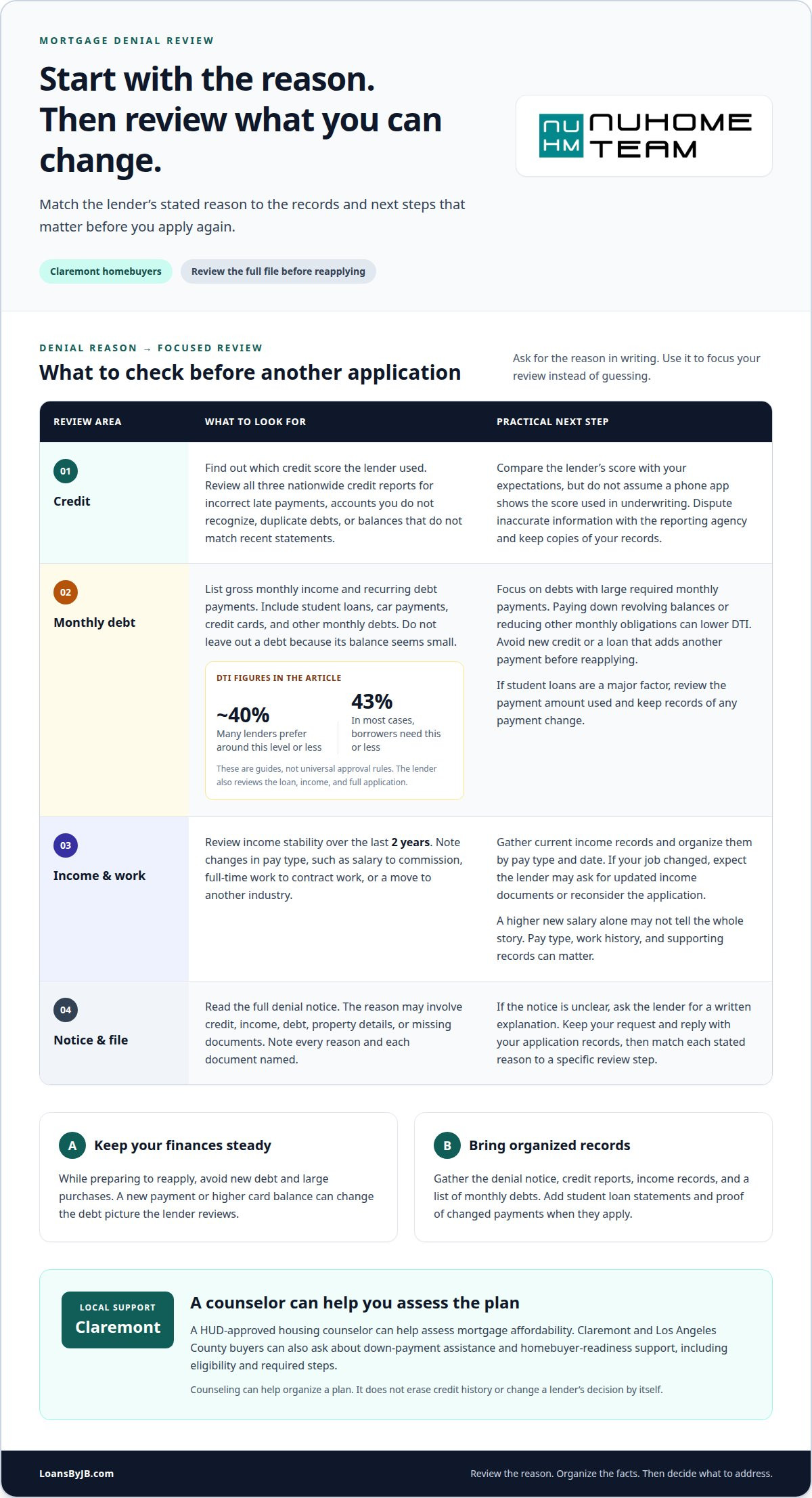
Ask the lender which credit score it used in its decision. The lender must provide a copy of that score. Compare it with the score you expected, but don’t assume a score from a phone app matches the one used in underwriting. A credit score is one clue. Review the lender’s stated reason and your full credit history before deciding what to address.
-
Review Credit Reports for Errors
Get your credit reports and compare each account with your own records. The Federal Trade Commission says consumers can obtain free reports from the three nationwide consumer reporting agencies at AnnualCreditReport.com. Check names, account balances, payment history, and debts you don’t recognize. A mistake on one report may not appear on another, so review all three instead of stopping at the first.
- Promptly dispute inaccurate information with the reporting agency and keep copies of your records. Look for incorrectly reported late payments, accounts that aren’t yours, duplicate debts, and balances that don’t match recent statements. For borrowers who need assistance reviewing their files, services like 750.Credit can help challenge inaccurate or unverifiable negative items. Also note unresolved disputes, which can make it harder for a lender to verify your financial history. Keep a simple record of each error, when you reported it, and the supporting documents you sent.
- Before applying again, check what may be affecting your credit score. Recent late payments and high credit use can signal financial strain. Pay bills on time, avoid taking on new credit, and reduce card balances where you can. Don’t close accounts or move money without understanding the effect on your overall credit profile. A mortgage advisor can help connect the denial reason to practical next steps.
- A HUD-approved housing counselor can help assess your ability to pay for a mortgage. Ask about down-payment assistance and homebuyer-readiness support for Claremont or Los Angeles County buyers, including eligibility and required steps. Counseling can help you organize a plan, but it doesn’t erase credit history or change a lender’s decision by itself. Bring the denial notice, credit reports, income records, and a list of monthly debts to make the conversation useful.
How does my debt-to-income ratio affect reapplying?
Calculate your debt-to-income ratio, or DTI, before applying again. A job change, new debt, or large purchase can affect your application by changing your income records or monthly obligations.
-
Review Your Debt-to-Income Ratio
List your gross monthly income and monthly debt payments, including student loans, car payments, credit cards, and other recurring debt. Compare total debt payments with your income to see what may be weighing on your application.
Many lenders prefer a DTI around 40% or less, and in most cases borrowers need 43% or less. These figures are guides, not universal approval rules. The lender also reviews the loan, income, and full application. Don’t leave out a debt because its balance seems small.
-
Reduce Debt-to-Income Ratios
Focus on debts with large required monthly payments. Paying down revolving balances or reducing other monthly obligations can lower your DTI. Avoid opening a new credit line or taking out a loan before reapplying, since new payments can raise the ratio and contribute to another denial.
If student loans are a major factor, review the payment amount used in your application. Reducing the monthly payment, including through an income-driven repayment plan, may lower your DTI. Keep records of any payment change so the lender can review your current obligation.
-
Assess Employment and Income Changes
Review your income and employment history before choosing when to reapply. Assess income stability over the last 2 years, then gather current records that show how you’re paid. A change from salary to commission, full-time work to contract work, or a move to another industry can prompt the lender to verify income and employment stability.
If your job changed before closing, the lender may request updated income documents or reconsider the application. Don’t assume a higher new salary tells the whole story. Pay type, work history, and supporting income documents can all matter.
- Hold off on new debt and large purchases while preparing to reapply. Financing a car or adding a credit line creates new monthly obligations. A large credit-card purchase can increase balances and affect the debt picture the lender reviews. Keep your finances steady while the lender evaluates your file.
- Organize documents that show your current income and debts. Gather recent pay records, student loan statements, and proof of changed payments. If your income varies, sort records by pay type and date. This gives the lender a clearer basis for reviewing your DTI and employment history.
If income changes or monthly debts make the next step unclear, mortgage advice about your application can help you focus on the figures lenders review.
Requesting an explanation for a mortgage denial
After a denial, ask for the reason in writing and keep the notice. Match each stated reason to a specific next step before applying again.
-
Request a Written Denial Explanation
If the notice doesn’t clearly explain the decision, ask the lender for a written explanation. Mortgage lenders are required to provide one when an applicant asks. Keep your request and the lender’s reply with your application records. A clear explanation can help you determine whether the issue involved credit, income, debt, property details, or missing documents.
-
Review the Mortgage Denial Letter
Read the full denial letter, not just its first line. Note each reason, any document named, and any credit score information included. If the lender relied on a credit report, compare the stated reason with the report and the score used for the decision. Ask the lender to explain any terms or codes you can’t connect to a specific part of your application.
-
Understand the Denial Reasons
Sort the reasons into issues you can address now and issues that may take more work. Missing paperwork may call for sending a document; high monthly debt may require changing your debt picture. A conventional loan denial tied to an appraisal difference points to the property and purchase terms, not necessarily your credit history. Focus on the reason actually stated.
- Compare the explanation with your application and check whether the details match. If the letter cites income, compare the stated amount with the documents you submitted. If it cites debt, list the monthly payments shown in your records. For a property issue, note whether the concern involved appraisal value, condition, or title. This side-by-side review can reveal missing information or details that need clarification.
- Keep the denial in perspective, including when reviewing reported differences by race. In a survey of denied applicants, one in five Black applicants said a negative credit-history item contributed to denial, compared with 16% of White applicants and 12% of Hispanic applicants. Those figures describe reported survey responses. They don’t explain any individual lender decision or establish why a specific borrower was rejected.
- Use the letter to set your next action instead of submitting another application with the same unresolved issue. Correct a document gap, review the credit or income detail named, or ask the lender what needs clarification. Keep a dated record of each response and document you provide. If the reason is still unclear, request a plain-language explanation of how it affected the decision.
What should I consider about a different property or location?
Before changing your purchase plan, compare the denied property and loan terms with other options. FHA, VA, USDA, and conventional loans don’t share one universal credit score, debt-to-income, or down-payment requirement. Lender and program rules vary.
- Identify whether the denial points to you, the property, or both. A low appraisal, property condition concern, title issue, or gap between the purchase price and appraised value can affect financing. Ask which property detail mattered, then compare it with another home you’re considering. A different property helps only if it addresses the stated issue and fits your financial profile.
- Rework the purchase numbers before making an offer elsewhere. Compare the likely monthly housing payment with your income, current debts, and available cash for closing. A lower purchase price can change the amount borrowed, but taxes, insurance, and other housing costs also affect the monthly picture. Use a mortgage calculator to compare scenarios, not to predict a lender’s final decision.
- Ask which loan types may fit the denial reason and your eligibility. FHA, VA, and USDA loans each have program rules, while conventional loans follow their own underwriting requirements. A different loan type is not an automatic workaround for credit, income, debt, or property concerns. Compare the full application requirements, including how each lender reviews your credit history and monthly obligations.
- Check location and property eligibility before pursuing a USDA option. The property address and program rules matter, so don’t assume a move within Claremont or Los Angeles County changes eligibility. For FHA or VA financing, compare the property requirements and borrower qualifications with the reason for your denial. Keep employment, income, and purchase plans steady while reviewing options.
- Set realistic expectations for credit, debt, and down payment requirements. Many lenders prefer a debt-to-income ratio around 40% or less, and in most cases borrowers need 43% or less. Those figures are not universal cutoffs. Credit score and down payment standards also depend on loan program and lender, so compare the specific requirements rather than relying on a single number found online.
- Compare options side by side before changing homes or locations. Write down the purchase price, estimated monthly payments, available funds, and the denial reason each option addresses. If a new location changes property eligibility, confirm that first. If the problem was employment or income documentation, moving farther away won’t fix it. Choose based on the actual issue, not guesswork.
Common reasons mortgage applications are denied
Most denials point to a specific part of the borrower’s file, the property, or both. Find the reason first, then match it to the right next step.
If you want to review the denial reason and your next purchase steps, book a mortgage call.
LoansByJB (The Nuhome Team): 30 Year Fixed Mortgage
LoansByJB (The Nuhome Team) can review your denial reason and help assess possible next steps. Bring the lender’s explanation, current income and debt records, and details about the property you’re considering. This gives the loan review a clear starting point.
If you’re ready to compare options, a 30 Year Fixed Mortgage may fit your purchase plan. FHA Loans and VA Loans may also be worth reviewing when their program rules fit your situation. Each application depends on its full financial and property details, along with underwriting and program guidelines.
Contact LoansByJB (The Nuhome Team) to discuss your mortgage options, or visit LoansByJB.com.
Choose a Clear Next Step
A denial doesn’t have to dictate your next move. If you’re asking what to do if a mortgage application is denied in Claremont, use the lender’s explanation to shape a fresh plan. Focus the next conversation on your finances, property, and possible loan options.
Knowing what to do if your mortgage application is denied in Claremont starts with choosing a loan path that fits your goals. A 30 Year Fixed Mortgage, 15 Year Fixed Mortgage, or FHA Loan may be worth discussing based on your situation and application.
Discuss your mortgage options with LoansByJB (The Nuhome Team). Bring your denial notice and updated documents so the conversation can focus on practical next steps. A clear plan can help you move forward with more confidence.
This article is for general education only and is not a commitment to lend. All loans are subject to credit approval, underwriting, property eligibility, and program guidelines. Rates and terms can change without notice. LoansByJB (The Nuhome Team), NMLS #1647915, CA DRE #02039443. Equal Housing Lender.
Frequently Asked Questions
What are the chances of getting denied after preapproval?
A preapproval isn’t a final loan approval. It’s based on an early review, and the lender still needs to verify your application, income, debts, and property details. For example, new monthly debt or an appraisal issue can change the file after preapproval. Treat preapproval as a useful checkpoint, not a promise. Keep your finances steady and respond promptly when the lender requests updated information.
What is a denial letter for a mortgage?
A mortgage denial letter is the lender’s written notice that it declined your application. Read it to identify the reasons given and any next steps or credit details included. If the language is unclear, ask the lender to explain each reason in plain terms. Keep the letter with your loan documents; it can help you focus on the issue to address before applying again.
When should you apply again?
Apply again once you understand the denial reason and have addressed the part of your file that caused it. If the issue was a missing record, gather the correct document first. If it involved income stability or debt, make a plan based on your current records before submitting another application. For a Claremont purchase, make sure the property and loan terms still fit your finances.
What are the most common reasons a mortgage application is denied?
Common reasons include credit or debt concerns, income or employment documentation, incomplete paperwork, and property issues such as a low appraisal or title dispute. Cash reserves can also matter. A reason behind one borrower’s denial may not apply to another. Use the lender’s explanation to identify which part of your application needs work, rather than assuming every listed issue carries the same weight.
How can you get and review the mortgage denial letter and adverse action notice?
Ask the lender in writing for the denial explanation and any adverse action notice connected with your application. Review the stated reasons, credit information, and instructions about obtaining the credit report used in the decision. Save the notice and your request together. If the letter uses a code or phrase you don’t understand, ask the lender to explain what application detail it refers to.
How can you check and correct credit report errors after a mortgage denial?
Get your reports from the three nationwide consumer reporting agencies, then compare account details with your statements and records. The Federal Trade Commission says consumers can obtain free credit reports through AnnualCreditReport.com. If you find an error, dispute it promptly with the reporting agency and keep copies of the dispute and supporting records. Track the account, the error, and the date you sent the dispute.
How soon can you reapply for a mortgage after being denied?
There’s no minimum waiting period before applying again after a denial. But a new application usually involves a credit check, which can temporarily affect your credit score. Decide when to reapply based on whether the underlying problem has changed. If the same debt, income, or property issue remains, applying immediately may leave the lender with the same concern and your file with another inquiry.
Can a different lender or mortgage program approve an application that was denied?
Another lender may approve an application that was denied elsewhere because lenders and programs can assess a file under different guidelines. That doesn’t mean a new application will be approved. First, compare the original denial reason with the alternative loan option’s requirements. Be ready to explain what has changed or why the new option may better fit your financial and property details.
Need the mortgage math checked?
Talk through the loan before you guess.
Use the estimator, request a refinance quote, or book a call with The Nuhome Team. We will help you compare the options that actually fit the file.
This is not a commitment to lend. Approval, terms, and pricing depend on credit, income, assets, property, and program guidelines.