

To get prequalified, share your income, assets, debts, and purchase plans with a mortgage professional for an early review of possible loan options. A low-down-payment FHA loan may require as little as 3.5% down, while some conventional options may start at 3% for qualified borrowers.
It’s reasonable to want a clear answer before you start house hunting. Prequalification can help you understand what a lender may consider, but it is not final loan approval.
This article explains how to prepare, compare low down payment home loan options, and consider assistance programs and seller contributions in Rancho Cucamonga.
Key Takeaways
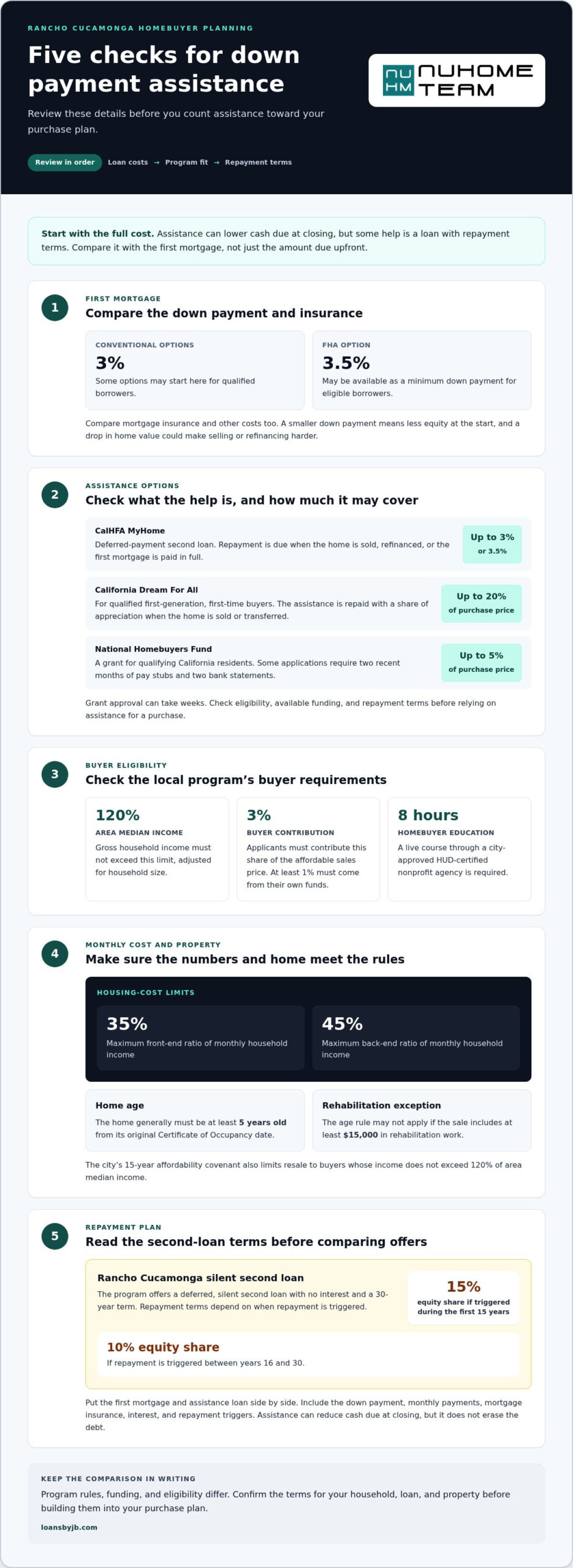
- Compare conventional options that may start around 3% down with FHA options that may start around 3.5%, then weigh mortgage insurance and other costs.
- Review local and state assistance programs early. Eligibility can depend on income, household size, the home, and buyer requirements.
- Ask how seller contributions could help cover eligible closing costs, and factor them into your offer and loan plan.
- Prepare income, asset, and debt details before prequalification so the lender can assess which options fit your finances.
- Compare fixed-rate loan choices alongside assistance options to see how the down payment and closing-cost plan work together.
Can an FHA mortgage lower the down payment, and how does mortgage insurance work?
FHA loans can allow a down payment as low as 3.5% for eligible borrowers. Mortgage insurance is part of the tradeoff: it adds to the cost of borrowing, while a smaller down payment leaves less equity in the home.
The main risks of buying with a small down payment are mortgage insurance costs and negative equity. If the home’s value falls below the mortgage balance, selling or refinancing may be harder because the sale proceeds might not cover what you owe.
FHA mortgage insurance and a second mortgage are separate costs. Mortgage insurance is tied to the FHA loan, while a second mortgage used for assistance has its own repayment terms. Compare both when reviewing the total debt, not just the cash needed at closing.
CalHFA’s MyHome Assistance Program can provide up to 3% or 3.5% of the purchase price as a deferred-payment second loan. Repayment is due when the home is sold, refinanced, or the first mortgage is paid in full. CalPLUS FHA also includes the CalHFA Zero Interest Program, a zero-interest loan for closing costs. That loan is repaid when the home is sold, refinanced, or the first mortgage is paid in full.
Assistance loans can reduce cash due at closing, but they do not erase the debt. Compare the first mortgage and any second mortgage side by side, including the down payment, monthly payments, mortgage insurance, interest, and repayment triggers for the assistance loan.
Term length also affects the plan. Mortgage terms offered on the page range from 5 to 30 years. A fixed-rate mortgage keeps its interest rate fixed for the loan term. An adjustable-rate mortgage typically has an initial fixed-rate period of 5-7 years, then its rate can change. Compare how each choice fits your expected time in the home and budget.
DreaMaker is another program to compare with FHA when reviewing low-down-payment options. Check its down payment, mortgage insurance, and eligibility rules alongside the FHA terms. Programs with similarly low upfront costs can have different costs and requirements.
For a low down payment home loan in Rancho Cucamonga, make a written comparison before choosing. List the first mortgage, any assistance second mortgage, mortgage insurance, and future repayment triggers. This makes the tradeoffs clearer than comparing down payment amounts alone.
What down payment assistance programs can Rancho Cucamonga buyers use?
Assistance can reduce the cash needed to buy, but each program has its own terms. Compare eligibility, repayment rules, and which homes qualify.
Local and State Assistance Programs
Rancho Cucamonga’s program offers a deferred, silent second loan with no interest and a 30-year term. California Housing Finance Agency programs include purchase assistance for eligible first-time homebuyers. The Housing Authority of the County of San Bernardino administers a Home Ownership Assistance Program, while San Bernardino County’s Community Development & Housing Department no longer offers down payment assistance.
CalHFA defines a first-time homebuyer as someone who doesn’t own a home now and hasn’t owned one within the previous three years. California Dream For All offers qualified first-generation, first-time buyers shared appreciation assistance of up to 20% of the purchase price. The assistance is repaid with a share of the home’s appreciation when it’s sold or transferred.
Assistance Amounts and Funding
Assistance may come as a grant or a loan, and the repayment terms matter as much as the amount. The National Homebuyers Fund offers qualifying California residents a grant of up to 5% of a home’s purchase price for purchase or closing costs. Some grant applications require two recent months of pay stubs and two bank statements. Approval for grant funds can take weeks.
Rancho Cucamonga’s silent second loan has repayment terms tied to when repayment is triggered. The borrower’s equity share is 15% if the trigger occurs during the first 15 years, or 10% between years 16 and 30. Read the assistance agreement alongside the first mortgage so future repayment is part of the plan.
Buyer and Purchase Eligibility
Local requirements can include income, household size, buyer contribution, housing costs, and the property. For Rancho Cucamonga assistance, gross annual household income can’t exceed 120% of area median income, adjusted by household size. Applicants must contribute 3% of the affordable sales price, with at least 1% from their own funds.
Applicants must complete a live 8-hour homebuyer education course through a city-approved HUD-certified nonprofit agency. Housing costs can’t exceed a 35% front-end ratio or a 45% back-end ratio of monthly household income. The city’s 15-year affordability covenant also limits resale to buyers whose income doesn’t exceed 120% of area median income.
Property and Geographic Eligibility
USDA geographic eligibility depends on the property address, so a county name alone cannot determine whether a home qualifies. Check the property location and USDA rules separately from local assistance eligibility. These are separate eligibility reviews.
For Rancho Cucamonga assistance, the home generally must be at least 5 years old from its original Certificate of Occupancy date, unless the sale includes at least $15,000 in rehabilitation work. The city’s maximum purchase price is based on Section 203 (B) of the National Housing Act. Review the home’s age, price, and required buyer contribution before relying on assistance for an offer.
Seller contributions toward closing costs
Cash needed at closing includes your down payment and closing costs remaining after approved credits. Earnest money is generally applied toward the funds due at closing, while required reserves must remain available after the purchase. The total depends on the home, loan, and transaction.
A seller contribution is a negotiated credit in the purchase contract. It can cover eligible closing costs under the mortgage program and reduce the cash you bring to closing. It does not automatically lower the purchase price or replace your down payment.
Discuss the seller credit early in the offer process. Your offer can state the contribution you are requesting, and the lender can review it against the program rules and your closing costs. Federal loan guidelines and program requirements determine which costs are eligible and how much credit may be accepted. A credit cannot be treated as extra cash if it exceeds eligible costs.
Keep seller credits separate from closing cost grants. A grant is a separate type of assistance, with its own eligibility rules and restrictions on how funds can be used.
Request a revised estimate after the seller credit is included in the offer. Compare the cash due before and after the credit, then review the closing disclosure to see how the funds are applied. Confirm that the credit covers eligible charges, such as allowable lender or settlement costs, rather than assuming it can pay every item. Limits depend on the loan program and transaction.
- List the funds needed. Separate down payment, closing costs, earnest money, and any required reserves.
- Track earnest money. Confirm how the deposit appears in the transaction and is credited toward funds due at closing.
- Request the credit in the offer. State the seller contribution clearly so the lender can review it with the loan terms.
- Compare available help. Review any grant, including Pathway, separately from the seller credit and its eligibility rules.
For a low-down-payment purchase, plan around the full closing statement, not just the down payment. A seller credit may reduce eligible closing costs, but you still need to budget for earnest money and reserves. The monthly mortgage payment is separate from closing funds, so consider both in your purchase budget.
The amount depends on the home, loan, and transaction. Budget for the down payment and closing costs remaining after approved credits. Earnest money is generally applied toward funds due at closing, while required reserves must remain available after the purchase.
Conventional fixed-rate loans with low down payments
Conventional financing can be worth comparing with FHA when your savings are limited. Qualified borrowers may find conventional options with down payments as low as 3%, while the best fit depends on the full application and property.
A conventional fixed-rate mortgage keeps the interest rate fixed for the loan term, which can make the principal and interest portion of the payment easier to plan than with an adjustable-rate loan. Taxes, insurance, and other housing costs can still change.
Compare more than the down payment. Ask for a side-by-side estimate of the loan amount, monthly payment, mortgage insurance, closing costs, and cash needed at closing. A smaller initial contribution may preserve savings, but it also means borrowing more and starting with less equity.
The traditional down payment described in the program information is 20%. A smaller contribution can make a purchase possible sooner, but the borrower should weigh the added loan balance against the cost of waiting and saving more. There is no universal answer. Household income, other debts, savings, and the purchase price all affect the tradeoff.
Eligibility matters. Treat a credit as a program feature to assess, not money every buyer will receive. Ask how it can be applied and what requirements apply.
Use this comparison process before choosing:
- Compare the full loan estimates. Review monthly payment, mortgage insurance, closing costs, and funds due at closing.
- Check assistance compatibility. Ask whether a grant or second mortgage can be paired with the conventional option.
- Review the fixed-rate term. Make sure the payment fits your budget over the planned time in the home.
- Keep reserves in view. Do not treat every available dollar as a down payment if it leaves no room for ownership costs.
Government-backed and conventional mortgages follow different program rules. Compare actual estimates rather than assuming one category costs less. A lower down payment alone does not reveal the long-term cost.
For a Rancho Cucamonga buyer, the key question is whether the conventional loan’s total cost and terms fit the household budget better than the alternatives. A mortgage professional can review income, assets, debts, and the property to assess options. Focus on a clear comparison, not only the smallest amount due upfront.
What low-down-payment home loan programs are available in Rancho Cucamonga, California?
Rancho Cucamonga buyers can compare conventional, FHA, VA, USDA, and local assistance options. Start by matching program rules to the buyer, property, and available cash.
Conventional loans may offer down payments as low as 3% for qualified borrowers. HomeReady and Home Possible are designed for eligible moderate-income buyers. Their requirements differ from government-backed loans, so compare the full loan terms and mortgage insurance, not just the opening cash amount.
FHA loans may allow down payments as low as 3.5%. Qualified veterans and active-duty service members may be eligible for VA loans with up to 100% financing. USDA loans are also among programs with down payment requirements in a range from 0% to 10%. Each program has its own borrower and property criteria.
USDA eligibility includes a property-location test. Check the exact address rather than relying only on a Rancho Cucamonga or San Bernardino County mailing address. Property eligibility is separate from whether the buyer qualifies for a loan.
Local assistance may be considered alongside a first mortgage. Rancho Cucamonga’s down payment assistance program uses a second loan, while CalHFA offers options for eligible homebuyers. Compare assistance terms with the first mortgage, including repayment triggers and any income, purchase-price, or property-type limits.
Rancho Cucamonga also has a Mortgage Credit Certificate program. Eligible buyers may claim 20% of yearly interest paid on a new mortgage as a tax credit. The home must remain owner-occupied for the entire duration of the certificate, and refinancing does not qualify. A qualified lender submits the application to the Golden State Financial Authority.
The certificate has purchase and income limits. The home’s purchase price generally cannot exceed 90% of the average area purchase price over the past 12 months, unless it is in a federally defined target area. Household income generally cannot exceed 115% of the Area Median Income, subject to listed exceptions. Talk with a CPA about the tax impact.
Use this short comparison before choosing:
- Conventional: Review the down payment, mortgage insurance, and any HomeReady or Home Possible eligibility.
- FHA: Compare its down payment and insurance costs with conventional terms.
- VA: Check eligibility based on military service and review the full loan terms.
- USDA: Assess the property address and borrower criteria.
- Assistance or MCC: Review repayment terms, occupancy rules, and income or purchase limits.
Bring income, asset, debt, and property details to prequalification. A side-by-side review can show how first-mortgage terms and assistance fit together. Compare your home purchase options and identify the next steps for your file.
LoansByJB (The Nuhome Team): 30 Year Fixed Mortgage
LoansByJB (The Nuhome Team) can help compare a 30 Year Fixed Mortgage with FHA Loans or VA Loans for a Rancho Cucamonga purchase. Bring your income, asset, debt, and property details to prequalification so the loan review can consider your full situation.
A 30 Year Fixed Mortgage keeps the interest rate fixed for the loan term. Compare its estimated payment and cash needed at closing with other eligible options. If your budget or plans point elsewhere, a 15 Year Fixed Mortgage is another available choice.
Turn to the team when you want a clear comparison of loan choices and lender steps, including how assistance or seller credits fit the purchase. The next step is to contact LoansByJB to discuss prequalification.
Set Up Your Next Step
Make your next step a prequalification review rather than relying on an online payment estimate. Gather details about income, assets, and debts, then decide what monthly housing cost fits your household. This gives the conversation a practical starting point.
For a low-down-payment home loan in Rancho Cucamonga, compare the full loan picture before choosing. Discuss how the purchase price, available cash, and assistance options work together. A practical review can clarify what to prepare and which options merit closer consideration. Final loan terms depend on the complete file and program guidelines.
When you’re ready to talk through your purchase plans, contact LoansByJB (The Nuhome Team). Take the next step with a clearer picture and a plan built around your budget.
Frequently Asked Questions
How can I get a mortgage prequalification?
Share your income, assets, debts, and purchase plans with a mortgage professional. Include your expected price range and any down payment funds or assistance you plan to use. Ask for a review of potential loan types and the documents needed for a fuller application. Prequalification is an early estimate based on the information reviewed, not final loan approval or a promise to lend.
How much do you need for a down payment?
The amount depends on the loan program and your qualifications. Conventional options may start at 3% down for qualified borrowers, while FHA options may start at 3.5%. Eligible VA borrowers may qualify for up to 100% financing. Plan separately for closing costs, earnest money, and any reserves required for your loan. Those items affect the cash you need beyond the down payment.
What are the benefits of getting prequalified?
Prequalification offers an early view of loan options and helps shape a purchase budget before you make an offer. It can also identify documents or financial details that need closer review. For example, assistance funds may require a separate eligibility review, which can help you plan your next steps. Treat prequalification as a starting estimate, not a final lending decision.
Why choose an FHA loan?
An FHA loan can be worth comparing if your available down payment is limited and you meet the program’s requirements. It may allow a down payment as low as 3.5%, but mortgage insurance and the total monthly cost belong in the comparison. Review the full loan estimate alongside conventional choices. A smaller upfront contribution does not automatically mean a lower overall cost.
What are the minimum down payments and credit score requirements for FHA, conventional, VA, and USDA loans?
Down payment terms depend on program eligibility and the borrower’s file. Conventional options may start at 3%, FHA at 3.5%, and eligible VA financing may reach 100%. USDA requirements vary with borrower and property eligibility. Credit score requirements also vary by lender and program, so compare the full criteria rather than treating one score as a universal cutoff.
Are there California or San Bernardino County down payment assistance programs for Rancho Cucamonga homebuyers?
Yes. Rancho Cucamonga has a local assistance program, and the California Housing Finance Agency offers purchase assistance options for eligible buyers. The Housing Authority of the County of San Bernardino administers a Home Ownership Assistance Program. The San Bernardino County Community Development & Housing Department no longer offers down payment assistance. Review each program’s income, property, buyer, and repayment rules before including it in your purchase plan.
How do FHA, conventional, VA, and assistance loans compare in rates, mortgage insurance, and total costs?
Compare written loan estimates for the same purchase, not just advertised rates. Review the interest rate, monthly principal and interest, mortgage insurance, closing costs, and cash needed at closing. For assistance, include any second-loan repayment terms or shared-appreciation obligations. These details clarify the overall cost; eligibility and final terms depend on the program and borrower’s file.
How much cash is needed for closing costs, earnest money, and reserves with a low-down-payment loan?
The amount depends on the home, loan, and transaction. Budget for the down payment and closing costs remaining after approved credits. Earnest money is generally applied toward funds due at closing, while required reserves must remain available after the purchase.
Need the mortgage math checked?
Talk through the loan before you guess.
Use the estimator, request a refinance quote, or book a call with The Nuhome Team. We will help you compare the options that actually fit the file.
This is not a commitment to lend. Approval, terms, and pricing depend on credit, income, assets, property, and program guidelines.