
Updated October 19, 2026 | By Justin Brown
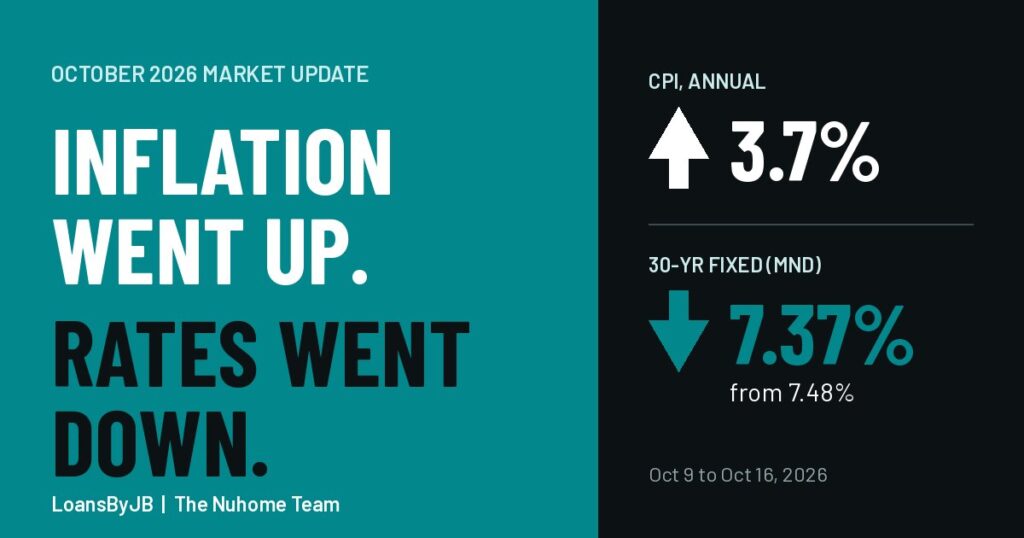
What if I told you inflation got worse last week, but mortgage rates still went down?
Sounds backward, right?
Most people believe when inflation goes up, mortgage rates go up with it.
And while that often happens, it’s not always the case.
Last week gave us a perfect example.
Mortgage rates dropped even after two reports showed prices were rising faster.
If you’re thinking about buying a home, refinancing your mortgage, or investing in real estate, understanding why this happened matters.
Because making decisions based on headlines alone might cost you money.
What Happened to Mortgage Rates in October 2026?
Let’s start with the numbers.
According to Mortgage News Daily, average 30-year fixed mortgage rates moved from approximately 7.48% on October 9 to 7.37% on October 16.
That’s a drop of 0.11 percentage points.
It doesn’t sound like much.
But here’s what that means for your monthly payment.
Example: An $800,000 Mortgage
Let’s say you’re borrowing $800,000 to purchase a home.
At 7.48%, your monthly principal and interest payment would be approximately $5,583.
At 7.37%, your monthly principal and interest payment would be approximately $5,523.
That’s roughly $60 less every month.
Or about $720 per year.
And you didn’t have to negotiate a lower purchase price to get it.
These examples assume a 30-year fixed-rate loan and exclude property taxes, insurance, mortgage insurance, and closing costs.
Why Did Mortgage Rates Fall When Inflation Increased?
Here’s where things get interesting.
Two inflation reports came out last week.
The Consumer Price Index, which measures changes in the prices people pay for everyday goods and services, showed prices rising 0.6% in September.
That put annual inflation at 3.7%.
Another report measuring prices businesses charge showed an even larger increase.
Normally, inflation like this puts pressure on mortgage rates to rise.
But rates went down instead.
Why?
Because mortgage rates don’t follow inflation reports directly.
They respond to what happens in the bond market.
What Is the Bond Market, and Why Does It Matter?
I’ll keep this simple.
The bond market is where investors buy and sell loans made to governments and businesses.
One important bond is the 10-year U.S. Treasury.
Mortgage rates often move in the same direction as the interest rate on this bond.
Here’s how it works.
When investors buy more Treasury bonds, bond prices tend to rise.
When bond prices rise, their yields, or rates of return, tend to fall.
Mortgage rates often follow those lower yields.
That’s what happened last week.
The 10-year Treasury yield fell from approximately 5.21% on Tuesday to 5.09% on Friday.
Even though inflation reports were bad, investors continued buying bonds.
That helped mortgage rates move lower.
The Lesson
Mortgage rates depend on how financial markets respond to economic news.
A bad inflation report does not automatically mean mortgage rates will rise.
And a good inflation report does not guarantee rates will fall.
That’s why trying to predict mortgage rates from news headlines is difficult.
Should You Wait for Mortgage Rates to Drop Before Buying?
This is one of the most common questions I hear.
And here’s how I look at it.
Nobody knows exactly where mortgage rates will go next.
They might improve.
They might get worse.
But waiting for the perfect rate isn’t a plan.
Instead, focus on what you know today.
Your income.
Your down payment.
Your monthly budget.
And the payment you’re comfortable making.
Here’s an Example
Let’s use that same $800,000 mortgage.
At approximately 7.40%, your principal and interest payment would be around $5,539 per month.
If rates increased to 7.65%, your payment would rise to approximately $5,676.
That’s roughly $137 more every month.
Or approximately $1,644 per year.
The question isn’t whether rates will rise or fall next week.
The better question is:
Would you still be comfortable with the payment if rates moved higher?
If the answer is no, you need to adjust your budget or financing strategy before moving forward.
What About Locking Your Mortgage Rate?
Here’s something worth asking your lender before closing.
“If I lock my interest rate today and rates drop before closing, do I get the lower rate?”
Some lenders offer a feature called a rate float-down.
A float-down gives eligible borrowers an opportunity to lower their locked interest rate if market pricing improves before closing.
But there are rules.
Some lenders charge fees.
Others require rates to drop by a certain amount.
And some lenders don’t offer this option at all.
The important thing is to ask before locking your rate.
Understanding your options gives you more control over your financing.
More Homes Are Available. Does That Mean Better Deals?
Mortgage rates aren’t the only thing changing.
The housing market is shifting too.
According to the National Association of Realtors, there were approximately 1.6 million existing homes available for sale nationwide in September 2026.
That’s 4.6% more than one year earlier.
More homes for sale means buyers have more choices.
But that doesn’t mean every property is a bargain.
Especially here in Southern California.
Where I See Opportunities
When I’m looking at properties in Los Angeles, Orange, Riverside, and San Bernardino counties, I pay attention to homes with certain characteristics.
- Properties that have been sitting on the market.
- Homes that have already reduced their asking price.
- Properties needing cosmetic repairs or major renovations.
- Sellers dealing with situations where a traditional sale might not be the best fit.
These situations sometimes create room to negotiate.
And negotiating doesn’t always mean asking for a lower purchase price.
Sometimes a seller credit toward closing costs or an interest-rate buydown creates more value.
The key is understanding the numbers before making an offer.
My Biggest Advice for Homebuyers and Investors Right Now
Stop trying to predict mortgage rates.
Start understanding your payment.
Before purchasing a home or refinancing, I recommend looking at four things.
1. Know Your Comfortable Monthly Payment
Not the maximum amount a lender approves.
The amount you feel comfortable paying every month.
Remember to include property taxes, insurance, HOA fees, and other housing expenses.
2. Compare Payments at Different Rates
Ask your lender to show you payments using today’s rate and a rate that’s 0.25% higher.
This helps you understand how much risk you’re taking if rates change.
3. Understand Your Rate Lock Options
Ask about locking your rate and whether a float-down option is available.
Get the terms in writing.
4. Make Sure the Deal Works Today
This is especially important for real estate investors.
Don’t buy a property assuming you’ll refinance into a much lower rate next year.
And don’t assume rents will increase enough to fix a deal that doesn’t make financial sense today.
If rates improve later, that’s an added benefit.
But your numbers should work from the beginning.
The Bottom Line
Last week showed us something important.
Inflation increased.
Mortgage rates declined.
And anyone making decisions based only on inflation headlines missed what was happening in the mortgage market.
The smartest move isn’t trying to guess what happens next.
It’s understanding your options and making decisions based on numbers that work for your situation.
Whether you’re buying your first home, refinancing, self-employed, or investing in real estate, the right financing strategy matters.
Have Questions About Your Mortgage Options?
I’ve spent more than 25 years in the mortgage and real estate industry.
I’ve worked on the lending side, the underwriting side, and as a real estate investor.
I’ve seen how the right loan structure changes the numbers on a deal.
If you’re thinking about buying, refinancing, or investing, I’d be happy to review your situation.
Send me the property price, estimated down payment, credit score range, and what you’re trying to accomplish.
I’ll help you understand the options available and what the numbers look like.
Justin Brown
Mortgage Broker | Real Estate Investor
LoansByJB | The Nuhome Team
909-833-3200 | teamjb@nuhometeam.com
Justin Brown, NMLS #242219. The Nuhome Team is a DBA of Loan Advisor Group Inc., NMLS #1647915, CA DRE #02039443. 1025 Sentinel Dr, Ste 200, La Verne, CA 91750. Payment examples are for illustration only and are not a loan offer or commitment to lend. Rates and terms change daily and are subject to credit approval, underwriting, and property review. Equal Housing Opportunity.
Need the mortgage math checked?
Talk through the loan before you guess.
Use the estimator, request a refinance quote, or book a call with The Nuhome Team. We will help you compare the options that actually fit the file.
This is not a commitment to lend. Approval, terms, and pricing depend on credit, income, assets, property, and program guidelines.