

The lender with the lowest advertised rate may be the wrong fit for your rental. The best dscr lenders are the ones whose underwriting matches the property and your financing strategy, not simply the ones with the flashiest terms.
Comparing lenders takes more than lining up rates. One lender’s rent calculation can produce a different debt-service coverage ratio than your own cash-flow analysis. Property rules, documentation, and loan structure can change the result, too. Compare the assumptions behind each option before weighing the headline rate.
This guide compares lender approaches and explains what to look at, what deal information to prepare, and how to have a more focused financing conversation. It also covers LoansByJB, a Southern California mortgage brokerage led by Justin Brown, who brings more than 25 years of broker, lender, and investor experience. The team’s investor-focused perspective brings carrying costs and exit strategy into the discussion alongside loan terms. Start with the property, then compare the financing.
Key Takeaways
- The best dscr lenders are a fit for your property’s cash flow, rental strategy, and loan purpose, not simply the lowest advertised rate.
- Compare rent calculations, borrower structure, property eligibility, loan features, and process using the same assumptions.
- Use a comparison shortlist to evaluate different program approaches, not to assume any one lender is a universal winner.
- For a Southern California property, base rent assumptions on its local market and consider carrying costs alongside the financing structure.
- Prepare property, ownership, rent, and loan-purpose details before discussing a DSCR plan so the conversation can focus on the deal.
What makes a DSCR lender the right fit for an investment property?
One rental property can pass one lender’s cash-flow test and miss another’s. Rent assumptions, payment components, property rules, and borrower setup can all affect the result. That’s why searching for the “best” lender by name alone can send you in the wrong direction.
A DSCR lender evaluates a rental property’s income against its debt obligations under the lender’s program rules. DSCR stands for debt service coverage ratio. The basic calculation compares income available to cover debt service with the debt service itself. Debt Service Coverage Ratio (DSCR) on Wikipedia provides a general overview of the calculation and its use in financial analysis.
General DSCR principles explain the math; each lender’s program rules determine eligibility and loan terms. The ratio is one underwriting input, not an approval promise. It doesn’t resolve questions about the property, ownership, documentation, or loan structure on its own.
What does a DSCR lender evaluate?
The lender compares qualifying rental income with the property’s eligible debt payment. Depending on the program and scenario, rent may be assessed from a lease or a projected market rent. The payment may be calculated as PITIA: principal, interest, taxes, insurance, and, where applicable, association dues. Because both the rent method and payment components can vary, use the lender’s calculation rather than assuming it matches your spreadsheet.
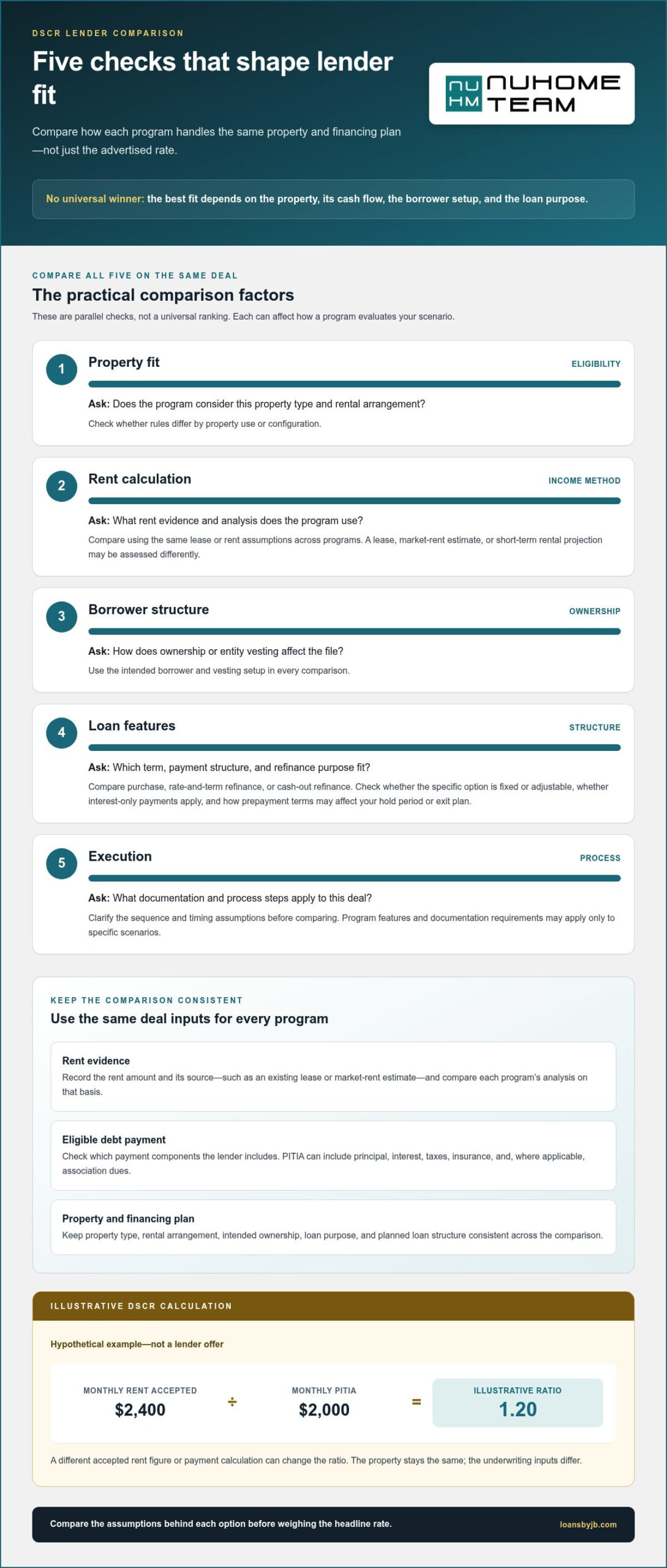
Hypothetical example, not a lender offer: If a lender accepts $2,400 in monthly rent and calculates monthly PITIA at $2,000, the illustrative ratio is 1.20 ($2,400 divided by $2,000). If another program uses a lower rent figure or includes a cost your estimate leaves out, its ratio may differ. The property hasn’t changed; the underwriting inputs have.
Why lender fit matters more than a “best lender” label
Fit depends on the deal in front of you. A single-family rental, multifamily property, or property with a different rental arrangement may be assessed differently. Specialized residential uses also introduce distinct requirements; for instance, investors who seek to buy RCFE facility California properties must navigate guidelines tailored to licensed care operations rather than standard residential leases. Borrower structure, such as individual or entity ownership, and loan purpose, such as purchase or refinance, can also affect the program and documentation.
Separate general marketing language from terms that apply to your scenario. An advertised feature describes a program, but it doesn’t establish that the feature applies to every property or borrower. Compare the rent method, eligible property type, ownership requirements, and loan structure for your specific deal.
The best dscr lenders for your deal are the ones whose rules align with the property and your investment plan. Start with a consistent rent estimate and a clear view of carrying costs. Then compare how each program treats those same inputs. This gives you a more useful answer than a universal ranking.
How to compare the best DSCR lenders: five practical criteria
A useful comparison isn’t a stack of rate quotes. It’s a side-by-side review of how each program handles your property and financing plan. The best dscr lenders for your deal are the ones whose criteria match its facts and whose loan structure supports your strategy.
DSCR eligibility depends on program rules and the complete file, not a ratio in isolation. Use this checklist to keep the comparison grounded:
| Criteria | Questions to compare | Scenario-specific notes |
|---|---|---|
| 1. Property fit | Does the program consider this property type and rental arrangement? | Check whether rules differ by property use or configuration. |
| 2. Rent calculation | What rent evidence and analysis does the program use? | Compare with the same lease or rent assumptions across programs. |
| 3. Borrower structure | How does ownership or entity vesting affect the file? | Use the intended borrower and vesting setup in the comparison. |
| 4. Loan features | Which term, payment structure, and refinance purpose fit? | Features may be limited to specific programs or scenarios. |
| 5. Execution | What documentation and process steps apply to this deal? | Clarify the sequence and timing assumptions before comparing. |
Compare underwriting and rental-income methods
Start with the rent evidence. A program may rely on an existing lease, a market-rent estimate, or another method. Don’t treat long-term rental assumptions as interchangeable with short-term rental projections; the program may assess them differently. For each option, record the rent amount and its source, then compare the resulting analysis on the same basis.
Appraisal forms, automated estimates, and third-party tools are program-specific. Distinguish a general feature description from the method that applies to your scenario.
Compare flexibility, process, and loan structure
Next, compare property eligibility, entity vesting, and loan purpose: purchase, rate-and-term refinance, or cash-out refinance. These distinctions can affect documentation and available structures. Don’t assume a feature advertised for a program automatically applies to every borrower or property.
Review the proposed term and payment setup. Compare whether the specific option is fixed or adjustable, whether interest-only payments apply to that scenario, and how any prepayment terms could affect your hold period or exit plan. These are comparison points, not universal DSCR features.
Finally, map the process: which documents are needed, who supplies them, and what milestones must be met? Keep a worksheet with each program’s rent assumptions, property rules, borrower setup, loan features, and outstanding items. This makes differences visible before they become surprises.
For a Southern California investment, an experienced mortgage broker can bring property cash flow, carrying costs, and your planned exit into the financing discussion. Explore DSCR financing options while organizing the details for a deal-specific comparison.
Best DSCR lenders to compare in 2026: four distinct approaches
Use this shortlist to compare different approaches, not as a universal ranking or endorsement. Some providers publish a specific rental-property program, while a brokerage can help investors consider financing options in the context of a particular deal. The right starting point depends on the property, rental plan, and loan purpose.
Competitor descriptions below reflect published or reported positioning, not guarantees of current program terms. Features and eligibility can change, and a published feature may not apply to every borrower or property. Compare current terms for the scenario you’re evaluating.
| Provider type | Stated approach | Useful-fit signals | Details to verify |
|---|---|---|---|
| Farm Bureau Bank, bank | Its page-reported rental-property program explains rent in relation to PITIA. | Useful for understanding how a published program frames rental cash flow. | Eligible properties, rent evidence, PITIA calculation, and terms for your scenario. |
| Kiavi, DSCR lender | Reported market positioning emphasizes speed. | Worth comparing if execution pace is important to your investment plan. | Current process, timing expectations, eligibility, and deal-specific terms. |
| CrossCountry Mortgage, mortgage lender | Its page-reported educational coverage explains DSCR requirements and application steps. | Can help readers understand the process and factors commonly discussed in a DSCR application. | Current program availability, property and borrower criteria, and deal-specific terms. |
| LoansByJB, Southern California mortgage brokerage | Offers DSCR financing and brings an investor lens to loan structure, carrying costs, and exit strategies. | A relevant comparison point for investors who want a deal-focused discussion grounded in the Southern California market. | How the proposed structure aligns with the property’s cash flow, investment plan, and intended exit. |
Farm Bureau Bank, Kiavi, and CrossCountry Mortgage
Farm Bureau Bank’s page-reported explanation gives investors a concrete way to think about rent relative to property obligations. Kiavi is commonly identified with a speed-focused approach, but that positioning isn’t a timing promise for a particular file. CrossCountry Mortgage’s educational material emphasizes requirements and application steps. These are different entry points, not equivalent offers.
Compare each using the same property details and rent assumptions. A published program feature or lender positioning is a starting point, not a guarantee that it applies to your scenario. Focus on the income method, eligibility, process, and terms relevant to the complete deal.
LoansByJB: broker-led guidance for Southern California investors
LoansByJB, also known as The Nuhome Team, is a mortgage brokerage offering DSCR financing, not a direct bank. Led by Justin Brown, whose experience spans more than 25 years across brokering, lending, and investing, the team brings an investor’s perspective to carrying costs and exit strategies. That puts the financing discussion in the context of the full deal, not just a ratio.
For investors in Claremont and nearby communities including La Verne, San Dimas, Upland, Rancho Cucamonga, Glendora, and Downey, local property context can inform a tailored loan-structure discussion. The best DSCR lenders to compare are ultimately those whose approach fits your property and plan.
Match a DSCR lender to your property, strategy, and California market
Start with the deal, not a lender’s headline feature. A program that suits a long-term rental may assess a short-term rental differently. The same goes for property type, occupancy, ownership, and whether you’re buying or refinancing. Write down those specifics first, then compare lender approaches against them.
Match the program to rental strategy and property
Long-term rent and short-term rental income are different inputs. A program may analyze them differently or apply property-specific criteria, so don’t assume one rent method carries over to another. Record how you plan to operate the property, how it’s configured, and who will own it. Then compare those details with each program’s approach.
For a Southern California deal, ground rent assumptions in the subject property’s market. Use relevant local information for that property, not a broad regional average or an optimistic projection. In Claremont, La Verne, San Dimas, Upland, Rancho Cucamonga, Glendora, and Downey, the property’s location and rental plan should guide your assumptions. Keep the evidence behind your estimate so you can explain differences between your operating model and the lender’s analysis.
Use a decision matrix before choosing a lender
Write down the deal’s core features and compare each program against the same set. A consistent comparison makes mismatches easier to spot.
| Decision factor | What to define | What to compare |
|---|---|---|
| Rental strategy | Long-term or short-term rental plan | How the program assesses that income |
| Property | Type, configuration, and occupancy | Eligibility and property-specific treatment |
| Ownership | Individual or intended entity structure | Vesting rules and required borrower documentation |
| Loan purpose | Purchase, rate-and-term refinance, or cash-out | Available structure and scenario requirements |
Stress-test the deal before selecting a lender
Run your operating model alongside the lender’s rental calculation. Include rent, PITIA, recurring property expenses, vacancy assumptions, and expected carrying costs. Then test how the numbers change if rent comes in below your projection or an expense rises. A lender’s calculation is an underwriting measure, not a full forecast of investment performance.
Put the exit plan on paper, too. Consider how the financing structure fits your intended hold period and next move. If speed or loan term is central, compare the role of DSCR financing with hard money in your acquisition or project plan. They serve different financing purposes, so weigh each structure against the actual timeline rather than assuming one substitutes for the other.
For a Southern California deal, discuss a DSCR financing plan with LoansByJB. Bring your rent assumptions, property details, ownership plan, estimated carrying costs, and exit strategy so the discussion can focus on the deal as a whole.
How LoansByJB helps investors move from lender comparison to a DSCR plan
Comparing the best dscr lenders is useful when it leads to a plan for your actual property. A broker conversation can bring rental cash flow, financing structure, carrying costs, and your intended exit into one discussion. The goal is to understand how those factors work together, rather than treating a ratio or advertised feature as the entire decision.
That deal-level view matters in Southern California, where rent assumptions should reflect the subject property and its local market. A clear picture of your plan also makes the conversation more focused, whether you’re considering a purchase or refinancing an investment property.
What to prepare before discussing a DSCR scenario
You don’t need a perfect file to organize the deal. Gather the available details, flag what’s still an estimate, and identify which assumptions you want to discuss.
- Property details: Location, property type, current or planned use, and whether the goal is a purchase or refinance.
- Rent evidence: Existing lease information, available rental data, or a realistic estimate for the subject property. Note whether the plan involves long-term or short-term rental income.
- Ownership plan: How the property is or will be held, including the intended borrower or entity structure.
- Carrying costs: Your estimate of PITIA and recurring property obligations. Separate known figures from assumptions.
- Investment timeline: Expected hold period, financing goal, and intended exit strategy.
These details help distinguish your operating model from the figures a lender may use for underwriting. Discuss that difference early, especially if a change in rent or carrying costs could affect the deal’s performance.
Turn the comparison into a tailored financing conversation
LoansByJB, also known as The Nuhome Team, approaches DSCR financing with an investor’s perspective. Led by Justin Brown, the team brings more than 25 years of experience across brokering, lending, and investing, and has guided thousands of transactions. That background informs a practical discussion of how the proposed financing relates to property cash flow, ongoing costs, and your expected exit from the investment.
A conversation doesn’t replace program underwriting or promise approval or specific terms. It can help organize the moving parts, clarify your financing goal, and focus the comparison on a structure that fits the deal. Start with the information you have and refine assumptions as the scenario takes shape.
Discuss your DSCR financing strategy with LoansByJB and take the next step toward a property-specific plan.
Make your next move with a deal-first financing plan
Your next step isn’t to chase a lender label. Turn your investment assumptions into a clear financing conversation. Decide what the property needs from the loan, what you can carry if rent or expenses shift, and how the structure fits your intended exit. This gives you a stronger basis for judging which of the best dscr lenders may suit your deal.
Bring your property details, rent information, ownership plan, and financing goal. You don’t need every answer in hand. A focused discussion can surface the questions that matter before you commit to a direction.
LoansByJB works with Southern California investors to connect DSCR financing discussions with property cash flow, carrying costs, and exit strategy. Center the next conversation on your investment property and the plan behind it.
Talk through your investment property and DSCR financing options with LoansByJB. Take the next step toward a clearer financing plan for your deal.
Frequently Asked Questions
Can you get a DSCR loan if the property’s DSCR is below 1.0?
Sometimes, but it depends on the lender’s program and the full scenario. A ratio below 1.0 means the rent used in underwriting is less than the property’s calculated debt obligations, so options may be narrower or terms may differ. Compare the lender’s qualifying rent and payment inputs with your operating budget. A property that falls short on paper still needs a realistic plan for covering its monthly shortfall.
Do DSCR lenders require tax returns or personal income documentation?
Not always, but don’t assume a DSCR loan means no personal documentation. Some programs focus primarily on property cash flow, while requirements may still include credit, asset or reserve information, entity documents, or personal financial records. Tax returns may be requested depending on the program and transaction. Identify the borrower and ownership structure, then organize the records tied to both the property and the people or entity involved.
Are DSCR loans available for short-term rental properties?
Some DSCR programs consider short-term rentals, but eligibility and income analysis vary by program. A lender may distinguish projected revenue from documented booking history and use its own method to assess rent. Gather available booking records, operating history, and details about the property’s intended use. For hosts seeking structured track records, working with a professional management provider like BnB Booking can help document booking performance. If the property is newly acquired or lacks rental history, make that clear so projections aren’t mistaken for established performance.
Can an LLC take out a DSCR loan?
Yes, some DSCR programs allow an LLC to be the borrower, subject to entity and underwriting rules. The lender may request formation and ownership documents and may have requirements involving individuals behind the entity. Decide how you intend to hold title before structuring the financing discussion. Changing ownership plans mid-process can create extra steps, so share the intended vesting structure early rather than treating it as a closing detail.
Are DSCR loans available for investment properties in California?
Yes, DSCR financing is available for California investment properties, though program terms and property eligibility can vary by market and deal. For properties in Southern California, including Claremont, La Verne, San Dimas, Upland, Rancho Cucamonga, Glendora, and Downey, base rent assumptions on the subject property’s local rental context. Don’t treat a statewide estimate as proof of what a specific property can earn. Local assumptions make the financing analysis more useful.
How do DSCR lenders calculate rental income?
Lenders generally compare qualifying rental income with a defined set of property debt obligations, but the rent input depends on the program. A lender may use lease information, an appraiser’s rent analysis, or another accepted estimate. Compare whether the figure is based on current rent or projected market rent, and whether the property’s rental strategy changes the method. Differences in accepted income or payment components can change the calculated ratio.
What is the difference between a DSCR mortgage broker and a DSCR lender?
A lender underwrites a loan under its program and provides or arranges the capital; a broker helps connect a borrower’s scenario with financing options from lenders. A broker isn’t automatically the funding source. LoansByJB is a Southern California mortgage brokerage offering DSCR financing. For investors comparing the best dscr lenders, a broker conversation can help frame the property, ownership plan, and financing goal before focusing on a particular program.
Need the mortgage math checked?
Talk through the loan before you guess.
Use the estimator, request a refinance quote, or book a call with The Nuhome Team. We will help you compare the options that actually fit the file.
This is not a commitment to lend. Approval, terms, and pricing depend on credit, income, assets, property, and program guidelines.