

What if you could stop hunting for the “perfect” duplex and instead build your own wealth by fixing a property the big banks won’t even look at? Most aspiring investors think multi-family real estate requires a massive 20% down payment or a building that’s already in pristine condition. You’re right to be worried about “money pits,” but the standard path is designed to keep you small. Using a 203k loan for multi family property allows you to bypass those barriers and take control of the asset from day one.
It’s time to change the game. You can weaponize this FHA program to buy, renovate, and house-hack a 2 to 4 unit asset with as little as 3.5% down. This guide will show you how to force equity through strategic renovations and navigate the FHA self-sufficiency test without the usual headache. We’ll break down the 2026 loan limits for high-cost areas like Los Angeles and Orange County. You’ll learn exactly how to get your tenants to pay your mortgage while you build a real portfolio with minimal cash out of pocket. Stop waiting for the market to give you a deal and start building one yourself.
Key Takeaways
- Acquire 2-4 unit properties with a 3.5% down payment, bypassing the restrictive 20-25% requirements of standard investment financing.
- Use 75% of projected rental income to boost your purchasing power and qualify for higher-value multi-family assets.
- Weaponize the 203k loan for multi family property to finance renovations and purchase costs into a single, stable mortgage.
- Clear the FHA self-sufficiency test for 3-4 unit buildings to ensure your tenants cover the mortgage from day one.
- Capitalize on Southern California’s high-balance loan limits to fund large-scale house hacking projects in premium local markets.
The House Hacking Blueprint: Why Use a 203k Loan for Multi-Family?
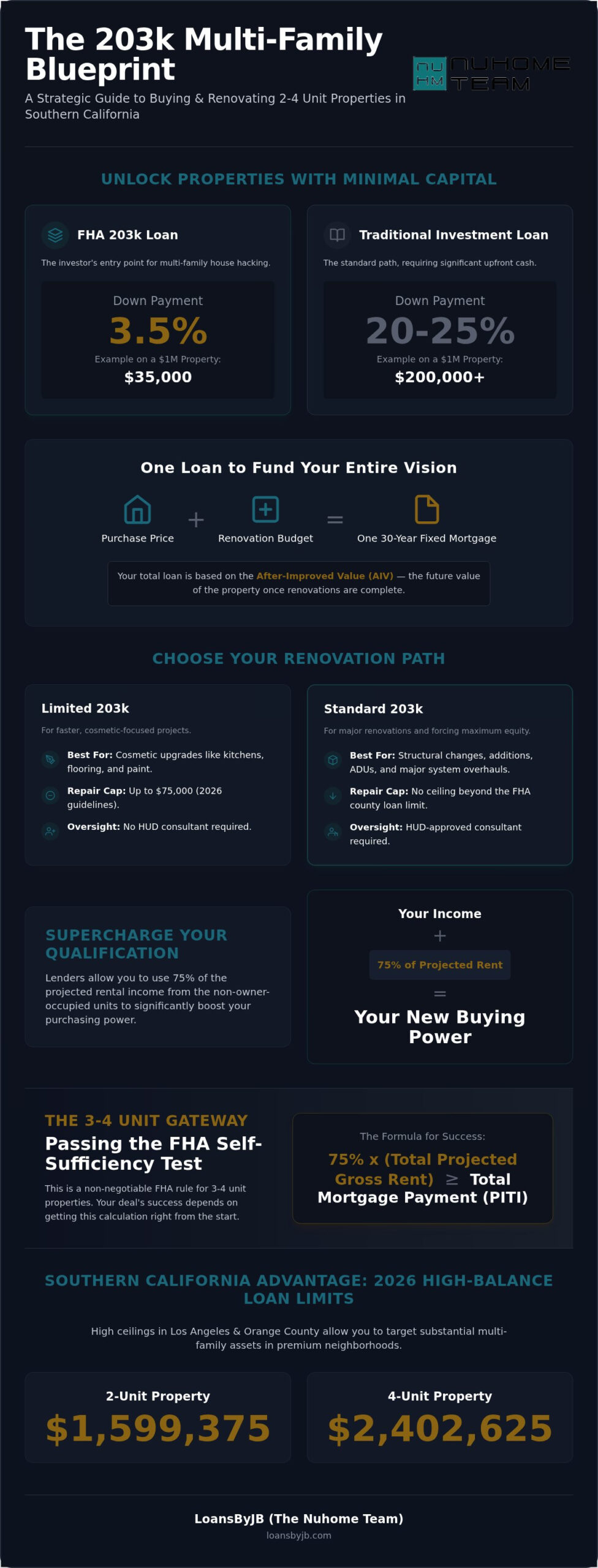
The 203k loan for multi family property is the ultimate shortcut for investors who don’t want to wait a decade to build a portfolio. It rolls your purchase price and your renovation budget into one 30-year fixed mortgage. This isn’t a complex hard money bridge; it’s a government-backed FHA insured loan designed to help you buy an asset and fix it at the same time. While traditional investment loans demand 20% or 25% down, you can lock this in with just 3.5%. That is the difference between needing $200,000 for a duplex and needing $35,000. This isn’t just a mortgage; it’s a strategic entry point into the Southern California market.
In 2026, 2-4 units are the sweet spot for new investors. You get the scale of a small apartment building with the financing terms of a single-family home. The catch is simple: you have to live in one of the units for at least 12 months. Living in one unit while the others pay your debt is the fastest way to achieve financial freedom. It is the most effective way to secure a multi-family asset before prices climb further.
Understanding the Multi-Unit Opportunity
Buying a “turn-key” duplex in Southern California usually means paying a premium for someone else’s mediocre choices. A 203k fixer lets you choose the finishes and force the equity yourself. You aren’t just buying a home; you’re acquiring a cash-flowing asset where the tenants pay your debt. A duplex, triplex, or fourplex accelerates equity growth because the market value is driven by the property’s potential income, not just neighborhood comps. The 203k multi-family strategy is a calculated wealth-building hedge against inflation and rising housing costs.
Limited vs. Standard 203k: Which One Fits Your Project?
You have two paths to choose from. The Limited 203k works for cosmetic upgrades like new kitchens, flooring, or paint. It’s capped at $75,000 in total repairs according to 2026 guidelines. It’s fast, and it doesn’t require a HUD consultant. However, multi-family properties often need more extensive work to maximize rents.
The Standard 203k has no repair ceiling beyond the county loan limit. It allows for structural changes, additions, or major system overhauls like plumbing and electrical. If you’re converting a garage into an ADU or fixing a foundation on a 203k loan for multi family property, the Standard version is your move. It requires more oversight and a HUD-approved consultant, but it’s where the real profit lives. Most multi-unit projects land in this category because the goal is to fully modernize the property to attract top-tier tenants.
Crunching the Numbers: Qualifying with Rental Income
Qualifying for a 203k loan for multi family property isn’t just about your paycheck. It is about the building’s potential to pay for itself. Lenders allow you to use 75% of the projected rental income from the vacant units to offset your debt-to-income (DTI) ratio. This is a massive advantage. It means you can qualify for a million-dollar triplex even if your W-2 income suggests a much lower ceiling. The FHA 203(k) loan guidelines are designed to help you scale, but the math must be precise from day one.
The most important number in your deal is the After-Improved Value (AIV). This is the appraised value of the property once all renovations are complete. Your total loan amount is based on this number, not the current “as-is” condition. In Southern California, navigating high-balance loan limits is critical. For 2026, the FHA loan limit for a 2-unit property in Los Angeles and Orange County is $1,599,375. If you are eyeing a 4-unit building, that limit jumps to $2,402,625. These high ceilings allow you to target substantial assets in premium neighborhoods like Claremont or Downey.
Passing the FHA Self-Sufficiency Test
If you are buying a 3-unit or 4-unit property, you must clear the “Self-Sufficiency Test.” This is a common deal-killer that most big banks won’t explain until it’s too late. The rule is simple: 75% of the total projected gross rent must be equal to or greater than the full mortgage payment (PITI). In expensive markets, high property taxes and insurance can make this math tight. You may need to buy down the interest rate or increase your down payment to make the numbers work. Our team at LoansByJB specializes in structuring these specific deals to ensure they pass underwriting without last-minute surprises.
Projected Rent and Underwriting
The FHA appraiser plays a dual role. They value the property and they determine the future “market rent” for each unit. If your contractor’s bid is too high but the appraiser’s rent estimate is too low, your deal will stall. Your renovation plan must focus on upgrades that actually drive rental value, like adding a bathroom or modernizing a kitchen. If the FHA requirements feel too restrictive for your goals, you might consider a DSCR Loan Guide: Scale Your Portfolio Without Tax Returns in 2026 to see how professional investors pivot when the 203k isn’t the right fit. Underwriting for a multi-unit rehab requires an investor’s lens, not just a standard checklist.
The Renovation Roadmap: Managing a Multi-Unit Rehab
Managing a rehab on a 203k loan for multi family property is where your strategy meets the dirt. You aren’t just a homeowner; you’re a project manager. The process starts with a feasibility analysis before you even close. You need to know if the numbers we discussed in the previous section actually hold up when the walls come down. It’s about identifying the difference between a profitable upgrade and a bottomless pit.
Your first move is hiring an FHA-approved 203k Consultant. This is mandatory for the Standard version of the loan. They aren’t just another fee; they are your technical advisor. They produce the “Work Write-Up,” which serves as the blueprint for your entire project. This document ensures your project adheres to the Official 203(k) Program Guidelines, covering everything from structural integrity to basic health and safety. Once the plan is set, you must vet contractors who actually understand the FHA draw process. They don’t get paid upfront. They get paid in stages—draws—only after work is completed and inspected. If a contractor can’t float the initial labor and material costs, they aren’t the right fit for this loan.
Renovating While Living On-Site
The house hacking goal is to move in fast. Focus your contractor on renovating the vacant units first. This allows you to occupy your unit while work continues on the others. If there are existing tenants, you’ll need a clear communication plan or a strategy for non-renewal if you plan to modernize their units. Surprises happen in old multi-family buildings. A foundation crack or a hidden plumbing leak shouldn’t sink your investment. That’s why we insist on a 10-20% contingency reserve. It’s your shield against the unexpected.
Working with FHA Consultants
The Consultant’s role is to protect the lender’s interest and yours. They ensure all “minimum property standards” are met so the building is safe and sound. This includes checking for lead paint, ensuring proper egress, and verifying that all major systems have at least a 10-year life expectancy. The Nuhome Team coordinates directly with your consultant and the underwriter. We bridge the gap between the technical requirements and the financial approval. We look at your project through an investor lens to ensure your timeline aligns with your cash flow goals. We don’t just fund the loan; we help you manage the roadmap to a finished, cash-flowing asset.
Southern California Strategy: Local Market Nuances
High-Balance FHA Limits in 2026
The real power in SoCal comes from the high-balance loan limits. In 2026, Los Angeles and Orange County limits are significantly higher than the national average. A single-unit limit is $1,249,125, but the 4-unit limit reaches $2,402,625. This is a massive spread. It means you can buy a fourplex in a city like Downey that would otherwise require a sophisticated commercial loan or a massive jumbo down payment. Utilizing the FHA 203k Loan: The 2026 Guide to Turning Fixer-Uppers into Equity ensures you aren’t priced out of premium neighborhoods just because you don’t have half a million dollars in the bank. These high ceilings are designed specifically for high-cost markets where density is the only path to affordability.
The ADU and Density Play
California has unique density laws that every house hacker should exploit. You can often use 203k funds to convert detached garages or unfinished basements into legal Accessory Dwelling Units (ADUs). This is a game changer for a 203k loan for multi family property. By adding a unit, you aren’t just increasing your rental income; you are creating massive forced equity. This density play is your long-term exit strategy. It allows you to maximize the property’s potential before you eventually move out and turn the entire building into a hands-off investment. Once you’ve built equity and are ready to scale beyond owner-occupancy, a DSCR loan California investors rely on can help you acquire your next property without income verification requirements. If you want to see if a specific property in the Inland Empire or LA County qualifies for this strategy, contact our high-balance experts today to run the numbers and verify the feasibility of your build.
The Nuhome Advantage: Your Rebel Expert Guide
Big banks run from the 203k loan for multi family property because it doesn’t fit into their automated, low-touch systems. They want pristine homes and perfect files that don’t require manual work. We take the opposite approach. We are the “rebel experts” who understand that real wealth is built in the margins of properties others are afraid to touch. Justin Brown’s 25 years in the trenches as a broker, lender, and investor means we’ve seen every underwriting hurdle imaginable. From Downey to Claremont, we know the local codes and the market nuances that can sink a deal if handled by an impersonal national lender.
Our “Investor Lens” is our secret weapon. Most brokers just want to close a loan and move on. We analyze your carrying costs and projected cash flow before you ever commit to a property. We want to ensure that your renovation budget aligns perfectly with the after-improved value. This proactive strategy is why our clients succeed where others fail. We don’t just give you a mortgage; we give you a path to a high-performing multi-family asset.
Optimizing Your Loan Structure
Success starts with balancing the renovation budget against the final appraisal. If you spend too much on gold-plated fixtures in a neighborhood that doesn’t support the rent, the deal collapses. We have the “Real Conversation” with you from day one. There is no corporate gatekeeping here. We tell you exactly what the underwriter needs to see to approve your vision. If the 203k loan for multi family property isn’t the sharpest tool for your specific goal, we’ll tell you. You might find that our 2026 DSCR Loan Guide: No Income Verification Required offers the flexibility you need for a pure investment play without the owner-occupancy rules. For investors whose tax returns are working against them, investment property DSCR financing offers a powerful alternative that qualifies you based on the property’s rental income rather than your personal income documents.
Next Steps: Getting Pre-Approved for a 203k
Ready to move? You’ll need your standard documentation: tax returns, pay stubs, and bank statements. But we go further. We help you vet properties before you even make an offer. This saves you from wasting weeks on a building in Rancho Cucamonga or Glendora that will never clear FHA’s self-sufficiency test. We provide the technical support and the “street-smart” advice you need to navigate the 2026 market with confidence. Don’t let a rigid bank tell you what’s possible. Let us show you how to build a portfolio on your own terms.
Ready to turn a multi-family fixer into an asset? Let’s talk.
Build Your Portfolio with Precision
The path to financial freedom in Southern California doesn’t require a massive inheritance. It requires a strategy that most big banks are too slow to execute. By weaponizing a 203k loan for multi family property, you can secure a cash-flowing asset with just 3.5% down and force equity through smart, calculated renovations. You now understand how to leverage 75% of your projected rents to qualify and how to navigate the high-balance limits that define our local market from Claremont to Downey.
Success in this arena comes down to the team in your corner. We bring over 25 years of investor-focused mortgage experience to every deal, specializing in the high-balance FHA and renovation underwriting that others find too complex. We don’t just process paperwork; we analyze your deal through an investor’s lens to ensure it makes sense for your future. Stop guessing and start investing. Structure your 2-4 unit 203k loan with the Nuhome Team today. Your first multi-family asset is within reach. It’s time to stop watching from the sidelines and start building real wealth.
Frequently Asked Questions
Can I use an FHA 203k loan for a 5-unit property?
No, you cannot use an FHA 203k loan for a 5-unit property. This program is strictly capped at residential properties with 1 to 4 units. Once you hit that fifth unit, you’ve crossed into commercial territory. If you’re looking at a 5-unit building, you’ll need to pivot to a commercial loan or a DSCR option. For the house hacker, the fourplex remains the ultimate prize under FHA guidelines.
Do I have to live in the multi-family property I buy with a 203k loan?
Yes, you must occupy one of the units as your primary residence for at least 12 months. This is the trade-off for getting a 3.5% down payment on a multi-family asset. If you don’t plan to live there, you’ll need to look at traditional investment financing with much higher down payments. The 203k loan for multi family property is designed for owner-occupants who want to build equity while they live on-site.
How much is the down payment for an FHA 203k multi-family loan?
The minimum down payment is 3.5% of the total project cost if your credit score is 580 or higher. This includes both the purchase price and the renovation budget. If your score falls between 500 and 579, the requirement jumps to 10%. This low entry cost is exactly why investors use the 203k loan for multi family property to preserve their cash for future deals while still acquiring high-value assets in Southern California.
What is the FHA self-sufficiency test for 3-4 unit properties?
The self-sufficiency test is a requirement for 3-unit and 4-unit properties. It dictates that 75% of the total presidential gross rental income must be equal to or greater than the full monthly mortgage payment. This calculation includes principal, interest, taxes, and insurance. To optimize your PITI and ensure your deal qualifies, you can explore Insurance Premium Commissions and Policy Sales Fees to find the most competitive rates. If the property doesn’t pass this math, the loan won’t clear underwriting. It is a critical hurdle in expensive markets like Los Angeles where high prices can squeeze these ratios.
Can I use a 203k loan to buy a property and add a new unit?
Yes, you can use 203k funds to add a unit, provided the final property does not exceed 4 units. In California, this often means converting a garage into a legal ADU or finishing a basement. This is a powerful way to force equity and increase your rental income. You’ll need a Standard 203k loan and a HUD consultant to oversee the structural changes and ensure the new unit meets all local building codes.
How long does it take to close an FHA 203k loan on a multi-family home?
Expect a closing timeline of 45 to 60 days. These loans take longer than a standard mortgage because they require a HUD consultant’s report and finalized contractor bids before the underwriter can issue a final approval. It is a methodical process. Working with a specialized team that understands the rhythm of renovation lending can prevent unnecessary delays. Speed is important, but accuracy in the initial bid package is what actually gets the deal closed.
Can I do the renovation work myself to save money?
No, you generally cannot do the work yourself. FHA requires that all renovations be performed by licensed and insured contractors to ensure the property meets safety standards. This protects both you and the lender’s investment. Even if you’re a skilled tradesperson, the bank wants a third-party professional on the hook for the timeline and quality. This ensures the project stays on track and the value is actually created as planned.
What happens if the renovation costs more than the original estimate?
Cost overruns are handled by the mandatory contingency reserve. Every 203k loan includes a buffer of 10% to 20% of the renovation costs to cover unexpected repairs or price increases. If you hit a surprise once the walls are opened, these funds are there to keep the project moving. If you don’t use the contingency money, it is typically applied back to your principal balance once the renovation is officially signed off by the consultant.
Need the mortgage math checked?
Talk through the loan before you guess.
Use the estimator, request a refinance quote, or book a call with The Nuhome Team. We will help you compare the options that actually fit the file.
This is not a commitment to lend. Approval, terms, and pricing depend on credit, income, assets, property, and program guidelines.